

A Thread of Memory: Hong Kong Artist Stopped by Police for Tiananmen Tribute
On June 4, 2025, a performance artist in Hong Kong was detained by police after attempting a minimal symbolic act to mark the 37th anniversary of the Tiananmen Square massacre. The incident highlights how even the faintest gestures of remembrance have become dangerous in a city once known for its freedom of expression.

.
A Thin Red Thread — and a Heavy-Handed Response
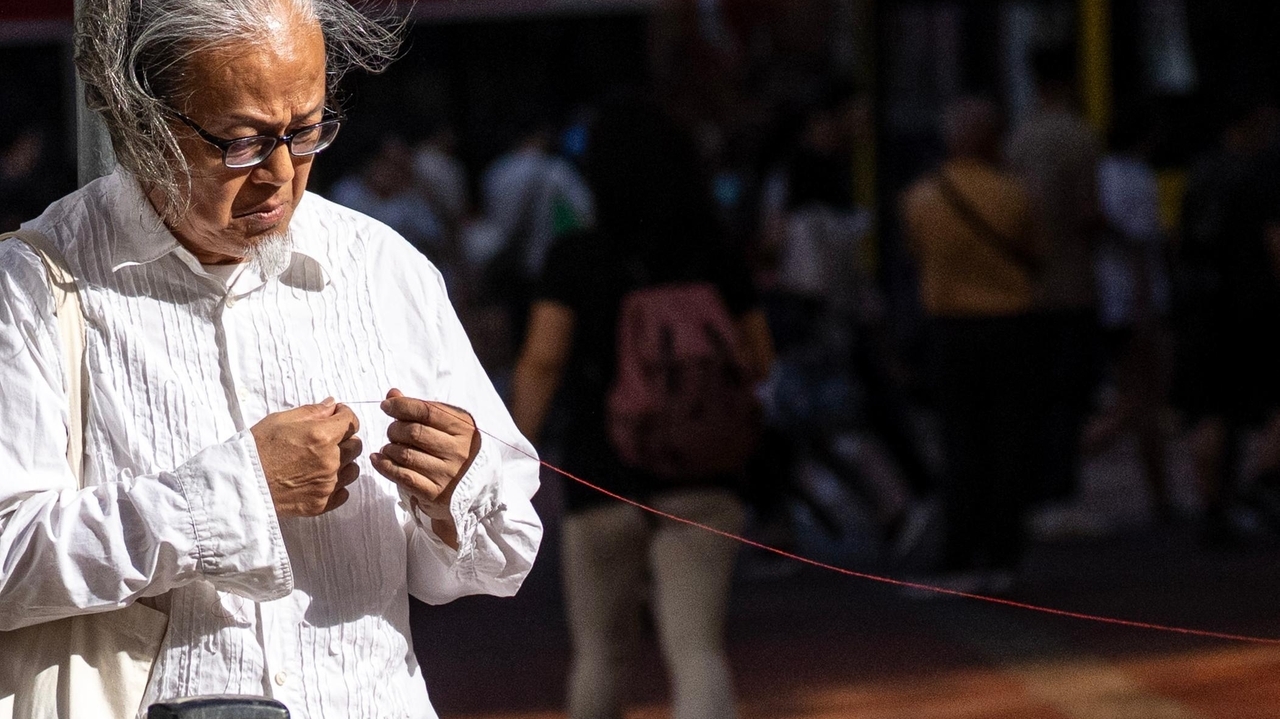
It was one of the most restrained acts of protest imaginable: a single red thread, 6.4 meters long, intended to be tied to a street signpost in Causeway Bay, one of Hong Kong's busiest shopping districts.
That was all performance artist Sanmu Chen attempted on June 4, 2025 — the 37th anniversary of China's brutal crackdown on pro-democracy protesters in Beijing's Tiananmen Square. The length of the thread was deliberate: 6.4, a quiet reference to the date June 4th.
Before Chen could complete the gesture, police officers moved in, stopped him, and searched his bag. He was released without charge — but the message was clear.
"It's abnormal when people monitor you when you are saying or doing something," Chen told reporters afterward. He said the thread was simply meant to express condolences for those who died.
The City That Once Kept the Flame Alive
For decades, Hong Kong stood apart from the rest of China as the one place under Chinese sovereignty where the Tiananmen massacre could be openly mourned. Every year on June 4, tens of thousands of people gathered in Victoria Park for a candlelight vigil — a tradition that made the city a beacon of memory and civil courage in the region.
That era is over.
The annual vigil was first banned in 2020, officially due to COVID-19 restrictions. But that same year, Beijing imposed a sweeping National Security Law (NSL) on Hong Kong following massive pro-democracy protests in 2019. Since then, the space for dissent has been methodically dismantled. Prominent activists have been jailed, independent media outlets shut down, and dozens of civil society organizations dissolved — including the group that had organized the June 4 vigils for more than three decades.
From Vigils to Carnival: The Erasure of Grief
Where tens of thousands once gathered in mourning, a pro-Beijing carnival now takes place. Beginning on June 4 this year, a five-day government-aligned event occupied the former vigil grounds — a jarring symbol of how thoroughly the city's political landscape has been reshaped.
Those who have tried to quietly commemorate near the site in recent years have faced arrest. The contrast is stark and, for many observers, deeply troubling.
A Pattern of Targeted Suppression
This was not Chen's first encounter with police around June 4. In 2024, he was briefly detained after appearing to write the Chinese characters for "8964" — a numerical shorthand for the crackdown date — in the air with his hand. In 2023, he was also stopped near the same area after calling out to passersby: "Hong Kongers, do not be afraid. Don't forget tomorrow is June 4."
On the evening of June 4 this year, another artist, Chan Mei-tung, stood near a department store holding a question-mark-shaped balloon. She too was quickly stopped by officers and escorted to the nearest subway station.
The 1989 Crackdown: What Is Being Remembered
On the night of June 3–4, 1989, Chinese military forces under then-leader Deng Xiaoping moved into Tiananmen Square to crush weeks of student-led protests calling for political reform. Soldiers fired live ammunition into crowds. Estimates of the death toll vary widely — from several hundred to potentially thousands, including civilians and soldiers. The Chinese government has never published an official accounting, and open discussion of the event remains censored on the mainland to this day.
Legal Jeopardy for Former Organizers
Three former leaders of the now-defunct vigil organization are facing serious criminal charges. Two went to trial and are awaiting a verdict, expected possibly in July. They are charged with inciting subversion under the National Security Law — a charge that carries a maximum prison sentence of ten years. A third co-defendant has already pleaded guilty.
Hong Kong and Beijing authorities have consistently defended the NSL as necessary for stability, and have stated that human rights protections remain in place under its framework. Critics and international human rights organizations strongly dispute that characterization.
Memory in Exile
As commemoration becomes increasingly impossible inside Hong Kong, diaspora communities around the world are stepping in to carry the tradition forward. Vigils and memorial events were held this year in cities across Europe, North America, and Australia — a dispersed but determined effort to ensure that June 4, 1989 is not forgotten.
For artists like Sanmu Chen, the stakes of even a symbolic act have never been higher. A red thread, 6.4 meters long — and it was already too much.
.
Sources
- Associated Press – "Hong Kong artist stopped by police while trying to display red thread for Tiananmen anniversary": https://apnews.com/article/hong-kong-tiananmen-crackdown-artist-sanmu-chen-4bdc7c34b4e9914bbccbb5a31d239870
- Human Rights Watch – "Hong Kong: One Year Under China's National Security Law": https://www.hrw.org/report/2021/06/17/hong-kong-one-year-under-chinas-national-security-law
- BBC News – "Tiananmen Square massacre: What happened in the 1989 crackdown?": https://www.bbc.com/news/world-asia-china-42465516
- Amnesty International – "Hong Kong: Five Years of the National Security Law": https://www.amnesty.org/en/location/asia-and-the-pacific/east-asia/hong-kong/
.
What's Your Reaction?
 Like
0
Like
0
 Dislike
0
Dislike
0
 Love
0
Love
0
 Funny
0
Funny
0
 Wow
0
Wow
0
 Sad
0
Sad
0
 Angry
0
Angry
0












Comments (0)