

China's Nuclear Shield: Satellite Images Reveal Massive Desert Defense Network Around Missile Silos
Newly released satellite imagery shows China is constructing an unprecedented network of launch pads, bunkers, and communications facilities across thousands of square kilometers of remote desert — built to protect its nuclear missiles from a potential first strike and guarantee the ability to hit back.


.
A Desert Transformed Into a Fortress
Something massive is taking shape in the barren wastelands of northwestern China. Commercial satellite images, analyzed by security experts and first reported by Reuters on May 29, 2026, reveal a sprawling military complex spreading across the Xinjiang desert near the city of Hami — one of the most secretive corners of the People's Republic.
The scale is striking: more than 80 concrete launch pads, armored bunkers, fortified storage facilities, and what analysts believe to be fiber-optic communications networks — all woven together across a landscape the size of a small country. At the center of this web sit two enormous octagon-shaped installations that experts say appear to function as command, logistics, and operational hubs for China's land-based nuclear forces.
The message, analysts say, is unmistakable: Beijing is working to ensure that no enemy — including the United States — could ever destroy China's nuclear arsenal in a surprise attack before it has a chance to fire back.
The Octagons: Nerve Centers of a Nuclear Web
The two primary structures driving concern are a pair of octagon-shaped installations in eastern Xinjiang, both constructed within the past six years. One sits roughly 140 kilometers southwest of the Hami nuclear silo field; the other lies about 230 kilometers away.
Satellite images show these facilities are far more than administrative outposts. They contain housing for large numbers of military personnel, storage areas for heavy military vehicles, armored bunkers, and fortified weapons depots. Airfields and railway connections link both octagons directly to the Hami silo fields, allowing rapid troop and equipment movements.
Active military exercises were observed around the northern octagon as recently as May 2026 — with satellite imagery capturing large tents, vehicle movements, and what analysts describe as camouflaged launch positions cut directly into the desert terrain. Some of these positions appear to include air-defense missile batteries.
"Taken together, I think there is a real possibility that the octagonal structures and the strange towers are linked to command, control, and communications — as well as maintenance and storage activities related to China's nuclear operations at the Hami ICBM silo site," said Tong Zhao, a senior fellow in nuclear policy at the Carnegie Endowment for International Peace.
More Than 80 Launch Pads — And Counting
Radiating outward from each octagon like the spokes of a wheel, a network of dirt roads and possible underground conduits connects to more than 80 concrete pads scattered among rocky outcrops and dry riverbeds. Security analysts say these pads could serve multiple purposes — from parking mobile intercontinental ballistic missile (ICBM) launchers to hosting electronic warfare units or air-defense systems.
Hans Kristensen, director of the Nuclear Information Project at the Federation of American Scientists, noted the sheer difficulty of drawing firm conclusions from satellite imagery alone. But he was clear about the scale of what he was seeing. "I've never seen anything quite like it," Kristensen said. "It's an extraordinary effort."
Alexander Neill of Hawaii's Pacific Forum think tank described the construction as covering "thousands of square kilometers of desert beyond the silo fields" and called it "a very considerable enhancement and diversification of China's strategic nuclear deterrent."
A third octagon, located south of the historic Lop Nur nuclear test site, appears to serve a different purpose entirely — functioning as a target range, with damaged structures and what analysts identified as mock-ups of Western-style jet fighters visible in the imagery.
The Logic: Survive a First Strike, Then Strike Back
To understand why China is building all of this, it helps to understand a concept called "second-strike capability." In nuclear strategy, this refers to a country's ability to absorb an enemy nuclear attack and still launch a devastating counterattack. It is the bedrock of nuclear deterrence.
China's official policy is "no first use" — meaning Beijing pledges never to be the one to launch nuclear weapons first. But that policy only works as a deterrent if China can convincingly guarantee retaliation. If an adversary believed it could destroy all of China's missiles in a preemptive strike, the deterrent collapses.
The new infrastructure in Xinjiang appears designed to make that scenario impossible. Mobile missile launchers are far harder to track and destroy than fixed silos. Electronic warfare facilities can disrupt enemy targeting and communications. Air-defense batteries protect the area from airstrikes and cruise missiles. And the fiber-optic communications network — if that is indeed what the conduits contain — would allow command centers to keep functioning even under attack.
China has also been investing in an early-warning satellite system called Huoyan-1. According to the Pentagon, it can detect an incoming ICBM within 90 seconds of launch and alert a command center within three to four minutes — fast enough to fire back before the missiles arrive.
A Buildup Like No Other
China's nuclear expansion has been the subject of intense concern in Washington for several years. Under President Xi Jinping, the country has accelerated its military modernization at a pace that has caught many Western analysts off guard.
When Xi came to power in 2012, China held around 200 nuclear warheads — a figure it had maintained for decades. That number has now grown to more than 600, according to a 2025 Pentagon assessment. The same report projects China will exceed 1,000 warheads by 2030. By comparison, the United States and Russia each hold several thousand warheads.
U.S. officials and arms-control analysts describe China as expanding its nuclear capabilities faster than any other nation. The country has tested multiple ICBMs in rapid succession from its silo fields — demonstrating the ability to launch salvos, not just individual missiles. It has built six nuclear-armed submarines, with at least one at sea at all times. And it has developed a nuclear-capable bomber fleet, completing what strategists call a "nuclear triad."
Unlike the United States and Russia — which rely primarily on sheer numbers of warheads and hardened silos to deter a first strike — China appears to be betting on layered active defenses, mobility, and redundancy. The Xinjiang network is a visible expression of that bet.
Transparency Gap Fuels Alarm
What makes China's buildup particularly alarming to Western governments and arms-control experts is the near-total lack of transparency around it. Beijing has repeatedly declined U.S. invitations to engage in nuclear arms control discussions, citing the far larger American and Russian arsenals as justification.
China's defense ministry did not respond to questions from Reuters about the satellite imagery. The Pentagon declined to comment on intelligence matters.
This silence is itself a strategic choice. Tong Zhao of the Carnegie Endowment noted that China has "little appreciation of the value of reassuring adversaries about the ultimate objectives or military rationale behind its nuclear buildup." For outside observers, that leaves a critical question unanswered: Is this purely defensive — or is Beijing quietly preparing for something more?
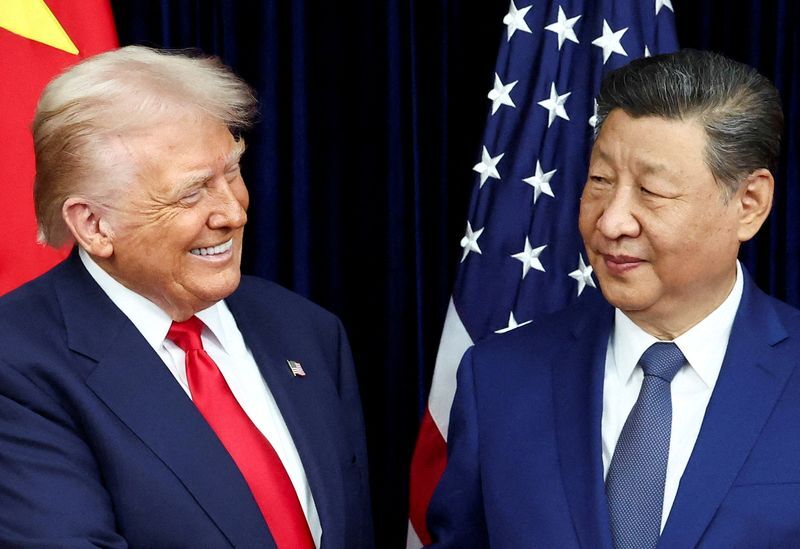
The question is not academic. Xi Jinping has warned President Donald Trump directly this month that mishandling disagreements over Taiwan — which China claims as its territory — could lead the two nations to a "dangerous place." Taiwan's government firmly rejects Beijing's claim to sovereignty.
Senior Western diplomats and analysts have raised the concern that China might use its growing nuclear arsenal as a form of coercion — a threat held in reserve to deter outside powers from intervening if China ever moved against Taiwan militarily.
What Comes Next
The Xinjiang construction project is ongoing. Analysts note that exercises at the northern octagon site are active, and the broader infrastructure network continues to expand. Whether the launch pads will ultimately be used for road-mobile ICBMs, air-defense systems, or some combination remains unclear.
What is clear is that China is committing extraordinary resources — in one of the world's most inhospitable environments — to make its nuclear arsenal as survivable as possible. For the United States and its allies, the message from the desert is hard to ignore.
.
Sources:
- Reuters – Original reporting with satellite imagery analysis (May 29, 2026): https://www.reuters.com/graphics/CHINA-MILITARY/NUCLEAR/zjpqmbrlqpx/
- Federation of American Scientists – Nuclear Information Project (Hans Kristensen): https://fas.org/initiative/status-world-nuclear-forces/
- Carnegie Endowment for International Peace – Tong Zhao, Nuclear Policy Program: https://carnegieendowment.org/experts/1256
- Pentagon Annual Report on Chinese Military Power (2025), via Breaking Defense: https://breakingdefense.com/2025/12/china-military-buildup-leaves-us-increasingly-vulnerable-pentagon-report/
- Arms Control Association – Beijing Fills Missile Silos, Claims Continuity (2026): https://www.armscontrol.org/act/2026-01/news/beijing-fills-missile-silos-claims-continuity
- Christian Science Monitor – China's nuclear arsenal growth in context (March 2026): https://www.csmonitor.com/World/Asia-Pacific/2026/0303/As-US-and-Russia-unbind-from-nuclear-treaty-China-s-arsenal-has-been-growing
.
What's Your Reaction?
 Like
0
Like
0
 Dislike
0
Dislike
0
 Love
0
Love
0
 Funny
0
Funny
0
 Wow
0
Wow
0
 Sad
0
Sad
0
 Angry
0
Angry
0












Comments (0)