

China's Property Crisis Gets Worse: Management Companies Are Abandoning Residential Compounds
China's real estate collapse, which began in 2021, has now spread into a new sector: property management. Across the country, firms responsible for maintaining residential compounds are walking away from contracts — because too few homeowners still bother paying their fees. The result is a vicious cycle of declining services, falling property values, and growing social unrest.

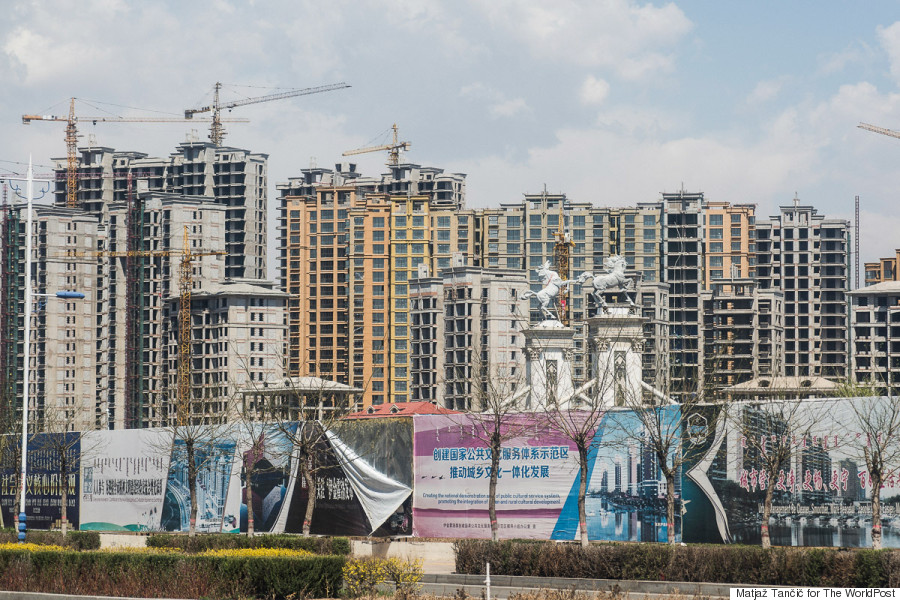
.
Unpaid Bills and Empty Buildings
China's real estate sector has been in trouble for years. But the crisis has now reached a point where the people keeping the lights on — literally — are giving up.
Property management companies across China are struggling to collect basic maintenance fees from homeowners. These fees cover essentials like security guards, waste collection, elevator maintenance, and garden upkeep. Without them, residential compounds slowly deteriorate.
The numbers tell a stark story. The average fee collection rate among China's top 500 property management firms fell from 89% in 2021 to just 71% in 2025, according to research firm CRIC. Industry insiders say 2025 saw the sharpest single-year decline on record — and conditions have continued to worsen into 2026.
Why Homeowners Are Refusing to Pay
The reasons homeowners withhold fees vary — but all point to the same underlying problem: a property market in freefall.
Some residents simply cannot afford the payments in a weakening economy. Others refuse to pay as a form of protest, pressuring management firms to lower their monthly rates. And many investors who purchased multiple apartments before the market bubble burst in 2021 now see little point in maintaining assets that have lost significant value.
China's residential price correction continued into 2026, with second-hand property prices in Beijing falling more than 8% year-on-year in the first quarter alone. Against that backdrop, the motivation to keep paying administrative costs for a depreciating asset is understandably low.
The problem is compounded by China's vast overhang of empty housing. By late 2025, completed but unsold housing inventory had climbed to 762 million square meters — a staggering volume that ANZ analysts estimate to be roughly twice the total land area of Greater London. In partially vacant compounds, it is often indebted property developers themselves who owe management fees on unsold units — and they are in no position to pay either.
A Vicious Cycle Takes Hold
As fee collection collapses, property management firms are doing the rational thing: they're leaving.
State-owned China Overseas Property pulled out of projects totalling 55.6 million square meters in 2025 alone — a 25% increase from the previous year. Country Garden's management unit, once tied to China's largest developer, withdrew from projects covering roughly 80 million square meters in the same period.
Around 2,000 Chinese communities replaced their property management company in 2024, with a turnover rate of 3.3% — up 1.6 percentage points since 2021.
This sets off a self-reinforcing downward spiral. When a management company exits, remaining residents struggle to find replacements willing to take on a community already known for non-payment. Inferior firms move in. Services deteriorate further. Property values fall. And fewer owners see any incentive to pay fees for a declining asset.
Real estate consultancy Enhance International estimates that apartments in compounds suffering from management deficiencies can lose up to 25% of their value. "This is a unique and major issue that has not been seen in other property crises," said the firm's CEO Sam Radwan.
Real Stories from Real Compounds
The human toll of this crisis is visible in cities across China.
In Qinhuangdao, a port city in northern China, 35-year-old resident Linda Cao received a notice from Vanke Service — the property management arm of state-backed developer China Vanke — announcing it would withdraw from her compound in June after six years of service. The reason: an unsustainable drop in fee collection. Some residents had refused to pay for two years, hoping to force a price reduction.
"Only weaker companies would be willing to take over," Cao told Reuters. She now fears property prices in her compound could fall by another 20%.
In Beijing, 33-year-old Jenny Zhao faces a similar situation. Her management firm is set to exit after replacing a previous company that left in 2023, citing a collection rate of just 45%. The compound already suffers from poor waste management, lax security, and crumbling walkways. Current asking prices there run roughly 5,000 yuan per square meter below neighboring developments.
"What worries us most is that if the next management company is even worse, no one will want to buy homes here," Zhao said.
Government Scrambles to Contain the Fallout
Local housing authorities across China are quietly rebranding — shifting from "Housing and Urban-Rural Construction Bureaus" to "Housing and Urban Renewal Bureaus." The name change reflects a broader policy shift: away from building new housing and toward managing what already exists. But managing what already exists is precisely where the system is now breaking down.
At least five county-level governments have issued directives ordering Communist Party members and public officials to "take the lead" in paying their management fees on time — a measure that signals how seriously authorities are taking the social dimension of the crisis.
In some cases, local governments have reportedly blocked management companies from exiting compounds, fearing that the absence of basic services could trigger public unrest. "It could affect social stability," one executive at a state-owned property management firm told Reuters.
Analysts do not expect China's housing market to bottom out before 2027, with structural drags including demographics, employment uncertainty, and high unsold inventory continuing to weigh on demand.
The Bigger Picture: A Crisis That Won't End Soon
China's property market once accounted for roughly a quarter of GDP and represented the primary store of household wealth for hundreds of millions of families. New home sales by the top 100 developers fell 36% year-on-year in late 2025, while secondary home prices in 100 cities dropped nearly 8% over the same period.
The management fee crisis is, in this context, a symptom of something deeper: the unraveling of a system built on ever-rising property prices. For decades, homeowners, investors, developers, and local governments all assumed that prices would only go up. That assumption is now definitively broken.
"It may be decades before you see a resolution to this particular housing crisis," Sam Radwan of Enhance International warned. The property management meltdown is not the beginning of that story — it is simply the latest chapter in a long and still unfinished collapse.
.
Sources
- Reuters – "China's real estate funk drags down yet another sector: property service providers" (June 3, 2026): https://www.reuters.com/world/asia-pacific/chinas-real-estate-funk-drags-down-yet-another-sector-property-service-providers-2026-06-02/
- Caixin Global – "Wave of Property Management Fee Cuts Reflects Industry's Struggles" (May 31, 2025): https://www.caixinglobal.com/2025-05-31/weekly-preview-wave-of-property-management-fee-cuts-reflects-industrys-struggles-102326177.html
- Global Property Guide – "China's Residential Property Market Analysis 2026": https://www.globalpropertyguide.com/asia/china/price-history
- CNBC – "China's property slump this year is looking much worse than expected, S&P says" (October 2025): https://www.cnbc.com/2025/10/10/chinas-property-slump-this-year-looks-worse-than-expected-sp-says.html
- The Storm Media – "China's Property Managers Are Walking Away — and the Government Is Quietly Rewriting the Rules" (April 2026): https://world.storm.mg/articles/1120247
.
What's Your Reaction?
 Like
0
Like
0
 Dislike
0
Dislike
0
 Love
0
Love
0
 Funny
0
Funny
0
 Wow
0
Wow
0
 Sad
0
Sad
0
 Angry
0
Angry
0













Comments (0)