

The Man Behind China’s National Anthem and His Persecution During the Cultural Revolution


.
It’s well known that during the Cultural Revolution in the 1960s and 1970s, the Chinese Communist Party (CCP) persecuted countless intellectuals—many of them to death—including some of the nation’s most celebrated figures in literature and the arts. Yet few realize that among those tortured and killed was the man who wrote the lyrics to China’s national anthem.
The song, originally titled “March of the Volunteers,” was written in 1935 amid intense nationalist sentiment during China’s struggle against Japanese invasion. Calling for unity and resistance, it quickly became an inspirational military march during the Sino-Japanese War (1931–1945), which was followed by a civil war between the ruling Kuomintang and the CCP. After the founding of communist China in 1949, the song was officially adopted as the national anthem.
Despite the song’s enduring popularity, few young people in China today know the name of its lyricist. He was Tian Han, a prominent playwright and one of the founding figures of modern Chinese theater. Often called the “Father of the National Anthem,” Tian Han was a left-leaning intellectual who joined the CCP in 1932.
In the early years of the People’s Republic, Tian Han held several influential cultural posts, including director of the Cultural Ministry’s Bureau of Opera Reform, head of the Arts Bureau, and president of the Chinese Dramatists Association. However, when the Cultural Revolution erupted in 1966, Tian Han, who was 68 years old at the time, quickly became a target of political persecution.
In February 1966, the People’s Daily published an article condemning one of Tian Han’s Peking Opera works, which depicted an upright Tang Dynasty official. The piece denounced the play as a “poisonous weed,” singling out lines such as “The water that carries the boat can also capsize it”—a traditional Chinese proverb implying that the people could overthrow unjust rulers—and “An official should dare to speak on behalf of the people.” Authorities claimed that Tian Han’s opera offered veiled criticism of contemporary affairs through historical analogy. Those lines were branded as anti-Party, anti-socialist, and counterrevolutionary, accusations that effectively sealed Tian Han’s fate.
As Red Guards rose to prominence as enforcers of the Cultural Revolution, Tian Han was subjected to relentless physical and psychological abuse. In July 1967, he was publicly humiliated during a “struggle session” at the Socialist Academy. His son, Tian Dawei, was coerced by the Party’s drama association to act as a representative of the “revolutionary masses,” reporting on his father’s every word to the authorities.
In February 1967, Tian Han was formally arrested by a special task force and transferred to Qincheng Prison, where he endured further interrogation.
.
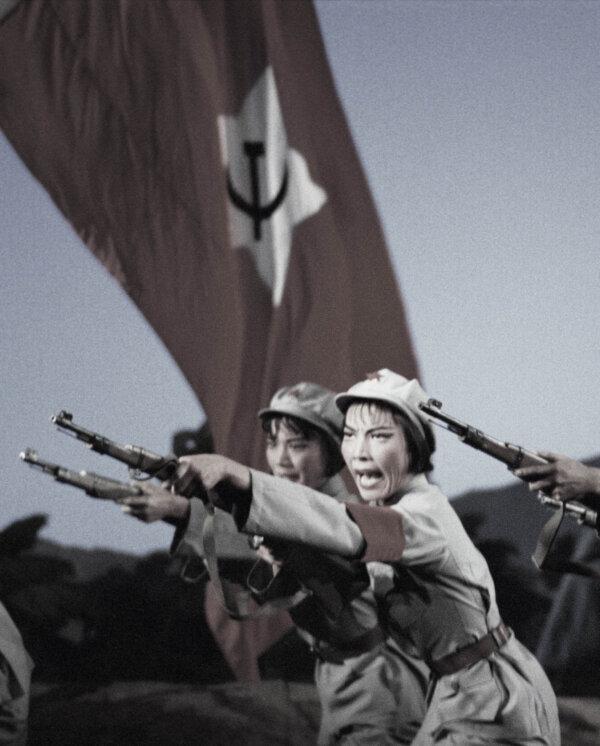
Later that year, Tian Han was sent under the alias Li Wu to the 301 Military Hospital, as revealed by renowned poet and literary critic Tu An in “Recollections of Tian Han During the Cultural Revolution” in 1980. Tu is also a victim of the Cultural Revolution who was sent to a rural area for “reeducation.”
The guards monitoring Tian Han at the hospital belonged to radical groups of students, workers, and officials who claimed loyalty to Mao Zedong by challenging local authorities and party leaders. Suffering from diabetes, Tian Han occasionally lost bladder control. His captors forced him to lie on the floor and drink his own urine, and at times injected him with glucose as a form of torture.He died in 1968 from complications of diabetes and other untreated illnesses, alone and without family present. To conceal his death, authorities again used the alias Li Wu—a tactic also used to obscure the death of former Chinese Chairman Liu Shaoqi, who perished under similar conditions.
Tian Han’s son was the only one informed of his father’s death, according to Tu’s account. Military personnel told him, “Tian Han is dead and has committed heinous crimes.” Terrified, Tian Dawei did not dare retrieve his father’s ashes. Other relatives and friends were kept entirely in the dark. Tian Han’s mother never had the opportunity to see her son after he was arrested. He left behind no final words, and his ashes remain missing to this day.
The denunciation against Tian Han continued even after his death. In 1970, the regime launched new campaigns to publicly denounce Tian Han and other intellectuals in the arts. By 1975, he was officially branded a “traitor” and permanently expelled from the CCP. During this period, official ceremonies were allowed to play only the tune of the national anthem, not its lyrics. Instead, songs like “The East Is Red” and “The Helmsman Guides the Ship” that glorify Mao Zedong were sung at political gatherings, a fact that Chinese state media officially admitted in a 2009 article about the national anthem.
It was only after Mao’s death and the end of the Cultural Revolution that Tian Han’s name was cleared. In 1978, the Party formally rehabilitated his reputation. “March of the Volunteers” was then reinstated as China’s national anthem.
What's Your Reaction?
 Like
0
Like
0
 Dislike
0
Dislike
0
 Love
0
Love
0
 Funny
0
Funny
0
 Wow
0
Wow
0
 Sad
0
Sad
0
 Angry
0
Angry
0














Comments (0)