

The CCP’s New 5-Year Plan for China: Subsidies, Unemployment, and Mercantilism


.
Commentary
In the context of state-directed inefficiencies, growing unemployment, and lagging economic growth, the Chinese Communist Party (CCP) published its new five-year plan this month. It seeks to double China’s economy between 2020 and 2035. That would be fine if the regime were not a genocidal dictatorship trying to export its form of totalitarianism abroad.
Thankfully for the world, the CCP cleaves to a failed production-led development model. The plan is to “modernize” China’s industrial and financial system through scientific and technological self-sufficiency, a stronger financial sector, and import substitution. It focuses on boosting technological self-reliance and innovation in the cyber and aerospace sectors. But the plan will continue to grind down Chinese consumers by putting their interests second.
The reasonable Trump administration proposal to rebalance the U.S.–China trade relationship with more demand-driven economics in China, boosting U.S. industrial exports, is therefore unlikely. The more probable outcome is additional CCP mercantilism that seeks to supplant foreign manufactures with those of China and turn other countries into sources of raw materials rather than equal trading partners that make progress toward their own industrial and technological innovations.
Meanwhile, the regime is tone-deaf to the growing consternation over its subsidized exports and technologies. Due to Beijing’s aggressive approach to trade, the United States led the way in protecting its declining industry with tariffs. Other countries, such as Turkey, Indonesia, and Brazil, are following suit.
China’s five-year plan includes the provision of more “support” to its private sector, especially in artificial intelligence (AI), quantum computing, drones, hydrogen and fusion energy, biomanufacturing, brain-computer interfaces, robotics, and 6G mobile communications. More subsidies are yet another state intervention in what appears to be a dystopic direction.
By 2024, Chinese research and development as a percent of revenues had already reached nearly 5 percent in sectors such as rail, ships, and aerospace. Research and development will likely increase further in 2025 and beyond. That spending is based on taxing the Chinese consumers to, in effect, replace their freedom of choice.
Involution is developing in China as a result of the CCP’s milking every last drop from the Chinese economy for its own purposes. This includes excessive competition driven by state-led subsidies for particular industries, such as rare-earth elements, electric vehicles, solar panels, and semiconductors. The subsidies increase supply in these and other state-chosen industries. They drive down prices and ultimately shut down competitor companies abroad that play by market rules.
But the international reaction to tariffs blocks China’s cheaper products from reaching the United States and Europe, for example. Chinese companies then try to sell them to Chinese purchasers, massively increasing supply and causing prices to drop. Deflation is the result that has afflicted Chinese industries for the last eight months.
.
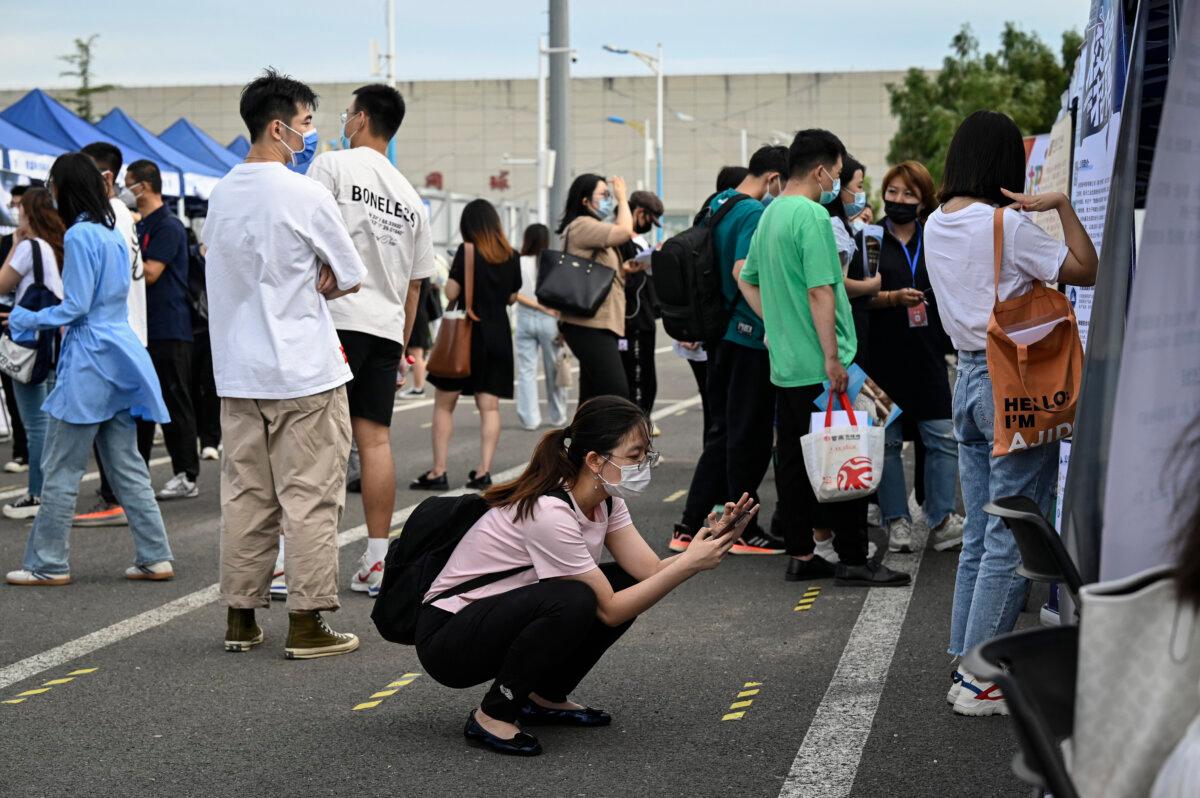
China’s debt, demographic decline, unemployment, and property crisis have further weighed on the economy. The regime’s budget deficit is 9 percent of GDP for 2025, more than 3 percent higher than in 2024. The provincial fiscal gap is even worse at 12 percent of provincial GDP. Central government transfers make up the difference. The provinces attempt to stimulate their own fashionable industries of the day, whether the property sector in the past or the AI sector today, leading to inefficient duplication in search of Beijing’s subsidies. Ghost cities, workerless factories, and industries without customers are the result.
Economic growth is slowing due to these communist inefficiencies. Total bank loans in China reached a record of $38 trillion in September. As consumers experience debt and a decline in their net worth, they save more and spend less. This decreases demand, which reduces prices and leads to business failures in a deflationary cycle. In the first three quarters of 2025, property investment, which used to be the engine of China’s growth, decreased nearly 14 percent. As Chinese companies face economic headwinds, they shed workers to stay afloat, causing unemployment to rise and triggering further downward spirals in China’s economy.
These types of problems have always accompanied governments that try to pick winners and losers, rather than let free markets do the job. Such governments lack all of the information that markets take into account, and almost always make bad choices to a greater or lesser degree. Consumers pay the price with lower household spending. In China, household spending is about 39 percent of the economy, compared to about 57 percent globally. The new five-year plan again pledges to increase consumer spending, but it rings hollow after decades of unfulfilled promises.
Communists in China are doing what communists do—continuing to plan the economy for their own party’s benefit. Without such a “plan,” the CCP would have to admit its own irrelevance—and, worse, its drag on the economy. Employment and a social safety net for Chinese citizens are, as usual, an afterthought. Rural Chinese seniors are still paid as little as $20 per month and are unlikely to feel relief. Their lack of spending power contributes to continued deflation and involution through 2026.
Yet, if realized, this month’s five-year plan, with its focus on self-reliance and technology, will make the CCP increasingly impervious to outside pressure of the democratic, free market, and human rights varieties. It will increase the regime’s influence over international trade and governance, as well as its military and economic power. Chinese citizens will bear the costs.
What's Your Reaction?
 Like
0
Like
0
 Dislike
0
Dislike
0
 Love
0
Love
0
 Funny
0
Funny
0
 Wow
0
Wow
0
 Sad
0
Sad
0
 Angry
0
Angry
0













Comments (0)