

The CCP Backing Venezuela: A Proxy War Against the US


.
In the face of a U.S. blockade, Beijing has deepened political, economic, and strategic ties with Caracas without committing to military intervention.
U.S. pressure on Venezuela has intensified through expanded military deployments, tanker seizures, strikes on vessels accused of drug trafficking, and a total blockade of sanctioned oil shipments. The Trump administration has designated the Maduro regime a foreign terrorist organization and accused Caracas of using stolen U.S. assets to finance drug trafficking, terrorism, and other crimes.
Following the release of a new U.S. National Security Strategy defining Latin America as a core U.S. interest zone, Washington has expanded its military presence in the Caribbean, seized sanctioned Venezuelan oil tankers, threatened possible land strikes, and ordered a “total and complete” blockade of U.S.-sanctioned oil tankers entering or leaving Venezuela.
China has backed Venezuela’s request for an emergency meeting of the United Nations Security Council and reaffirmed political support at the highest levels. During a recent phone call with Venezuelan Foreign Minister Yvan Gil, Chinese Foreign Minister Wang Yi said the two countries are strategic partners bound by longstanding mutual trust and opposition to what Beijing calls unilateral bullying.
Chinese leader Xi Jinping reiterated that position in a meeting with Venezuelan President Nicolás Maduro in Moscow in May, saying China would firmly support Venezuela in safeguarding its sovereignty, national dignity, and social stability, and describing the relationship as an “ironclad” friendship viewed from a long-term strategic perspective.
Since elevating ties to an all-weather strategic partnership in 2023, China and Venezuela have expanded cooperation across trade, investment, governance exchanges, and people-to-people ties. Xi has said Beijing is prepared to deepen practical cooperation in multiple sectors and strengthen coordination with Venezuela and other Latin American countries, aligning with the Chinese Communist Party’s (CCP’s) push for an international order shaped and led by Beijing.
Caracas’s connections with the CCP are already deep. Venezuela formally joined China’s Belt and Road Initiative in 2018, making it one of at least 10 Latin American countries to do so that year. It has since become one of the largest regional recipients of Chinese investment under the BRI, particularly in the oil sector, and now owes more than $60 billion to Chinese state-owned enterprises.
Venezuela has applied for BRICS membership but has not been accepted. Following the 2024 BRICS summit, Brazil blocked the application, citing refusal to recognize Maduro’s election victory and concerns over democratic legitimacy. Russia has stated that BRICS expansion requires unanimous consent, leaving Venezuela outside the bloc.
Venezuela is not a member, observer, or dialogue partner of the Shanghai Cooperation Organization, which remains focused on Eurasia and Central Asia. Militarily, however, Caracas has deepened cooperation with China, Russia, and Iran. Since 1999, Venezuelan Special Forces have trained with China’s People’s Liberation Army in areas including language, diving, sniping, and helicopter operations.
In August 2022, Venezuela hosted Russia’s International Army Games in Barquisimeto, the first time the Russian-organized military competitions were held in the Americas, with China, Russia, Iran, and other countries participating.
.
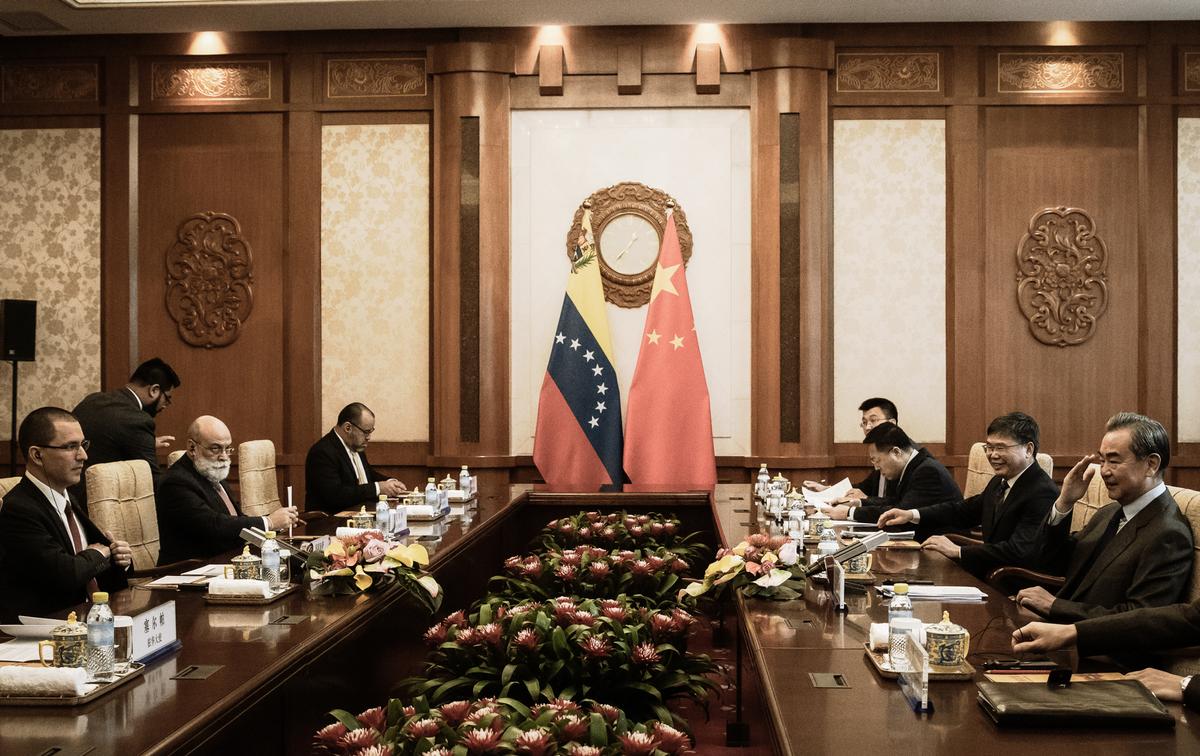
Venezuela has also signed onto China’s broader ideological and governance frameworks. Maduro announced that Venezuela would join Xi’s Global Governance Initiative, aligning the country with all five of the CCP’s major international initiatives, including the Belt and Road Initiative and the four so-called Global Initiatives.
As it deepens its footprint in Venezuela, the CCP has rejected U.S. claims to exclusive control over the Western Hemisphere, reaffirmed its ties with Latin America through a new regional policy paper, opposed unilateral sanctions, and emphasized cooperation under the Global South framework, stopping short of any commitment to military support for Caracas.
Beijing has announced a zero-tariff trade agreement with Caracas covering hundreds of product categories, accelerating China’s entry into a heavily sanctioned economy. The deal deepens Venezuela’s dependence on China, reinforcing an oil-for-goods relationship that undercuts local industry while expanding Beijing’s leverage.
Experts warn that China has paired financial influence with strategic infrastructure projects, providing Beijing with an intelligence foothold in Latin America. Venezuela hosts two Chinese-built satellite ground control facilities: the El Sombrero tracking station at Capitán Manuel Ríos Air Base in Guárico state and a backup facility at Fort Manikuyá in Bolívar state. Technicians interviewed by The Washington Post have said China may retain remote access to these sites even without a continuous physical presence, raising concerns about surveillance and intelligence monitoring capabilities.
Venezuela has become a convergence point for U.S. adversaries, with China, Russia, Iran, and Cuba embedded across its economy, security services, and military institutions. Despite deep economic ties and strong rhetorical backing, China and Russia have refrained from providing concrete military or financial assistance to Maduro, and analysts say both are unwilling to escalate given U.S. military dominance in the region.
While China benefits from using Venezuela as a strategic entry point into the Americas, including for potential espionage against the United States, it cannot match U.S. military power in the region or appears unwilling to do so. Despite pledges of an all-weather friendship, Beijing is unlikely to support Caracas militarily, leaving the outcome largely dependent on U.S. President Donald Trump’s next moves.
At the same time, the standoff has broader negative consequences. The CCP is closely watching and learning from U.S. tactics, including blockades, incremental military pressure, and economic isolation as tools of coercion. These methods are being studied in Beijing for their implications for potential future scenarios involving Taiwan.
What's Your Reaction?
 Like
0
Like
0
 Dislike
0
Dislike
0
 Love
0
Love
0
 Funny
0
Funny
0
 Wow
0
Wow
0
 Sad
0
Sad
0
 Angry
0
Angry
0













Comments (0)