

Taiwan's President Praises U.S. Defense Support – As Trump Heads to Beijing
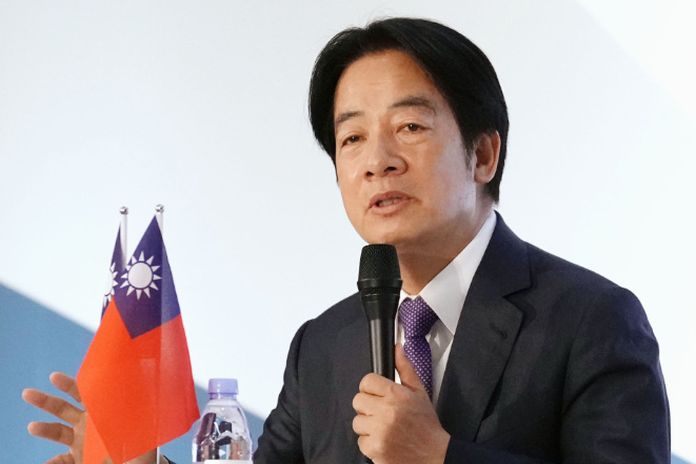
Taiwan's President Lai Ching-te has publicly thanked the United States for its continued support in strengthening the island's defenses. His statement comes at a critical moment: President Donald Trump is preparing to meet Chinese leader Xi Jinping in Beijing — and Beijing is pressing Washington to scale back its security commitments to Taiwan.

.
A Thank-You With a Nervous Eye on Beijing
The timing could hardly be more charged. Taiwan's President Lai Ching-te extended his gratitude toward Washington for years of arms sales and defense cooperation — even as President Donald Trump prepares to fly to Beijing for a high-stakes summit with Chinese President Xi Jinping later this week.
Trump confirmed he would put the topic of arms sales to Taiwan directly on the table with Xi. "I'm going to have that discussion with President Xi," Trump told reporters at the White House. "President Xi would like us not to, and I'll have that discussion. That's one of the many things I'll be talking about."
For Taipei, that statement is both reassuring and unsettling at the same time.
$25 Billion — A Hard-Won Victory, But Not Enough
Just days before Lai's expression of gratitude, Taiwan cleared a major domestic political hurdle. On May 8, Taiwan's legislature passed a $25 billion supplement to the island's annual defense budget, ending months of debate over the appropriations package. The spending bill, which will run from 2026 to 2033, was passed unanimously by the opposition after all government representatives abstained from voting due to its diminished size compared to President Lai Ching-te's initial $40 billion proposal.
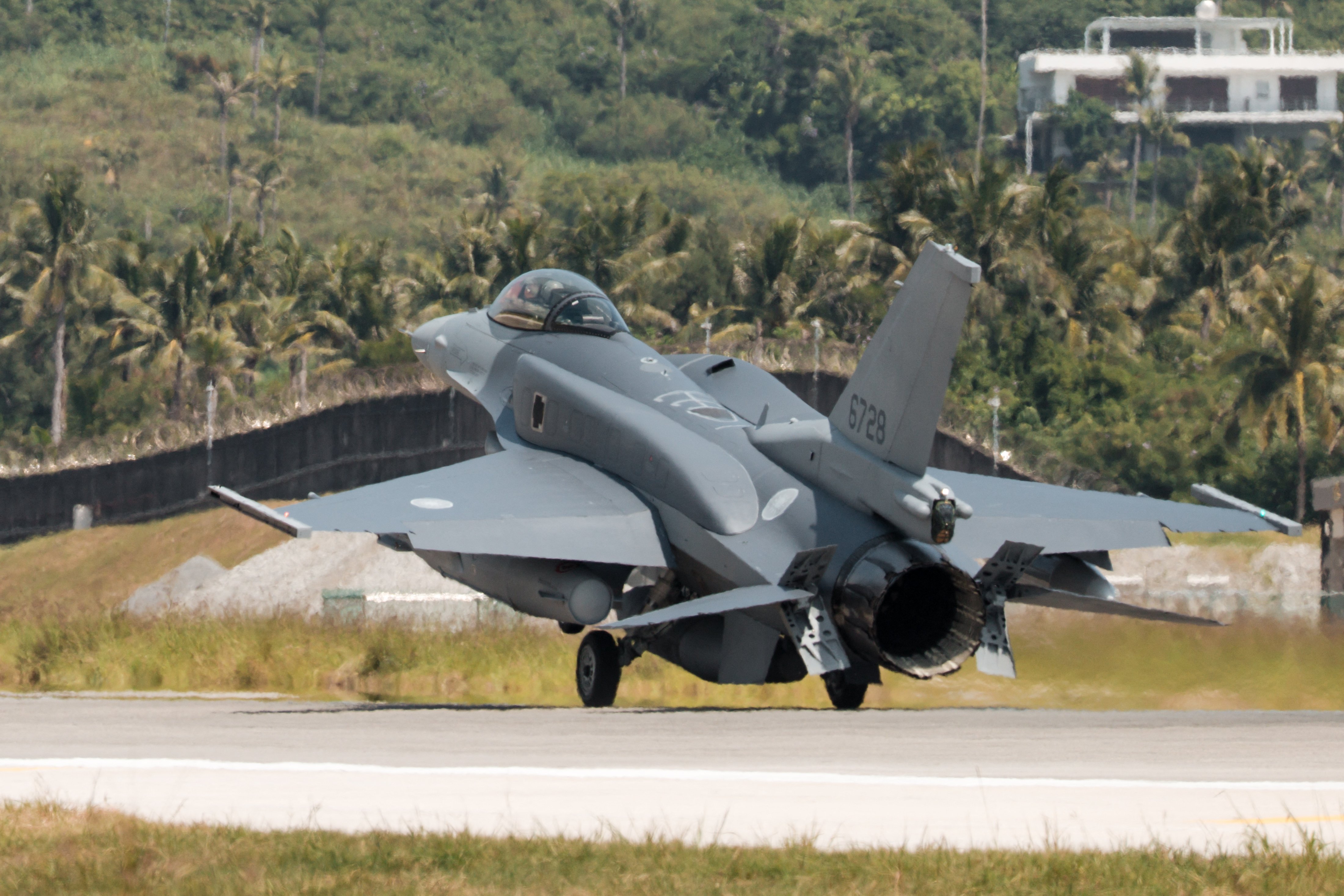
The defense supplement covers both previously authorized U.S. arms sales and an arms package likely coming within the next several months. Roughly $11 billion of the budget will be used to pay for HIMARS rocket systems, Javelin anti-tank missiles, howitzers, and loitering munitions whose sale was initially announced by the Trump administration in December 2025.
That's concrete military hardware — the kind that matters on a battlefield. But the scaled-down budget still disappointed Washington. A senior Trump administration official, who spoke to reporters on the condition of anonymity, said it was disappointing that the parliament did not fully fund Lai's proposal.
Trump: "I Don't Think It'll Happen"
Despite the backdrop of geopolitical tension, Trump struck a notably relaxed tone when asked whether conflict over Taiwan could erupt during his presidency. "I don't think it'll happen," he said, without elaborating. "I think we'll be fine. I have a very good relationship with President Xi. He knows I don't want that to happen."
Whether that confidence is well-founded — or dangerously optimistic — is a question many in Taipei are quietly asking.
Beijing Turns Up the Pressure
China has made no secret of its intentions heading into the summit. Chinese Foreign Minister Wang Yi raised Taiwan during a call with Secretary of State Marco Rubio to prepare for the trip, and urged the United States to "make the right choices" about its policies toward the island in order to safeguard "stability" between the two nations, according to a statement by the Chinese Foreign Ministry.
Translation: Beijing wants Washington to back off.
The Trump administration has reportedly not moved ahead with arms deliveries following a record $11 billion weapons package for Taiwan, authorized in December, ahead of the presidential summit. For Taipei, that pause is a source of considerable anxiety.
Analysts are worried that Taiwan could become a bargaining chip. Taiwan's backers are concerned that Taipei will be "on the menu" when Trump and Xi sit down for talks. "I do worry that we have a transactional president and a transactional opportunity could arise, and then we would have a challenge," said retired U.S. Navy Rear Admiral Mark Montgomery, now with the Foundation for Defense of Democracies.
Taipei's Message: Policy Unchanged
Taiwanese officials are doing what they can to project calm. Taiwanese government officials have expressed concern about China's rhetoric ahead of the summit, though they've also taken some comfort from Secretary of State Rubio's measured comments. "China may attempt some maneuvering during the talks, but the U.S. has repeatedly reiterated, through both public and private channels, that its policy toward Taiwan remains unchanged," National Security Bureau Director-General Tsai Ming-yen told reporters.
A Long-Term Race Against Time
Lai's government has spent much of the past year warning that the window to prepare Taiwan's defenses may be closing. Lai has pushed for a major boost to defense spending with a plan that would direct roughly $40 billion toward new missile defenses, long-range precision weapons and unmanned systems over the coming eight years.
Taiwan's president has said he intends to increase defense spending to around $31 billion, or 3.3% of GDP, in 2026, with a goal to reach 5% of GDP by 2030.
Meanwhile, the island is developing its own indigenous defense capabilities. President Lai has championed the so-called "T-Dome" — a multi-layered missile defense system modeled loosely on Israel's Iron Dome — designed to intercept Chinese missiles, rockets, drones, and combat aircraft.
What's at Stake
The upcoming Trump-Xi summit may be one of the most consequential meetings in decades for Taiwan's future. Trump's backing of Taiwan faced scrutiny after the 2026 U.S. National Defense Strategy omitted direct mention of the island. That omission did not go unnoticed in Taipei — or in Beijing.
China, which has never renounced the use of military force to bring Taiwan under its control, has been conducting increasingly aggressive military exercises near the island. For Taiwan's 23 million people, the question isn't abstract: it's about whether the world's most powerful democracy will stand with a smaller one when it matters most.
For now, Lai has chosen the language of gratitude — thanking Washington for what it has done. Whether that support holds firm after the doors close in Beijing remains to be seen.
.
Sources:
- Taipei Times / Reuters – Trump says he will discuss Taiwan arms sales, Jimmy Lai with Xi (May 12, 2026): https://www.taipeitimes.com/News/taiwan/archives/2026/05/12/2003857202
- Foundation for Defense of Democracies – Taiwan Authorizes New Defense Spending (May 8, 2026): https://www.fdd.org/analysis/2026/05/08/taiwan-authorizes-new-defense-spending-to-counter-chinese-coercion/
- PBS NewsHour – The best-case scenario for Taiwan from the Trump-Xi summit: https://www.pbs.org/newshour/world/the-best-case-scenario-for-taiwan-from-the-trump-xi-summit
- Washington Times – Trump-Xi summit comes with high stakes for Taiwan (May 11, 2026): https://www.washingtontimes.com/news/2026/may/11/trump-xi-summit-coming-high-stakes-taiwan-island-democracy-china/
- CNBC – Trump puts Taiwan arms sales, Jimmy Lai on agenda ahead of Xi meeting (May 12, 2026): https://www.cnbc.com/2026/05/12/trump-xi-china-summit-taiwan-arms-sale-jimmy-lai-.html
- Congressional Research Service / Congress.gov – Taiwan: Defense and Military Issues: https://www.congress.gov/crs-product/IF12481
- Radio Taiwan International – Legislature passes scaled-down special defense budget (May 8, 2026): https://www.rti.org.tw/en/news?uid=3&pid=207362
.
What's Your Reaction?
 Like
0
Like
0
 Dislike
0
Dislike
0
 Love
0
Love
0
 Funny
0
Funny
0
 Wow
0
Wow
0
 Sad
0
Sad
0
 Angry
0
Angry
0












Comments (0)