

China Flexes Naval Muscle in Pacific: Aircraft Carrier Liaoning Conducts Drills East of the Philippines
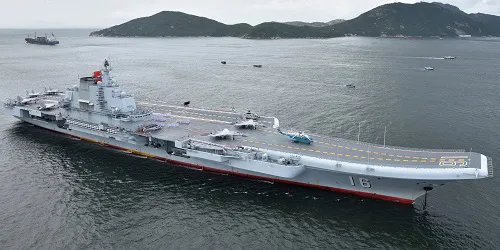
China's aircraft carrier Liaoning completed a major training exercise in the Pacific Ocean east of the Philippines in late May 2026. Japan's defence ministry tracked the deployment and released a detailed bulletin. The drills are widely seen as Beijing's military response to deepening security cooperation between Japan, the Philippines, and the United States.

.
Japanese Military Monitors Chinese Carrier Operations
Japan's defence ministry confirmed on Monday, June 1, 2026, that the Chinese navy's aircraft carrier Liaoning conducted extensive flight operations in the western Pacific Ocean between May 26 and May 28. The Japan Maritime Self-Defense Force tracked the carrier and its escort vessels as they sailed through waters east of Luzon — the northernmost major island of the Philippines.
During the three-day exercise window, carrier-based fighter jets and helicopters performed approximately 170 take-off and landing operations. On the first day alone, roughly 80 sorties were recorded. The Liaoning strike group came within approximately 590 kilometres (367 miles) of Japan's Miyakojima island in the southwest Ryukyus — close enough to draw serious attention from Tokyo.
The strike group comprised the aircraft carrier Liaoning (hull number 16), the cruiser Wuxi (104), the destroyer Kaifeng (124), the frigate Luohe (545), and the fast combat support ship Hulunhu (901).
A Display of Force — Not a Routine Exercise
The People's Liberation Army (PLA) described the deployment as routine training. The PLAN announced the carrier strike group's deployment to the Western Pacific on May 19, describing it as routine training. Analysts and regional observers, however, were quick to point out the timing was anything but coincidental.
The Liaoning and its strike group conducted a live-fire exercise in the Pacific east of the Philippines following one of its longest deployments in the South China Sea. China's latest naval movements suggest that Beijing is doing far more than reacting angrily — the southward passage of the Liaoning combined with the deployment of a PLA Navy task group into the Western Pacific points to a broader strategic design: signaling resolve to Japan, countering the Philippines–U.S. Balikatan exercise, and shaping the military balance ahead of possible high-level diplomacy with Washington.
Balikatan 2026: The Trigger Behind the Deployment
The timing of the Liaoning's movements coincides directly with a landmark joint military exercise. The deployment coincided with the launch of "Balikatan 2026", a 19-day annual large-scale joint exercise led by the United States and the Philippines — this year featuring an unprecedented level of participation from Japan and taking place in areas facing the South China Sea and Taiwan, including Luzon.
China expressed its displeasure through official channels: a Chinese Foreign Ministry spokesperson blamed the US, the Philippines, and Japan for disrupting regional peace through cooperative security activities, saying these countries were "playing with fire" and that such activities were likely to backfire.
Taiwan Also Watches the Liaoning
The Liaoning has not only attracted attention from Japan. Taiwan's defence ministry has been tracking the carrier closely throughout the year. In April 2026, it was the aircraft carrier Liaoning that transited the Taiwan Strait on April 20 — marking a significant escalation in China's display of naval power in the region.
The carrier's latest arc through the western Pacific — moving southeast along the Philippines after the drills — suggests continued projection of naval power well beyond China's immediate coastal waters.
Growing Japan–Philippines Ties Driving China's Reaction
The broader context for Beijing's naval posture is a rapidly deepening security relationship between Japan and the Philippines. Japan and the Philippines signed a defence pact in January 2026 that allows their forces to exchange essential supplies such as fuel and ammunition during joint training.
Months after the Japan–Philippines Reciprocal Access Agreement entered into force in September 2025, Tokyo and Manila signed a new logistical agreement on January 15, 2026 — the Acquisition and Cross-Servicing Agreement (ACSA) — setting a bilateral framework for reciprocal provision of supplies and services between the Japanese Self-Defense Forces and the Armed Forces of the Philippines.
Japanese Prime Minister Sanae Takaichi and Philippine President Ferdinand Marcos Jr. further elevated their countries' relationship to a comprehensive strategic partnership on May 28, just days before the carrier drills were reported — a signal from both capitals that their security alignment is deepening, regardless of Beijing's objections.
What Comes Next
The Liaoning's movements are part of a clear and deliberate pattern. Beijing's revisionist designs — from the Senkakus to the South China Sea — pose a clear and present danger to the safety and security of two core American allies, Japan and the Philippines, according to defence analysts.
The Trump administration's 2026 National Defense Strategy explicitly addresses the increasing security challenges in the First Island Chain, particularly China's military aggression against Taiwan and gray zone activity in the South and East China Seas.
As the Liaoning continues southeast, regional militaries remain on alert. Whether Beijing escalates further — or uses the naval muscle as a backdrop for diplomatic engagement — will depend heavily on what unfolds in the coming weeks.
.
Sources
- Japan Joint Staff Office bulletin, June 1, 2026: https://www.mod.go.jp/js/pdf/2026/p20260601_01.pdf
- USNI News — Western Pacific Pulse, May 29, 2026: https://news.usni.org/2026/05/29/usni-news-western-pacific-pulse-may-29-2026
- South China Morning Post — China's Type 054B frigate makes carrier force debut with Liaoning for live-fire drills: https://www.scmp.com/news/china/military/article/3354978/chinas-type-054b-frigate-makes-carrier-force-debut-liaoning-live-fire-drills
- The Diplomat — China's Liaoning Carrier Heads South: More Than a Routine Drill, April 21, 2026: https://thediplomat.com/2026/04/chinas-liaoning-carrier-heads-south-more-than-a-routine-drill/
- Council on Foreign Relations — China in the Indo-Pacific: January 2026: https://www.cfr.org/articles/china-in-the-indo-pacific-january-2026
- CNAS — U.S.-Japan-Philippines Trilateral Cooperation, March 17, 2026: https://www.cnas.org/publications/reports/u-s-japan-philippines-trilateral-cooperation
- South China Morning Post — How Philippines and Japan future-proofed ties amid China tensions: https://www.scmp.com/week-asia/politics/article/3355392/how-philippines-and-japan-future-proofed-ties-amid-china-tensions-us-wavering
- The Diplomat — China's Emerging Two Front Problem, January 30, 2026: https://thediplomat.com/2026/01/chinas-emerging-two-front-problem
.
What's Your Reaction?
 Like
0
Like
0
 Dislike
0
Dislike
0
 Love
0
Love
0
 Funny
0
Funny
0
 Wow
0
Wow
0
 Sad
0
Sad
0
 Angry
0
Angry
0











Comments (0)