

Taiwan Deploys Robot Patrol Dogs to Guard Disputed South China Sea Islands
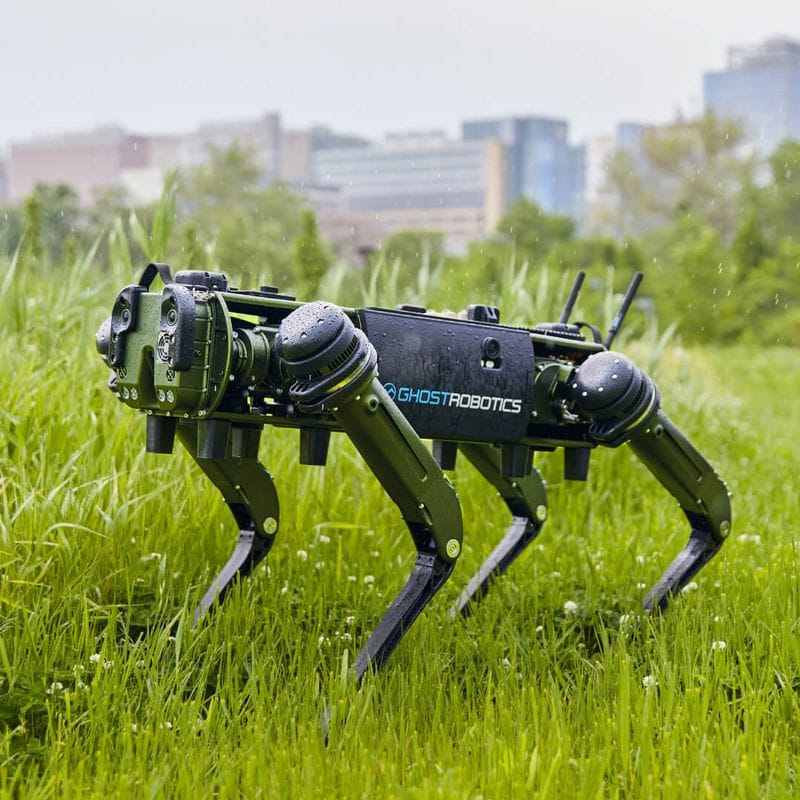
Taiwan's military has unveiled three armed robot dogs designed for patrol and surveillance duties on its remote South China Sea islands. The move comes as China steadily increases pressure on Taiwan-controlled territory in the region — with drone intrusions and coast guard provocations becoming near-routine.

.
Steel Sentinels for Lonely Outposts
On Tuesday, June 2, 2026, Taiwan's military gave journalists a striking glimpse of the future of island defense: three four-legged robots, built by American firm Ghost Robotics, strutting across a demonstration area at the Ministry of National Defense in Taipei. The machines are being considered for deployment on Taiwan's outermost and most exposed positions in the South China Sea — small, isolated islands where human patrols are both costly and potentially dangerous.
The robots were presented by the National Chung-Shan Institute of Science and Technology (NCSIST), Taiwan's premier state-run weapons research body. The institute fitted the American-made platforms with its own locally developed technology, producing three distinct variants: one optimized for reconnaissance, one for surveillance, and one equipped with a mounted firearm.
What These Machines Can Do
Ghost Robotics, headquartered in the United States, is one of the world's leading suppliers of military-grade quadruped robots (four-legged walking machines). Its platforms are already in use by the U.S. Department of Defense and have been evaluated for border patrol duties by American authorities. The robotic dogs are designed to navigate rough, uneven terrain — precisely the kind of coastal and beach environments found on Taiwan's South China Sea outposts.
Jen Kuo-kuang, deputy head of NCSIST's missile and rocket systems research division, confirmed that Taiwan's military branches have already signaled strong interest. "The marines believe that on beaches and the coastline, including for the coast guard in Nansha and Dongsha for patrols and inspection, there is a pressing need," he told reporters. No formal procurement order has been placed yet, but the demonstration was clearly intended to move that process forward.
The Islands in Question
Taiwan controls two key positions in the South China Sea: Itu Aba (also called Taiping Island), its largest holding in the Spratly Islands; and the Pratas Islands (Dongsha), a coral atoll group strategically positioned at the northern entrance to the South China Sea, roughly 170 nautical miles southeast of Hong Kong.
Both locations are uninhabited by civilians. The Pratas in particular are guarded only by Taiwan's Coast Guard Administration during peacetime — a relatively light presence for territory of considerable strategic value. Taiwan has designated the Pratas a national marine park, but that has not deterred Beijing.
A Pattern of Chinese Pressure
The robot dog announcement comes at a moment of sharply escalating Chinese activity around Taiwan's South China Sea positions. The pressure campaign has taken multiple forms.
In January 2026, a Chinese reconnaissance drone flew directly over the Pratas Islands, briefly entering Taiwanese airspace at an altitude beyond the effective range of local air defense weapons. Taiwan's Defense Ministry condemned the incursion as "provocative and irresponsible." Just days later, Taipei announced plans to enhance defenses on the atoll in response to what officials described as a systematic Chinese campaign to erode Taiwan's presence there.
By late May 2026, Chinese coast guard vessels had entered the restricted waters around Dongsha on six separate occasions — four different ships in total. In the most recent incident, Taiwan's coast guard dispatched the cutter Taichung to intercept and push out the Chinese vessel CCG-3501. According to analysts at the Global Taiwan Institute, Beijing has been deliberately combining coast guard ships, maritime militia fishing boats, and drones to incrementally challenge Taiwan's control of the area — a so-called "gray zone" strategy that avoids open military confrontation while still exerting relentless coercive pressure.
Taiwan's Broader Military Modernization
The robot dog program fits into a much larger effort by Taiwan to modernize its armed forces in the face of growing Chinese military capabilities. Unmanned systems — drones in particular — have been a stated priority for Taiwan's defense ministry for several years. The addition of ground-based autonomous platforms like the NCSIST-modified Ghost Robotics machines extends that logic to the land and coastal domain.
Ghost Robotics has also confirmed cooperation with Taiwanese manufacturers aimed at building supply chains independent of China — a significant consideration given the broader geopolitical tensions surrounding the Taiwan Strait.
The strategic calculus is straightforward: robot patrols can operate continuously without rest, require no food or water resupply, and expose no human soldiers to risk on islands that are difficult and expensive to reinforce once threatened. For small, lightly garrisoned outposts like the Pratas, where a Chinese drone can appear overhead with virtually no warning, automated sentinels offer a meaningful upgrade in persistent awareness.
Outlook
Whether Taiwan ultimately places a formal procurement order remains to be seen. But the public demonstration itself sends a signal — to Beijing and to Taiwan's own military establishment — that Taipei is serious about defending positions that have historically been considered secondary concerns compared to the main Taiwan Strait theater.
With Chinese gray-zone operations intensifying across the South China Sea and drone incursions over Taiwanese territory becoming more brazen, the pressure to act is only growing. The robot dogs may be on their way.
.
Sources:
- Reuters – Robot patrol dogs could be coming to Taiwan's South China Sea islands (June 2, 2026): https://www.reuters.com/world/china/robot-patrol-dogs-could-be-coming-taiwans-south-china-sea-islands-2026-06-02/
- Global Taiwan Institute – China's Next Target in the South China Sea: Taiwan? (May 2026): https://globaltaiwan.org/2026/05/chinas-next-target/
- Taipei Times – Chinese drone enters Pratas airspace (January 18, 2026): https://www.taipeitimes.com/News/front/archives/2026/01/18/2003850781
- Taipei Times – Taiwan to boost Pratas islands' defenses as China steps up pressure (April 3, 2026): https://www.taipeitimes.com/News/taiwan/archives/2026/04/03/2003854953
- Digitimes – Taiwan's Ministry of National Defense plans to deploy robotic dogs for unmanned reconnaissance (April 29, 2026): https://www.digitimes.com/news/a20260428PD246/taiwan-mnd-military-supply-chain.html
- IEEE Spectrum – Ghost Robotics' Arm Brings Manipulation to Military Quadrupeds: https://spectrum.ieee.org/amp/ghost-robotics-quadruped-robot-arm-2674388435
.
What's Your Reaction?
 Like
0
Like
0
 Dislike
0
Dislike
0
 Love
0
Love
0
 Funny
0
Funny
0
 Wow
0
Wow
0
 Sad
0
Sad
0
 Angry
0
Angry
0













Comments (0)