

Taiwan’s Asymmetric Defense Plan Faces Political Gridlock as CCP Military Pressure Increases


.
Asymmetric warfare, including the Porcupine Strategy, massive drone deployment, and the Taiwan Dome, is recommended by U.S. officials and endorsed by Taiwan’s Democratic Progressive Party as the most effective way to defend against a Chinese invasion.
As of February, Taiwan’s Legislative Yuan is debating a multi-year Special Defense Budget covering 2026 through 2033. Taiwan already has a regular 2026 defense budget of about $31.1 billion, but the ruling Democratic Progressive Party (DPP) has proposed an additional NT$1.25 trillion, or approximately $40 billion, focused on asymmetric-warfare capabilities.
Opposition parties—the Kuomintang and the Taiwan People’s Party—have advanced a scaled-back alternative. U.S. officials and many defense experts argue that the larger package is critical because it strengthens Taiwan’s ability to deter or withstand a blockade or invasion by investing in survivable, mobile, and distributed systems central to asymmetric defense.
The DPP’s proposal aligns with the Porcupine Strategy, designed to make Taiwan unswallowable. It calls for more than 200,000 aerial drones, over 1,000 unmanned surface vessels, and the Taiwan Dome, a multilayered, artificial intelligence-integrated missile-and-drone defense network designed to counter saturation attacks. Funding would also support mobile systems such as the High Mobility Artillery Rocket System (HIMARS), Javelin anti-tank missiles, and Altius loitering munitions.
To understand Taiwan’s defense strategy, you have to start with the math of the Taiwan Strait. Taiwan is a democratic island of about 23.5 million people facing a superpower with a military budget roughly 10 to 15 times its own. Taiwan cannot win a symmetric fight. If it tried to match China jet for jet or ship for ship, it would lose because China can always build more. The PLA has a tremendous navy and a massive inventory of ballistic missiles capable of crippling Taiwan’s airfields and ports in the opening hours of a war.
The cost imbalance compounds the problem. A single U.S.-made F-16 costs tens of millions of dollars, while a Chinese missile costs a fraction of that. Concentrating Taiwan’s limited resources in a small number of high-value platforms would only create easy targets. Geography reinforces this logic. The Taiwan Strait is roughly 100 miles wide, making it a potential kill zone for an invading force if the defender employs the right tools.
Asymmetric warfare is designed for exactly this scenario. Rather than competing platform for platform, it relies on small, numerous, mobile, and precise systems to defeat a larger force. The goal is deterrence by denial, making the cost of invasion in lost ships and troops so high that Beijing decides it is not worth attempting. It prioritizes survivability through mobile launchers hidden in tunnels, urban areas, or natural terrain, and lethality through relatively inexpensive precision weapons capable of destroying far more costly platforms.
Under Taiwan’s Overall Defense Concept, the military has shifted away from traditional force structures toward these asymmetric methods. At sea, emphasis has moved from large destroyers and frigates to sea mines and fast, missile-armed corvettes designed for hit-and-run attacks. In the air, reliance on manned fighter aircraft is increasingly supplemented by mobile surface-to-air missile systems such as the U.S.-made Patriot and Taiwan’s indigenous Sky Bow.
On land, heavy tanks are no longer the central. Instead, Taiwan is fielding man-portable anti-armor and air defense weapons alongside large numbers of unmanned aerial vehicles. Command and control has also been decentralized and hardened to survive an initial missile barrage.
.
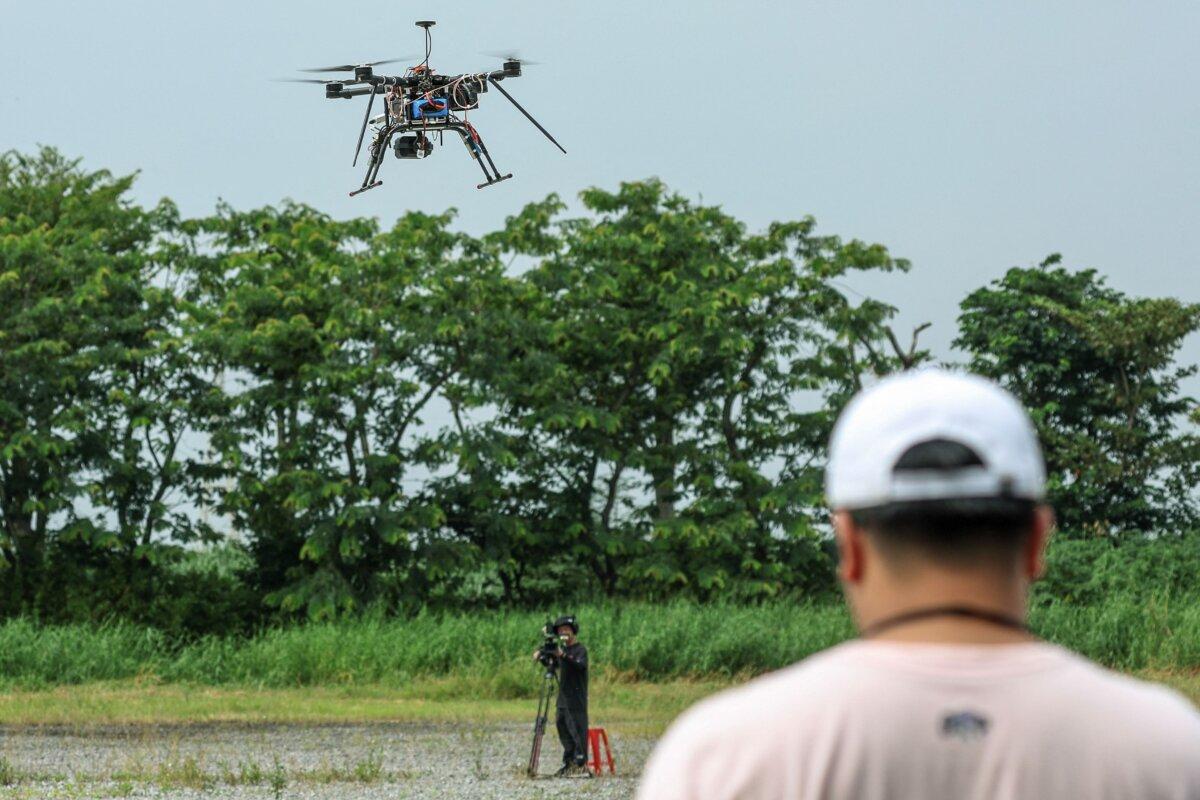
Recent developments reinforce this approach. Taiwan is rapidly expanding drone production, drawing lessons from Ukraine, where small unmanned systems have neutralized heavy armor and disrupted far larger forces. Although submarines are traditionally considered major platforms, Taiwan’s new Hai Kun-class submarines are asymmetric in function. They are designed to operate quietly in the shallow, noisy waters of the Strait and target transport ships rather than surface combatants.
Taiwan has also extended mandatory military service to one year and is reforming its reserve forces so that even if the regular military is heavily damaged, an invading force would face armed resistance in every major city. The objective is not to destroy the entire People’s Liberation Army—it is to destroy the amphibious landing force. If the ships carrying troops and equipment are sunk in the Strait, the invasion fails before it reaches Taiwan’s shores.
The supplemental budget would fund the Taiwan-Dome island-wide air defense system, alongside drones, precision artillery, and artificial intelligence-enabled command-and-control systems through 2033. Taiwanese President Lai Ching-te intended this package to raise the cost of aggression while moving Taiwan’s defense spending toward 5 percent of GDP by 2030. This plan builds on earlier special budgets for systems such as the Brave Wind anti-ship missile and the Harpoon coastal defense system, aligning with the 2025 National Defense Report’s focus on asymmetric deterrence.
Modeled in part on Israel’s Iron Dome and the “Golden Dome” missile shield proposed by President Trump for the U.S. homeland, the Taiwan Dome is designed as a multi-layered safety net to protect cities and infrastructure from saturation strikes.
If approved, the special budget would run alongside a separate $11.1 billion U.S. arms package that includes HIMARS, a truck-mounted launcher capable of GPS-guided precision strikes at ranges of several hundred miles. Its shoot-and-scoot mobility allows it to strike command posts, air defenses, logistics hubs, and troop concentrations, then relocate before Chinese forces can coordinate a counter-strike. For Taiwan, it is a textbook asymmetric weapon.
What's Your Reaction?
 Like
0
Like
0
 Dislike
0
Dislike
0
 Love
0
Love
0
 Funny
0
Funny
0
 Wow
0
Wow
0
 Sad
0
Sad
0
 Angry
0
Angry
0













Comments (0)