

Taiwan Takes Foreign Lawmakers to Sea to Expose China's Growing Coast Guard Pressure
A rare boat trip for foreign lawmakers around Taiwan's Kinmen islands has put a spotlight on Beijing's expanding coast guard patrols near Taiwanese territory. The visit, organized by Taipei, comes as China widens its maritime pressure campaign into waters off Taiwan's east coast — a shift that has already drawn concern from Washington, London, Paris and Berlin.

.
A Front-Row Seat to the Dispute
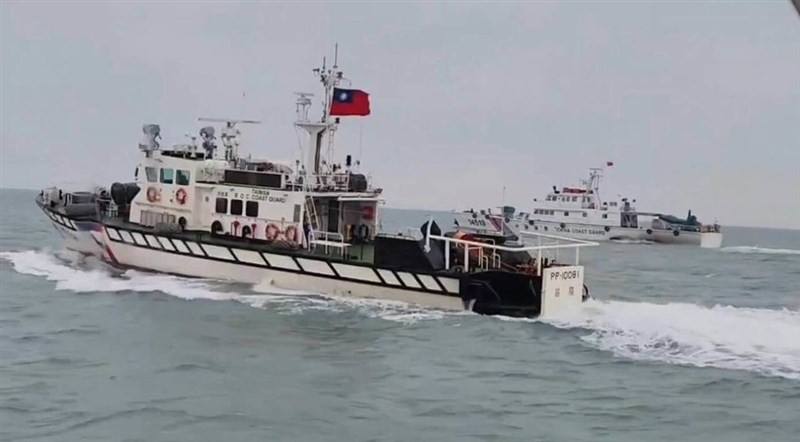
Seven foreign lawmakers and two Taiwanese legislators spent 90 minutes aboard a Taiwan Coast Guard vessel this week, sailing through waters around the Kinmen islands just a few kilometers from China's coast. Organized by Taiwan's foreign ministry together with the Ocean Affairs Council, the trip is thought to be the first of its kind and was designed to let international observers see firsthand how close Chinese territory truly is — and how often Chinese ships enter waters Taiwan considers its own.
The ship carried no visible weapons, and the crew was unarmed. That detail matters: confrontations here typically stay at the level of radio warnings rather than physical clashes, even though Chinese vessels are many times larger than Taiwan's roughly 100-ton patrol boats stationed in the area.
Among the visitors was British MP Tom Tugendhat, a former UK security minister known for his critical stance on Beijing. He framed the trip as a statement about international law rather than a provocation aimed at China, arguing that being present in Taiwanese-administered waters simply affirmed the rules-based order that Beijing itself claims to support. He was joined by two other British lawmakers and one legislator each from Ukraine, the Czech Republic, India and New Zealand — all members of the Inter-Parliamentary Alliance on China, an international grouping of lawmakers focused on China policy.
A Ukrainian member of the delegation, Yulia Sirko, drew a direct line between Taiwan's situation and her own country's experience with Russia. Her message was blunt: nations hoping to avoid war need to prepare for one — a lesson she said Ukraine learned only after it was too late.
Why Kinmen Matters
Kinmen sits only a few kilometers from the Chinese cities of Xiamen and Quanzhou, making it one of the most exposed points in the Taiwan Strait. Taiwan has governed the islands since 1949, when Republic of China forces retreated there after losing the Chinese civil war to Mao Zedong's Communist forces. Beijing has never recognized Taiwan's sovereignty over the islands, or over Taiwan itself.
The islands' history is a violent one. In 1958, China launched a major military assault on Kinmen in what is now called the Second Taiwan Strait Crisis. Sporadic Chinese artillery fire continued for another two decades, only stopping in 1979. Today, Kinmen has transformed into a tourist destination with regular ferry connections to the mainland — though Taiwan still maintains a significant military presence there.
China's Coast Guard began regularly patrolling near Kinmen in February 2024, following an incident in which two Chinese nationals died while their speedboat was being pursued by Taiwan's Coast Guard after entering restricted waters. Independent tracking data compiled by the Asia Maritime Transparency Initiative shows Chinese coast guard vessels have entered Kinmen's restricted and prohibited waters roughly 13 times per week on average in recent years, with activity peaking in 2024.
Pressure Spreads to Taiwan's East Coast
Until last month, Beijing's coast guard pressure campaign was concentrated around Kinmen and the nearby Matsu islands. That changed when China's Coast Guard launched what it called a "law enforcement" patrol in waters off Taiwan's east coast — a considerably more significant expansion, since it moved Chinese enforcement activity into open waters far from any island Beijing could plausibly claim on historical grounds.
Analysts monitoring the region describe the shift as part of a broader effort by Beijing to normalize its maritime presence around all of Taiwan, not just its outlying islands. Taiwanese officials have publicly warned that the tactic could be expanded further, and Taiwan's National Security Council has reported tracking more than 110 Chinese naval and coast guard vessels along the so-called First Island Chain — a record high linked to China's seasonal exercise period.
The new patrols prompted formal expressions of concern from the United States, the United Kingdom, France and Germany. Taiwanese officials have labeled the move "expansionism in disguise," arguing that Beijing is using ostensibly civilian law-enforcement language to advance territorial claims it could not otherwise justify under international law.
Taipei's Strategy: International Attention as Leverage
For Taiwan, the Kinmen boat trip is part of a broader strategy to internationalize what could otherwise be dismissed as a narrow, bilateral dispute. Taiwan Coast Guard officials framed the visit explicitly in these terms, saying they hoped democracies around the world would come to understand Kinmen's position on what they called the front line of the Taiwan Strait, facing direct pressure from the Chinese Communist Party.
That messaging fits a pattern. Taiwan's government, under President Lai Ching-te, has consistently argued that only Taiwan's 23 million people have the right to determine their own political future — a position Beijing rejects outright. China's government refuses direct contact with Lai, branding him a separatist.
The Trump administration, along with European governments, has voiced increasing concern over Beijing's gray-zone tactics — coercive activity that stops short of open conflict but steadily erodes the status quo. Washington has continued to emphasize the importance of peace and stability across the Taiwan Strait as a matter of regional and economic security.
Outlook
With Chinese coast guard activity continuing to expand — both around Taiwan's outlying islands and now along its eastern coastline — further friction appears likely. Taiwan seems set to keep using visits like this week's trip to draw international lawmakers and media attention to the dispute, betting that visibility abroad will translate into diplomatic and, if necessary, material support.
Whether that strategy shifts Beijing's calculus remains an open question. What is clear is that the waters around Kinmen — once the site of Cold War-era artillery duels — have once again become a barometer for how far China is willing to push, and how the democratic world chooses to respond.
.
Sources:
- Hong Kong Free Press (AFP): https://hongkongfp.com/2026/07/08/china-signals-new-normal-with-coast-guard-patrols-off-eastern-taiwan/
- U.S. News & World Report (Reuters): https://www.usnews.com/news/world/articles/2026-07-04/china-launches-coast-guard-patrol-east-of-taiwan-despite-international-pushback
- AEI China & Taiwan Update, July 2, 2026 (background/analysis): https://www.aei.org/articles/china-taiwan-update-july-2-2026/
- Asia Maritime Transparency Initiative, CSIS – "A New Normal for the China Coast Guard at Kinmen and Matsu" (data/background): https://amti.csis.org/a-new-normal-for-the-china-coast-guard-at-kinmen-and-matsu/
.
What's Your Reaction?
 Like
0
Like
0
 Dislike
0
Dislike
0
 Love
0
Love
0
 Funny
0
Funny
0
 Wow
0
Wow
0
 Sad
0
Sad
0
 Angry
0
Angry
0












Comments (0)