

Typhoon Dolphin Unleashes Record Floods Across China, Puts Beijing on High Alert
Typhoon Dolphin, the strongest storm to hit China this year, has pushed deep into the country's interior, flooding streets in Hubei province and triggering emergency flood measures in Beijing. Millions of people across eastern and central China have been evacuated, and forecasters warn the danger is far from over.

.
A Storm That Won't Let Go
Typhoon Dolphin first made landfall on China's eastern coast in Zhejiang province on Sunday evening, hitting with sustained winds of 151 km/h (93 mph) — roughly the strength of a Category 1 hurricane. Rather than fading quickly, as most storms do, Dolphin kept moving. By Tuesday it had pushed hundreds of kilometers inland into Hubei province, flooding streets, shutting down tourist attractions, and halting construction projects.
Meteorologists say what makes Dolphin unusual is its staying power. Before making landfall, the storm had already traveled nearly 6,000 kilometers (3,700 miles), bringing with it an unusually large cloud system. Some forecasters have compared its impact to Typhoon Doksuri, which caused major destruction in 2023 and brought record rainfall to Beijing.
.
Beijing Braces for a Year's Worth of Rain
Even though Dolphin was downgraded to a tropical depression on Tuesday afternoon, its reach extended more than 1,000 kilometers north to the capital. Four districts on Beijing's outskirts activated the highest level of emergency flood response, as the city prepared for more than one-third of its entire annual rainfall to fall within just 24 hours.
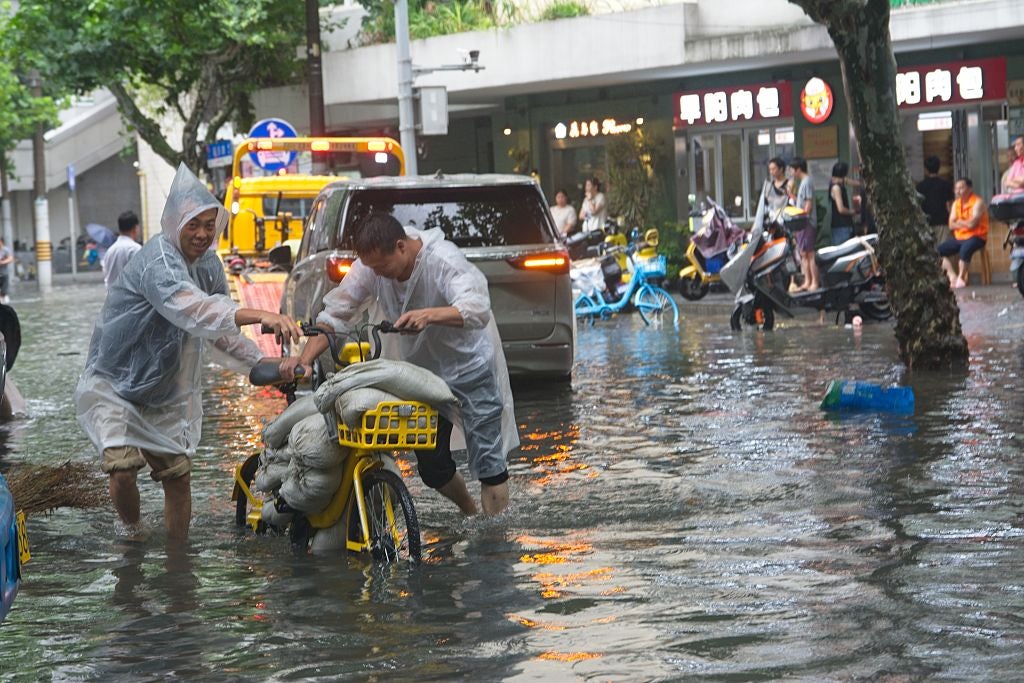
The hardest-hit spot so far has been Houshayu in Beijing's Shunyi district, where 88.5 millimeters of rain fell in a single hour on Tuesday afternoon. Photos shared on Chinese social media showed buses and cars partly submerged, with one delivery driver wading through water deep enough to hide everything but his scooter's handlebars.
.
Hubei Under Water
In Hubei, a manufacturing hub of more than 58 million people, the situation on the ground was just as dramatic. In the city of Xiangyang, pedestrians waded through flooded streets while electric scooters disappeared under the water. At one intersection, drivers slowed to inch through floodwater more than 30 centimeters deep; others simply turned around.
"This area always gets flooded when it rains. If it continues like this, the water could reach my home," a 60-year-old resident named Huang told Reuters, describing her worry as she watched the rising water near her apartment building.
Authorities said water levels at 35 reservoirs in Xiangyang had already exceeded flood-control limits by Tuesday morning, forcing the relocation of nearly 9,700 people. Popular tourist sites, including the area around the Three Gorges Dam, were closed, and provincial officials suspended 26 high-risk construction projects along highways and waterways. The floods come only weeks after the region was hit by two rare tornadoes tied to a previous storm, which killed at least 11 people.
.
Shanghai Already Broke a 150-Year Record
Before reaching Hubei, Dolphin had already left its mark on China's east coast. A weather station in central Shanghai recorded nearly 313 millimeters of rain in just 24 hours — the city's heaviest rainfall in more than 150 years of record-keeping, with one station logging almost 400 millimeters. Shanghai's two main airports canceled roughly 900 flights, about 40 percent of the day's schedule, and several metro and train lines were suspended.
Ahead of landfall, more than a million people across eastern China were moved to safety. Wenzhou alone relocated over 900,000 residents and opened more than 1,000 emergency shelters, while smaller numbers were evacuated in Taizhou, Fujian, and Shanghai. Officials reported no confirmed deaths, though state media said a nine-year-old boy remained missing after being swept out to sea in Zhejiang.
.
More Rain on the Way — and Another Storm Behind It
The danger has not passed. In Henan province, north of Hubei, authorities issued a red flash-flood alert, the highest warning level, as the storm continues pushing moisture northward. Forecasters expect up to 350 millimeters of additional rain there by Wednesday afternoon, while parts of Hubei could see up to 250 millimeters more in the next 24 hours.
Meanwhile, Japan — which was already lashed by Dolphin before it reached China — is bracing for a second storm. The Japan Meteorological Agency said Typhoon Chan-hom could move across the Japanese mainland later on Tuesday, bringing further risk of landslides, flooding, and strong winds.
.
Sources:
- Reuters – "Typhoon Dolphin floods central China, puts Beijing on alert for heavy rain" (Aug 11, 2026) – https://www.reuters.com/business/environment/typhoon-dolphin-floods-central-china-parts-beijing-2026-08-11/
- ABC News / AP – "Tropical storm causes some flooding in eastern China" (Aug 10–11, 2026) – https://abcnews.com/International/wireStory/tropical-storm-causes-flooding-eastern-china-135509323
- Al Jazeera – "Typhoon Dolphin hits eastern China, more than one million evacuated" (Aug 9, 2026) – https://www.aljazeera.com/news/2026/8/9/flight-cancellations-evacuations-as-china-braces-for-typhoon-dolphin
.
What's Your Reaction?
 Like
0
Like
0
 Dislike
0
Dislike
0
 Love
0
Love
0
 Funny
0
Funny
0
 Wow
0
Wow
0
 Sad
0
Sad
0
 Angry
0
Angry
0














Comments (0)