

China's Arctic Shipping Push Deepens Ties With Russia — And Raises Alarms in Washington
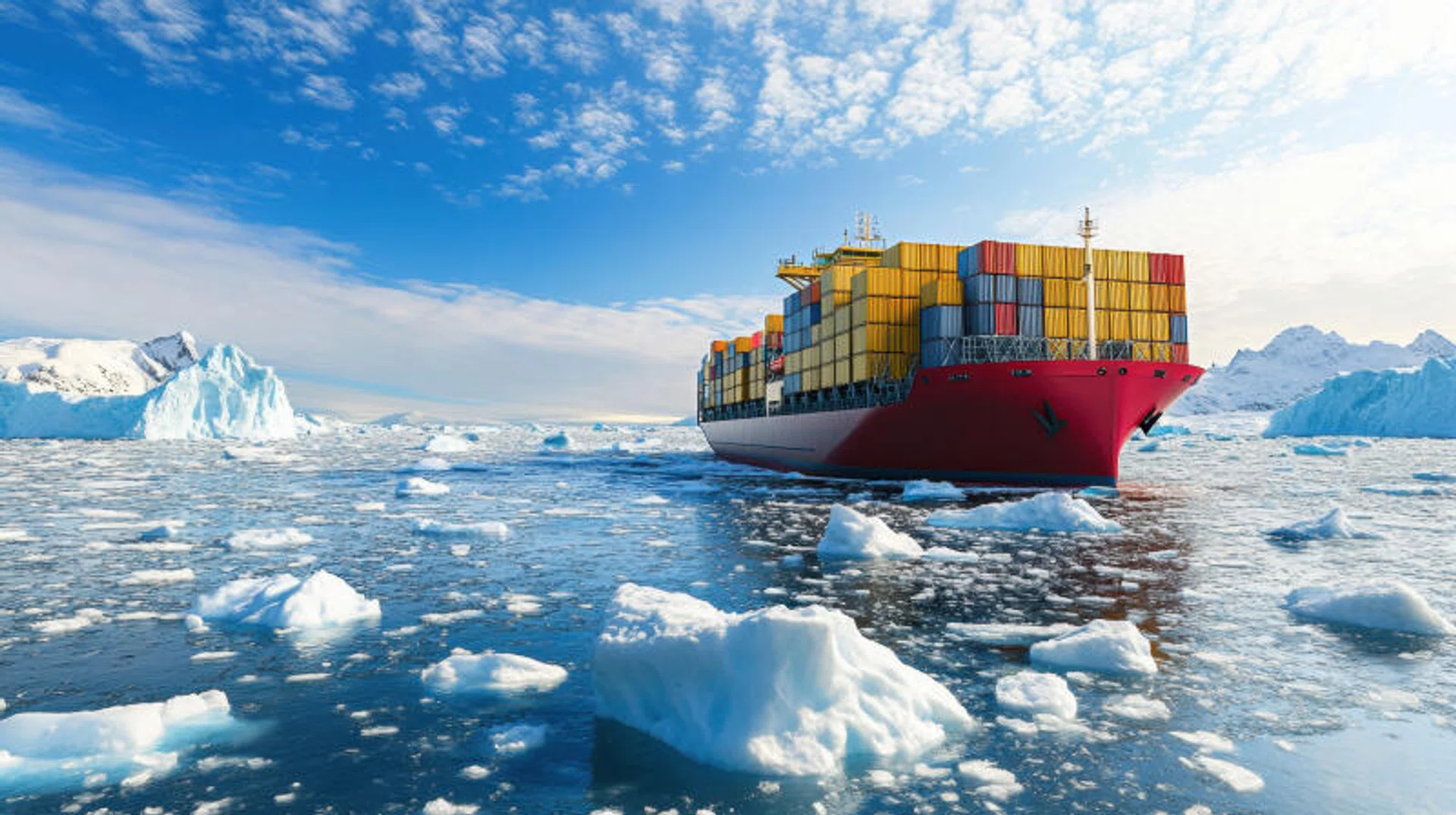
A Chinese shipping company has launched the first regular container service through Russia's Arctic waters, cutting weeks off the journey to Europe. The route strengthens China's partnership with Russia and highlights how far behind the United States has fallen in Arctic infrastructure.

.
A New Route Through the Ice
Chinese carrier Sea Legend Line has begun a regular container service linking the port of Ningbo in eastern China with Felixstowe in the United Kingdom, sailing through Russia's Northern Sea Route (NSR) along the country's Arctic coastline. The service could cut the usual 40-day sailing time between the two ports down to roughly 20 days.
The company plans eight consecutive voyages between China and Europe during this year's Arctic navigation season, using seven ships. The first vessel, the Dubai Tower, was scheduled to depart Zhoushan in mid-August, with weekly sailings planned into October.
This is not China's first attempt. Sea Legend tested the route in 2025 with the container ship Istanbul Bridge, which sailed from China to Felixstowe in about 20 days before continuing on to Germany, Poland and the Netherlands.
.
Why Beijing Wants to Avoid the Usual Route
The appeal for China is strategic as much as economic. The standard route to Europe runs through the Strait of Malacca, the Indian Ocean, the Red Sea and the Suez Canal — a corridor that a rival naval power could, in theory, restrict during a crisis. The Arctic route instead advertises a 20-day transit, about half the time of a standard Suez voyage, while "avoiding geopolitical disruption risks."
Beijing has pursued this ambition for years. Despite having no coastline anywhere near the Arctic Ocean, China's 2018 white paper on the region set out the country's intent to build a role in Arctic shipping, resources and governance. Sea Legend's new scheduled service now represents a concrete step toward the regular commercial shipping Beijing had described in that plan.
.
Russia's Growing Dependence on China
The route also illustrates how the war in Ukraine has pushed Russia and China closer together. Moscow remains cautious about letting China gain a Arctic security foothold, hoping instead that Beijing will keep buying Russian energy and help finance the Northern Sea Route's build-out. A separate Chinese carrier, New New Shipping, formed after Russia's 2022 invasion of Ukraine, has already opened its own line to Russia's largest Arctic port, Murmansk.
Traffic on the route is still growing quickly, if from a low base. Container-ship transits reached a record 23 in 2025, up from 15 the year before, according to industry tracking cited by multiple outlets.
.
Washington Is Badly Outmatched in the Ice
The imbalance in Arctic hardware is stark. Russia operates 42 icebreakers, some nuclear-powered, while the United States has only two that are currently operational — and even China, with no Arctic coastline of its own, fields more icebreakers than America does.
The Pentagon has taken notice. The 2026 National Defense Strategy compares Arctic dominance to a modern-day Monroe Doctrine, stating that the Department of War will give the president "credible options to guarantee U.S. military and commercial access to key terrain from the Arctic to South America, especially Greenland." Officials have separately warned that deepening Chinese-Russian cooperation could translate into a larger Chinese military and economic footprint along Russia's Arctic coast.
The Trump administration has treated the region as a genuine security priority rather than an afterthought. That thinking has also shaped the president's continued push to bring Greenland — a Danish territory sitting astride key Arctic approaches — under closer American control, arguing it is essential to national defense even though Copenhagen and Nuuk have so far rejected the idea.
.
A Route With Real Limits
Arctic shipping is unlikely to replace established trade lanes soon. The season is short, ice conditions are unpredictable, and environmental groups have already criticized the ships involved as unsuited for polar conditions. South Korea is even positioning its own, more tightly regulated Arctic service as a competitor to the Chinese offering.
Still, the symbolism is hard to miss: a decade after declaring its ambitions for a "Polar Silk Road," Beijing now has a working, scheduled route through the top of the world — while the U.S. Coast Guard is only beginning to rebuild a fleet that fell badly behind.
.
Sources
- CNN — "How the Northern Sea Route is bringing China and Russia together": https://www.cnn.com/2026/08/14/china/china-arctic-northern-sea-route-russia-intl-hnk-vis-dst
- UPI — "China pushes Arctic 'Ice Silk Road' to cut Europe shipping time": https://www.upi.com/Top_News/World-News/2026/08/13/arctic-Ice-silk-road/6551786664732/
- The Maritime Executive — "China's Sea Legend Poised to Launch First Regular 'Ice Silk Road' Service": https://maritime-executive.com/article/china-s-sea-legend-poised-to-launch-first-regular-ice-silk-road-service
- IndexBox — "China's Sea Legend Line Plans Weekly Arctic Container Service via Northern Sea Route": https://www.indexbox.io/blog/sea-legend-line-to-launch-first-regular-arctic-container-service-on-northern-sea-route/
.
What's Your Reaction?
 Like
0
Like
0
 Dislike
0
Dislike
0
 Love
0
Love
0
 Funny
0
Funny
0
 Wow
0
Wow
0
 Sad
0
Sad
0
 Angry
0
Angry
0

















Comments (0)