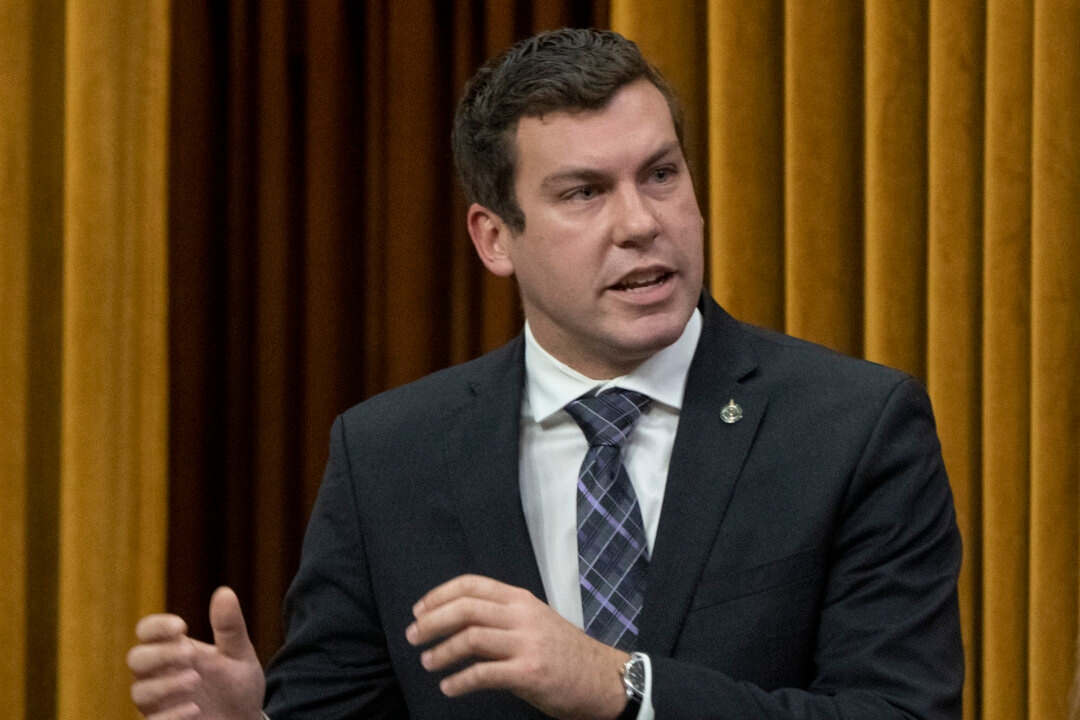
Prime Minister Mark Carney has announced that his parliamentary secretary, Liberal MP Kody Blois, will travel to China from Sept. 6 to 9 as part of a trade delegation led by Saskatchewan’s premier to discuss China’s canola tariffs.
The Prime Minister’s Office (PMO) made the
announcement on Sept. 4, saying Blois will “engage constructively” with Chinese officials in discussing trade irritants and will “demonstrate” Ottawa’s commitment to supporting Canadian farmers affected by Beijing’s tariffs.
The delegation will be
led by Saskatchewan Premier Scott Moe, who has
called China’s tariffs on canola “punitive,” and has urged the federal government to engage with Beijing to have them removed. Canola is one of Saskatchewan’s main exports.
“Canada’s new government will work with provinces, territories, farmers, and businesses to build one Canadian economy and secure reliable trading partnerships for the trade of high-quality Canadian goods,” reads the PMO’s press release.
“We are taking action to protect hard-working canola producers, workers, and exporters, defend their fair access to global markets, and protect Canadian jobs.”
China last month
imposed 75.8 percent temporary tariffs on Canadian canola. The tariffs came weeks after Ottawa
said it would apply additional 25 percent tariffs on steel imports from all non-U.S. countries containing steel melted and poured in China, citing protection of Canada’s domestic industry.
.
The new Chinese tariffs added to the 100 percent duties China
levied earlier this year on Canadian canola products and other agricultural items, and stemmed from an “anti-dumping”
investigation the regime initiated last year after Ottawa imposed 100 percent tariffs on Chinese-made electric vehicles and 25 percent tariffs on Chinese aluminum and steel.
.
Ottawa has
rejected Beijing’s allegations that Canadian farmers dump canola. Dumping involves selling products to another country at a price below their normal value.
“Canada does not dump canola,” said Carney in an Aug. 14 social media
post, a few days after China announced its latest tariffs. “Canadian canola products meet the highest standards, and our inspection systems are robust.”
Blois said at a
press conference late last month that Canada would engage with Beijing to reopen the canola market, given China’s large market share, while simultaneously working to diversify its trade.
“One marketplace in terms of trade diversification or multiple may not replace one Chinese market,” he said. “But if you do that work, multiplied over many different jurisdictions ... there’s an ability to try to help mitigate the situation.”
China last month
filed a complaint with the World Trade Organization over Canada’s latest tariffs on Chinese steel, arguing the levies are inconsistent with international trade rules.
Ottawa has stood by the tariffs, saying that Beijing’s “non-market”
practices threaten the domestic industry. These policies include “pervasive subsidization, insufficient or non-existent labour and environmental standards that are contrary to Canadian values, and other measures to artificially lower production costs,” according to the Canadian government.
.
“Non-market policies and practices by the Chinese government in [the steel and aluminum] sectors, often utilizing higher carbon production technology, have contributed to persistent, non-market structural overcapacity, affecting the profitability and long-term economic viability of market-oriented Canadian firms,” Ottawa said in its surtax
order for its latest levies on China.
Beijing has previously targeted Canada’s canola industry–of which China is the second-largest export market–during periods of diplomatic or trade tensions with Ottawa. In one such case in 2019, it imposed a three-year
ban on Canadian canola imports following the arrest of Huawei executive Meng Wanzhou in Vancouver on a U.S. extradition warrant.
Moe has noted that Canadian canola is frequently impacted during periods of tension with China, due to Canada’s reliance on that export market.
“That’s why we all too often see it being targeted when there are global relation challenges,” he said during an Aug. 21
press conference.
.



 Like
0
Like
0
 Dislike
0
Dislike
0
 Love
0
Love
0
 Funny
0
Funny
0
 Wow
0
Wow
0
 Sad
0
Sad
0
 Angry
0
Angry
0












Comments (0)