

Key Factors Trump Should Weigh Before His April Trip to China


.
Commentary
.
U.S. President Donald Trump said that he plans to visit Beijing in April. But given the intensified infighting at the top of the Chinese Communist Party (CCP), Chinese leader Xi Jinping’s brutal military purges leaving everyone on edge, extreme political uncertainty, promises that Beijing never keeps, and widespread public desire for change, a Trump trip in April looks badly timed and likely more harmful than helpful.
Leadership Clash Has Pushed China’s Politics to Breaking Point
On Jan. 24, Xi’s regime suddenly announced that Politburo member and Central Military Commission (CMC) Vice Chairman Zhang Youxia, along with CMC member and Joint Staff Department Chief Liu Zhenli, were being probed for “serious violations of discipline and law.” This is the usual CCP wording used to announce a high-level corruption or political probe..
This marks the most insane, brutal, and shocking moment in high-level CCP infighting since the 20th CCP National Congress ended in 2022. Some compare it to the plane crash in 1971 that killed Lin Biao—Mao’s personally chosen successor, then-vice chairman of the CCP, and minister of national defense. Lin and his family were allegedly aboard a British-made Trident airliner that crashed in Mongolia on Sept. 13, 1971. The reasons for their trip and the crash have been obscured by the CCP.
.
The analogy has some merit: both Zhang and Lin were vice supreme commanders. But key differences stand out:
- As the founding leader of the Party, army, and state, Mao’s prestige remained high at the time of the Lin Biao Incident. Xi, by contrast, is widely seen as the man responsible for the full-scale deterioration of China’s domestic and foreign policies. His reputation has hit rock bottom after arresting Zhang.
- Mao purged many senior officials during the Cultural Revolution, but he deliberately kept some veteran generals who had fought alongside him. Xi has no combat experience and has turned the military into a near-empty shell—surrounded only by yes-men too afraid to speak truth.
- In his 14 years of rule as CCP chairman, Xi has been purging his opponents through anti-graft campaigns. Anti-Xi sentiment now runs from top officials to ordinary citizens—many openly curse him and demand he step down. He’s close to total isolation.
.
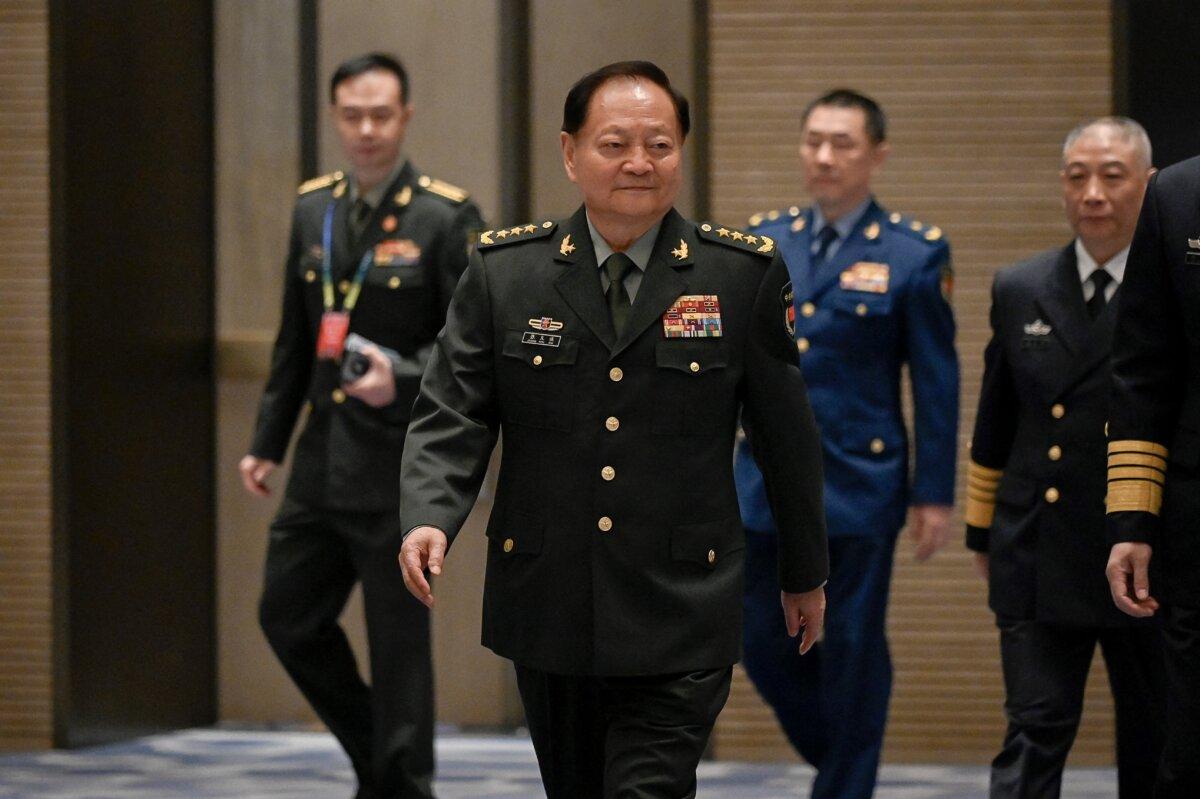
Zhang Youxia, China's vice chairman of the CPC Central Military Commission and vice chairman of the Central Military Commission (C), arrives for a group photo before the opening ceremony of the 19th Western Pacific Naval Symposium in Qingdao, Shandong province, on April 22, 2024. Wang Zhao/AFP via Getty Images
.
Xi Is Losing Control of the Military
Four clear signs show Xi’s control of the military has hit rock bottom..
The top military command structure has collapsed.
.
The CMC is the top command body of the PLA. At the 20th National Congress, which was convened in 2022, Xi set up a seven-member CMC: himself as chairman, vice chairmen Zhang Youxia and He Weidong, and members Li Shangfu, Liu Zhenli, Miao Hua, and Zhang Shengmin. By January 2026, five of those seven had been removed for “undermining the CMC Chairman Responsibility System.” Only Xi and Zhang Shengmin remain. Zhang Shengmin is a political officer, not a military expert. On major strategy or tactics, Xi has almost no one in the CMC who is qualified to advise him.
.
The Rocket Force corruption case exposes Xi’s total failure in military management.
.
The Rocket Force is the CCP’s so-called “ace army,” and is mainly responsible for managing land-based nuclear missiles and conventional ballistic missiles. It is allegedly the PLA’s most lethal arm for intimidating the United States and annexing Taiwan. In April 2023—barely six months after the CCP’s 20th National Congress—Xi launched a massive purge targeting the Rocket Force’s top brass. So far, all four commanders of the Rocket Force Xi personally promoted and appointed—Wei Fenghe, Zhou Yaning, Li Yuchao, Wang Houbin—have been removed on corruption charges.
Selecting and appointing the commander of the Rocket Force is one of Xi’s most critical responsibilities as chairman of the CMC. Choosing the wrong person once might be understandable. Choosing wrong twice could perhaps be forgivable. Choosing wrong three times is neither forgivable nor understandable. But getting it wrong four times in a row can only point to one conclusion: Xi’s judgment is badly impaired, and his leadership deeply incompetent.
Almost every general Xi promoted has been wiped out.
In his 14 years of rule since becoming the paramount leader in China in 2012, Xi has purged as many as 400 generals, according to my own counting from internal CCP documents—more than all CCP generals lost in civil wars, foreign wars, and the Cultural Revolution since the PLA’s founding in 1927. Of all the PLA commanders, only three are generals—Central Theater Commander Han Shengyan, Eastern Theater Commander Yang Zhibin (both were promoted in December 2025), and Defense Minister Dong Jun; all the rest are lieutenant generals.
.
Xi’s military purge has entered a vicious cycle: the more fear he feels, the more he purges; the more he purges, the more fear grows. No one feels safe; no one knows who’s next. The purged officers and their networks are the most anti-Xi forces in the Party, and are looking for any chance to settle the score.
Xi’s Major Policy Blunders Keep Piling Up
Since Xi took over in 2012, he has left China in disarray at home and abroad, with public anger steadily building..
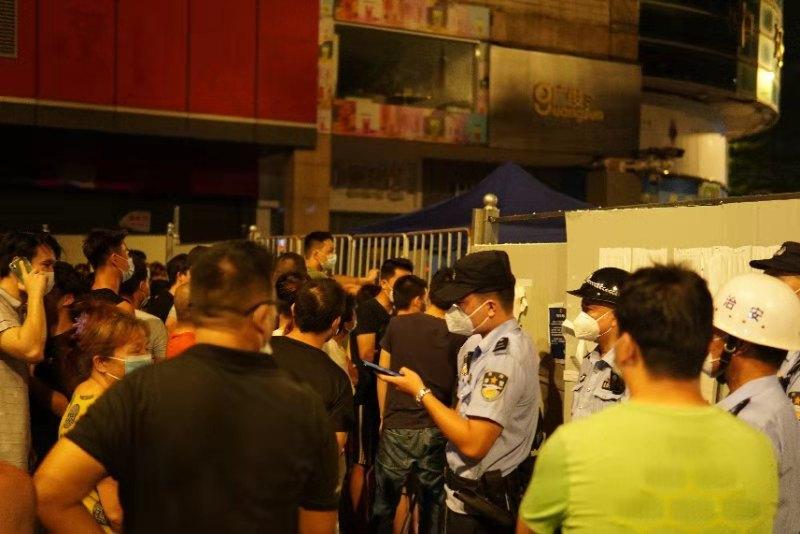
Hundreds of protesters from Luocun Village, Dali Town, Guangdong province, China, demand for the lifting of the lockdown for over 20 days. Courtesy: interviewee of The Epoch Times
.
One example is COVID-19. The 2020 pandemic from Wuhan led to three years of unscientific and extreme “zero-COVID“ lockdowns that turned China into a giant prison and wiped out decades of reform-era wealth. Then, at the end of 2022, Xi abruptly lifted the lockdown without warning—causing mass infections and countless deaths.
.
After Xi’s 14 years at the top, most ordinary Chinese people are worse off: struggling with childbirth, jobs, healthcare, housing, and retirement, among others. Resentment is everywhere; anti-Xi incidents keep erupting, and Xi is sitting on a volcano about to blow.
Some of the Things Beijing Did That Disrupted Trump’s First Term
The CCP doesn’t keep its promises and is not to be trusted.From 2017 to 2019, Trump delivered major domestic and foreign successes. But in 2020—his fourth year—the COVID-19 virus from Wuhan, called the “CCP virus“ by many, swept America, destroying so much he'd built. Now Missouri has been working to seize Chinese-owned assets in the United States to collect $25 billion in COVID-19 damages.
.
Another China-related setback is that Beijing failed to keep its promises made in the phase-one U.S.–China trade deal signed in January 2020, stemming from negotiations that began in 2018 amid escalating tariffs. Beijing committed to purchasing an additional $200 billion in U.S. goods and services over 2020–2021, including agriculture, energy, manufactured goods, and services. However, China fell far short. Then-U.S. Agriculture Secretary Tom Vilsack said that China’s purchases of U.S. farm goods alone fell short of the phase-one goal by about $13 billion.
.
A third major disruption came from China’s role in fueling the U.S. fentanyl crisis through the export of precursor chemicals used to produce the deadly synthetic opioid. China largely failed to enforce crackdowns, allowing precursors to continue flowing to Mexican cartels for final production and smuggling into the United States.
.
Finally, widespread Chinese intellectual property theft and economic espionage targeted U.S. companies, with Beijing-linked actors stealing billions of dollars in trade secrets to boost China’s tech and military sectors.
Concluding Thoughts
Xi’s purge of Zhang Youxia and Liu Zhenli has pushed China’s politics to the brink of a major explosion. At the most desperate moment of Xi’s regime—when he’s lost almost all public and elite support—a Trump visit to Beijing now would be a major strategic mistake—it would hand Xi a lifeline, sending the wrong signal to the world and to China. It would contradict U.S. global strategy, go against American public opinion, and alienate ordinary Chinese people who want change.For Trump to visit now lacks the timing, conditions, and support of the people—it could easily backfire.
Views expressed in this article are opinions of the author and do not necessarily reflect the views of The Epoch Times.
.
What's Your Reaction?
 Like
0
Like
0
 Dislike
0
Dislike
0
 Love
0
Love
0
 Funny
0
Funny
0
 Wow
0
Wow
0
 Sad
0
Sad
0
 Angry
0
Angry
0














Comments (0)