

How Curiosity Supercharges Your Memory and Cognitive Function

.
Leonardo da Vinci’s to-do lists were like no one else’s.
His journals reveal an impressive range of ideas, from sketches of hearts and how blood circulates to questions about a woodpecker’s tongue. Nothing was beneath his attention. For da Vinci, curiosity did not wait for permission. It is what made him “the most relentlessly curious man in history,” as described by art historian Kenneth Clark.
At the Edge of the Unknown
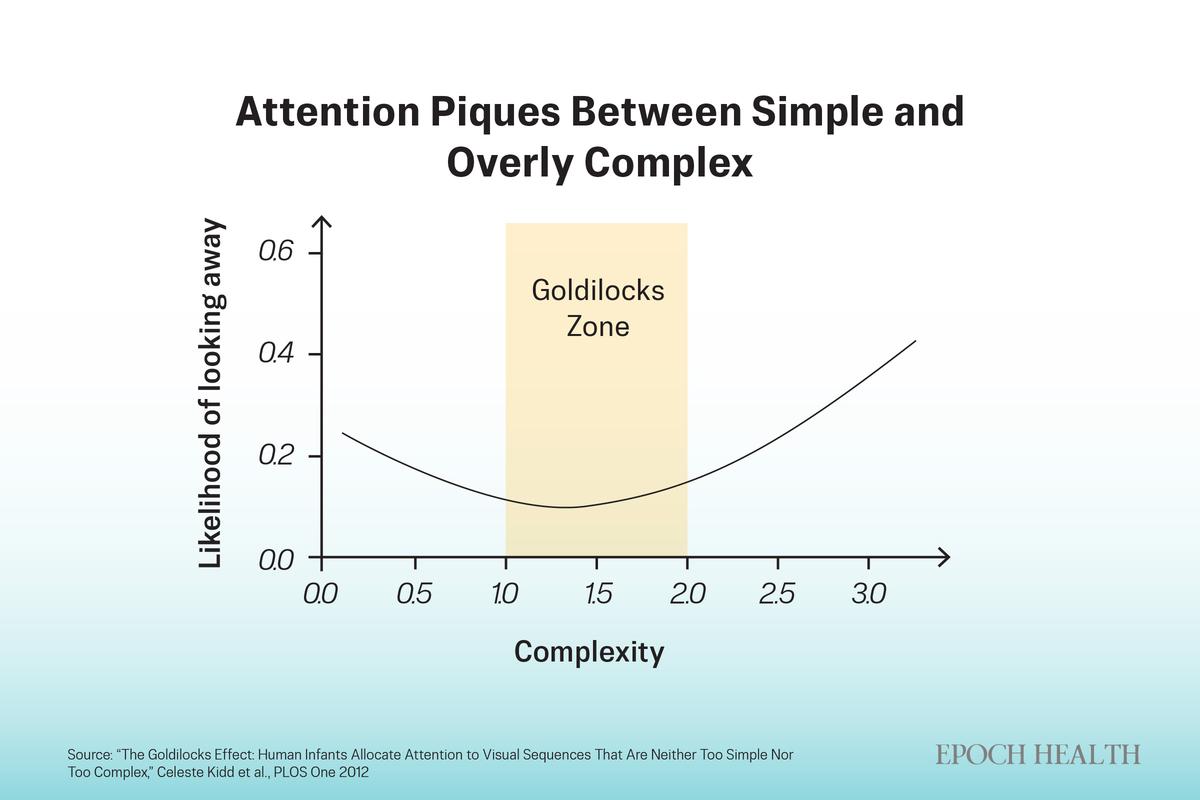
In the landscape of knowledge, there are “known knowns”—facts we’ve already mastered—and they lull us to boredom. On the far horizon, there are “unknown unknowns”—things we can’t even imagine enough to question. The real action happens in the middle, at the edge of our understanding—the “known unknowns.”There, curiosity flourishes.
Then they measured attention by how long the infants maintained their gaze.
Attention held the longest in the middle, where the scenario felt somewhat mysterious but tractable enough to tug on their attention. The researchers called this allocation of observation the “Goldilocks effect.”
.
The Epoch Times
.
The Learning Vortex
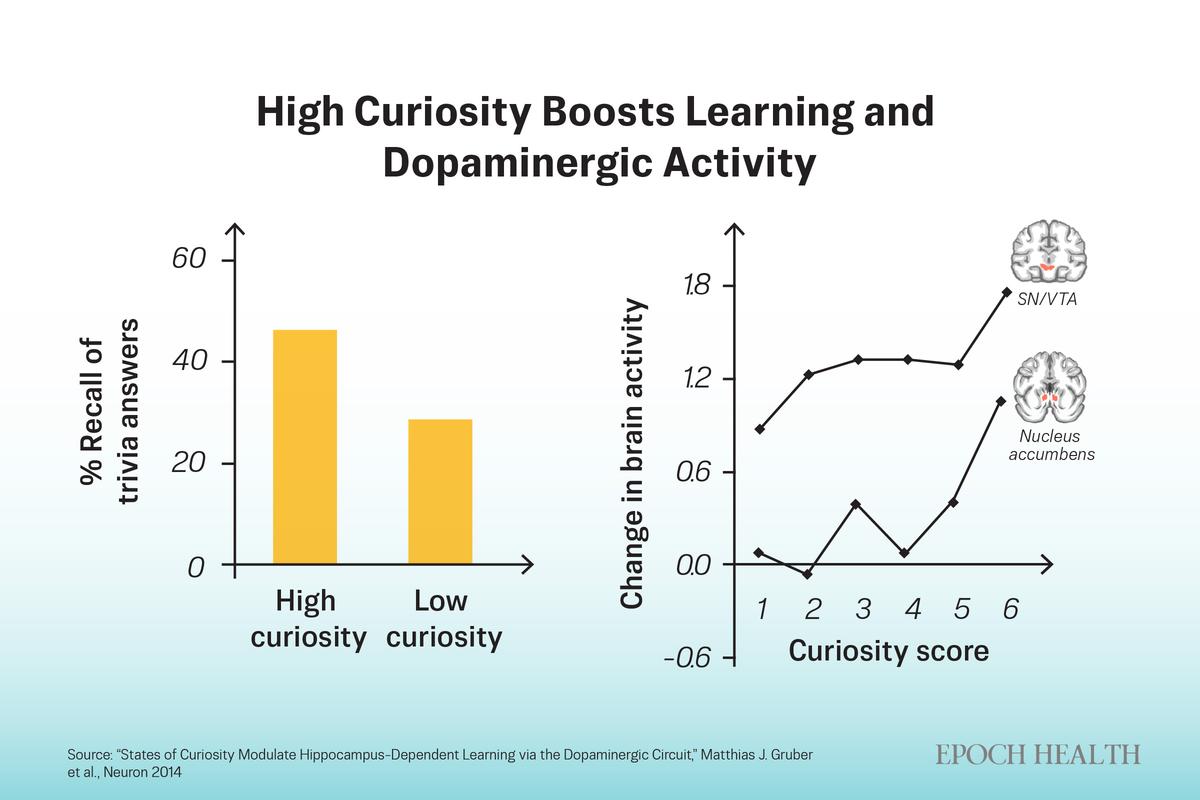
Curiosity physically changes the way we learn and remember.Quantitatively, participants recalled about 47 percent of trivia answers in the high curiosity condition, compared to 28 percent in the low curiosity condition.
The scientists called curiosity a “learning vortex”—that is, it pulls in information about what you want to learn but also draws in all the incidental information around it. The brain shifts into a state that favors learning and memory.
Further, the fMRI scan revealed specific brain circuits tied to dopamine release, the nucleus accumbens and substantia nigra/ventral tegmental area, were activated, making memory work more efficiently.
The higher the curiosity level, the more those regions were stimulated.
.
The Epoch Times
.
“Curious learning adds to an intrinsic sense of needs and pleasure,” Jamie Jirout, associate professor and curiosity researcher at the University of Virginia, told The Epoch Times.
Benefits Across a Lifetime
Starting in childhood, a higher level of curiosity is related to significantly better learning and academic performance.Another boon is that curiosity doesn’t fade but rather evolves across the lifespan, and keeping the “information gap” alive may help one’s brain stay healthy into old age.
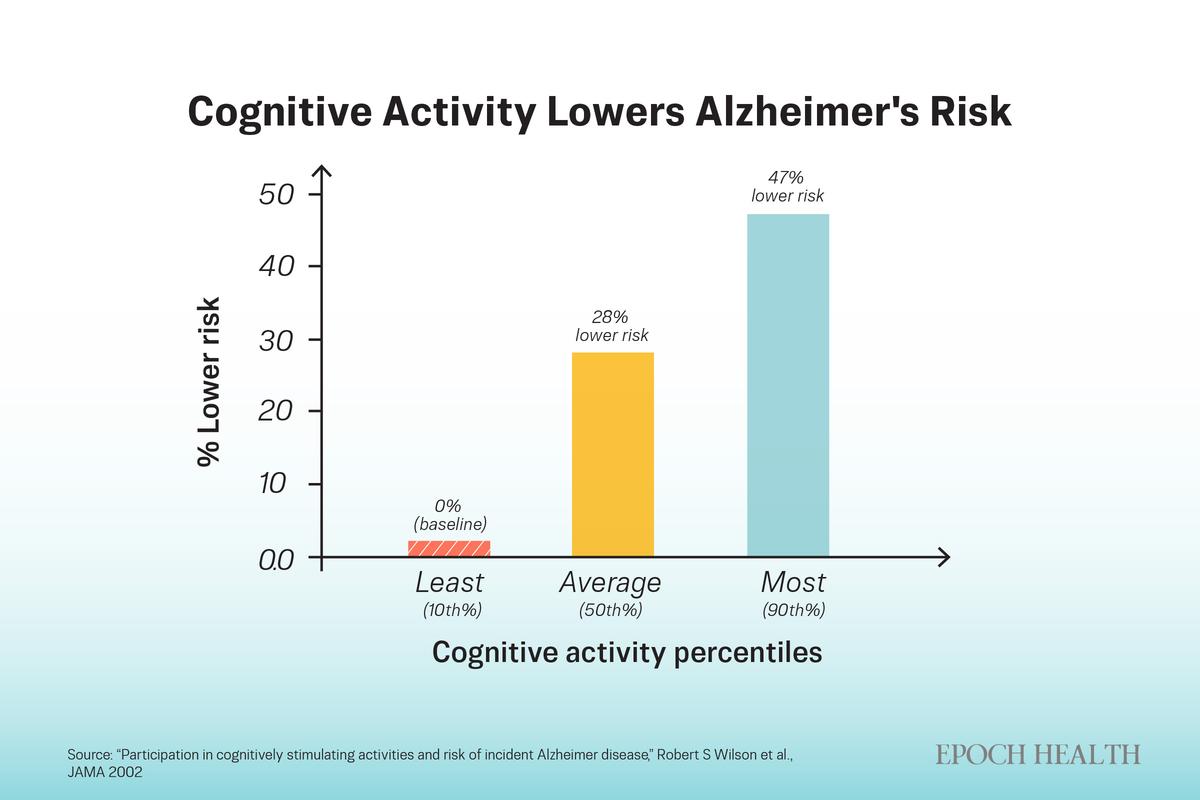
After a 4 1/2-year follow-up, the researchers found that “a 1-point increase in cognitive activity score was associated with a 33% reduction in risk of [Alzheimer’s disease].”
Curiosity Nurtures Closeness
Curiosity breeds intimacy. In a series of experiments, Todd Kashdan, a psychologist and curiosity researcher, found that strangers who exchanged questions rooted in genuine curiosity as opposed to small talk built significantly more closeness and warmth.Participants had real 45-minute conversations with strangers and were randomly assigned to either the intimate or small-talk format. Small-talk included questions such as “Do you read a newspaper often, and which do you prefer? Why?” On the other hand, the closeness-focused questions included “What would constitute a ‘perfect’ day for you?” and “What is the greatest accomplishment of your life?”
In the situations designed for intimacy, almost everyone felt close. In the small talk group, only highly curious people did, because they transformed the situation.
Therefore, according to the researchers, curiosity may be the “neglected ingredient” of intimacy—even in unpromising or boring situations. Less curious people need a more structured, intimate context to feel close, while highly curious people generate closeness even where there may be fewer opportunities.
“The goal is not to get the answer. The goal is to join in the adventure of figuring out things together,” he said.
Make Mental Space for Wonder
Humility sits at curiosity’s core. Knowing what you don’t know is the very edge upon which wonder and learning balance—humility that makes curiosity possible by inviting in the unknown.However, Jirout noted that even this openness can be stifled by efficiency, task completion, and seeking certainty. The insidious nature of distractions—not least of which is social media—need hardly be mentioned. Thus, experts recommend we first make room—time and mental space for wonder to have a chance.
“Intentionally giving oneself the time and mental space to think about what they might be curious to know, almost like a type of meditation, will help to strengthen the curiosity skill—the basic desire to understand one’s world,” Jirout said.
Begin where interest tugs, and let curiosity flow naturally. Kashdan advocates for practices such as his “no phones” rule during social gatherings, in which you allow questions to unfold and resist the itch to Google an answer. Let common curiosity be a social experience and avoid short-circuiting a profound way of connecting with another person, he said.
We are endowed with curiosity, and that gift does not expire. At any time, Kashdan said, “you can find the variety, novelty, and meaning that make for an amazing life"—never more than one “why?” away.
.
What's Your Reaction?
 Like
0
Like
0
 Dislike
0
Dislike
0
 Love
0
Love
0
 Funny
0
Funny
0
 Wow
0
Wow
0
 Sad
0
Sad
0
 Angry
0
Angry
0

















Comments (0)