

Assistant Secretary Nominee Says Taiwan Needs to Lift Defense Spending, Calls for Increased Sub Building


.
U.S. President Donald Trump’s pick for assistant secretary of defense for Indo-Pacific Security Affairs has told his Senate confirmation hearing about needing to redefine defence deals with Taiwan—expecting it to up spending—and make changes AUKUS more “sustainable.”
John Noh is currently the Deputy Assistant Secretary of Defense for East Asia.
Speaking at his hearing, he said he would, if appointed, be taking up the role at a time of “alarming” growth in Beijing’s military.
“China is undergoing really historic and unprecedented military buildup. It is the most rapid military buildup in history and the largest since World War Two, and it spans both conventional and nuclear as well as cyber and space capabilities,” he said.
.

Asked by Senator Rick Scott (R-FL) whether the Chinese Communist Party (CCP) leadership had “made the decision to be our enemy?”
Noh replied, “I would look at the facts, the realities of what they’re doing with the military ... looking at the unprecedented military growth, the actions that they’re taking in [the] Taiwan Strait [and] South China Sea. I think those actions really speak for themselves.”
He was then asked about military operations within the “first and second island”—a geographical security concept crafted by the United States in the 1940s to deter China and the then-Soviet Union’s maritime ambitions.
The first chain comprises the Kuril Islands, the main Japanese archipelago, Okinawa, the northern part of the Philippine archipelago, the Malay Peninsula, and Taiwan. The second chain consists of the islands of Japan stretching to Guam and the islands of Micronesia.
Beijing has managed to establish a significant and ongoing presence in the first island chain, but has yet to establish a permanent presence in Taiwan, which it would need to do if it is to control that sector completely.
.
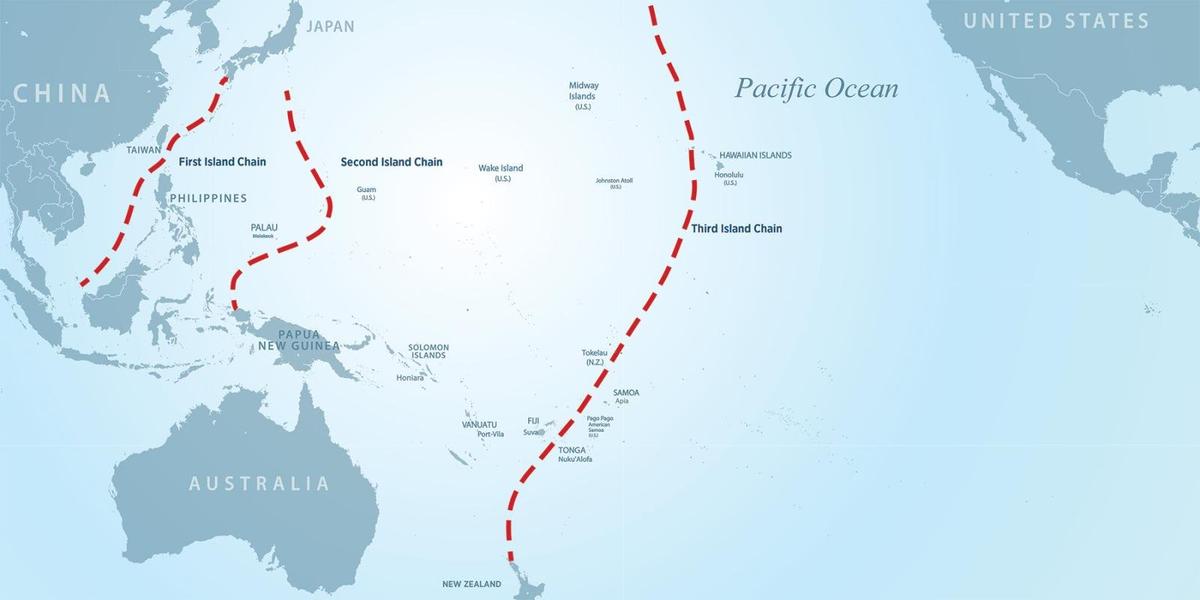
The first, second and third island chains are illustrated in this image from the U.S. Naval Institute.
.
Noh responded that it was of “enormous concern” and pledged to do everything in his power to ensure the United States has “combat credible forces postured forward in the western Pacific, along ... the first island chain, second island chain, with the right capabilities at the right places.
Noh Says Submarine Production Needs to Increase
Noh was then asked by Senator Tim Kaine (D-VA) about the current review of AUKUS, noting the agreement has “strong bipartisan support in this committee and on the Hill generally.”“This committee is conducting a review of AUKUS to make sure that it is fully aligned with President Trump’s America First foreign policy,' Noh replied, calling the move ”brass tacks common sense.”
“Look at the realities facing AUKUS. My understanding is [that] our submarine industrial base produces 1.2 Virginia-class submarines a year. That number needs to go up to 2.33 ... for us to be able to meet both U.S. requirements and fulfil our obligations under AUKUS pillar one.
“These are the issues that we are looking into, as well as whether it’s properly funded, and I know significant investments have been made from the U.S. side in addition to the contributions that Australia has made.”
The review should be completed “by this fall,” he said.
Before moving on, Committee Chair Roger F. Wicker (R-MS) said, “I think it’s fair to say that the review came as a surprise to this committee, to the Congress, and to the public, and as a distressing surprise to our steadfast ally, Australia.”
Senator Tim Sheehy (R–MT), who referred to Australia as America’s “stalwart ally in the South Pacific,” asked Noh how he would ensure that alliances held across the region when countries such as South Korea and Japan are currently undergoing major political realignments.
Sheehy noted that it was “important to keep in mind that the only scenario in which we have rough vessel-to-vessel parity with China is when all of our allies are included.”
Noh said he had already engaged with Australia, Japan, South Korea, Japan, and the Philippines during his trips with Hegseth to the region.
Noh Says Taiwan Should Up Defense Spending
Asked by Senator Ted Budd (R-NC) about what steps he'd take to improve security cooperation with Taiwan, the nominee said there were “multiple tools” at the Department’s disposal.“Everything from FMS [the foreign military sales programme] to PDA [presidential drawdown authority] to TSCI, the Taiwan Security Cooperation Initiative. TSCI was modelled after the USAI on Ukraine security assistance as a way of coming up with creative ways to speed up deliveries of weapons to Taiwan.”
However, Noh added that, “Taiwan needs to make a significant number of reforms in training, mobilisation, civil-military integration, hardening its infrastructure, [and] strengthening its cyber security practices. So in addition to the weapons portion, there are also a lot of things that Taiwan can and must do urgently to prepare for a potential invasion scenario.”
Wicker raised concerns that the newly-named Department of War may be taking back items procured for Taiwan using PDA, and asked Noh whether it was good policy to not only return weapons meant for Taiwan into the general defence stock but also require Taipei to pay for them.
Noh answered that Taiwan should not only “do its part and to pay,” but should also increase its defence spending to around 10 percent of GDP. The island nation will spend 3.22 percent in 2027, but Taiwanese President Lai Ching-te has set a longer-term goal of 5 percent.
Senator Mark Kelly (D-AZ) referred to rumours of an “alarming” shift in America’s National Defense Strategy, “away from the PRC and away from the Indo Pacific, and instead focusing on the Western Hemisphere.
“Suddenly shifting away from what I view is our biggest ... adversary might strategically leave us in a very vulnerable place with regard to the Indo Pacific,” he said.
In response, Noh pledged to “be the biggest advocate to my leadership in the Department to make sure that we have all the resources we need to strengthen deterrence in the Indo Pacific.”
.
What's Your Reaction?
 Like
0
Like
0
 Dislike
0
Dislike
0
 Love
0
Love
0
 Funny
0
Funny
0
 Wow
0
Wow
0
 Sad
0
Sad
0
 Angry
0
Angry
0












Comments (0)