

Hegseth: Dealing with China’s Military Buildup Urgent While Time Remains


.
U.S. Secretary of War Pete Hegseth issued a fresh warning about the rising threats that China’s military capabilities pose to the region during his trip to Asia and underscored the urgency of dealing with them while there is still time.
“The threats we face are real, and they are urgent. China’s unprecedented military buildup and its aggressive military actions speak for themselves,” Hegseth said.
Praising Japan’s commitment to increase its defense spending, Hegseth said: “We’re going to invest now and invest quickly while we still have time. We’re going to act with urgency, and we must act with speed.”
Hegseth issued the warning a day after President Donald Trump and newly elected Japanese Prime Minister Sanae Takaichi spoke about the U.S.–Japan alliance aboard the aircraft carrier USS George Washington stationed at the U.S. naval base in Yokosuka on Tuesday.
Takaichi, the first woman to lead Japan and a conservative with a hardline stance opposing China, pledged on Oct. 21 in her first major speech since taking office to expedite an increase in Japan’s defense spending to 2 percent of its gross domestic product (GDP) by March 2026. Japan had formerly planned to raise its defense spending from 1 percent of GDP to 2 percent by 2027 under former Prime Minister Fumio Kishida.
The plan to increase defense spending is seen as a response to the rising threat that China poses to the region.
Hegseth at the press conference said: “We don’t have to stand here and tell Japan what it needs to do because we both look out at the world and see the threat of a Chinese military buildup.
“To strengthen the alliance, we need to continue building strong, lethal, combat-credible forces that are ready to deter war, and if necessary, fight and fight to win.”
China’s military modernization has rapidly led to the production of an advanced military arsenal that challenges U.S. air, land, and naval capabilities and poses a threat to the U.S. and its allies in the Indo-Pacific.
Robert Peters, a senior research fellow for Strategic Deterrence at the Heritage Foundation’s Allison Center for National Security, said, “The Chinese military is a significant threat to the United States, given that it has the largest navy in the world, [and] the largest concentration of ballistic and cruise missiles.”
He told the Epoch Times that China’s military is also “building a highly capable fleet of fifth-generation fighter aircraft and is the fastest growing nuclear power on the planet.”
Peters said, “For these reasons, in any confrontation with the United States, China would be a highly capable adversary, particularly given that they are able to marshal and focus their forces within the region, while the U.S. military is deployed globally.”
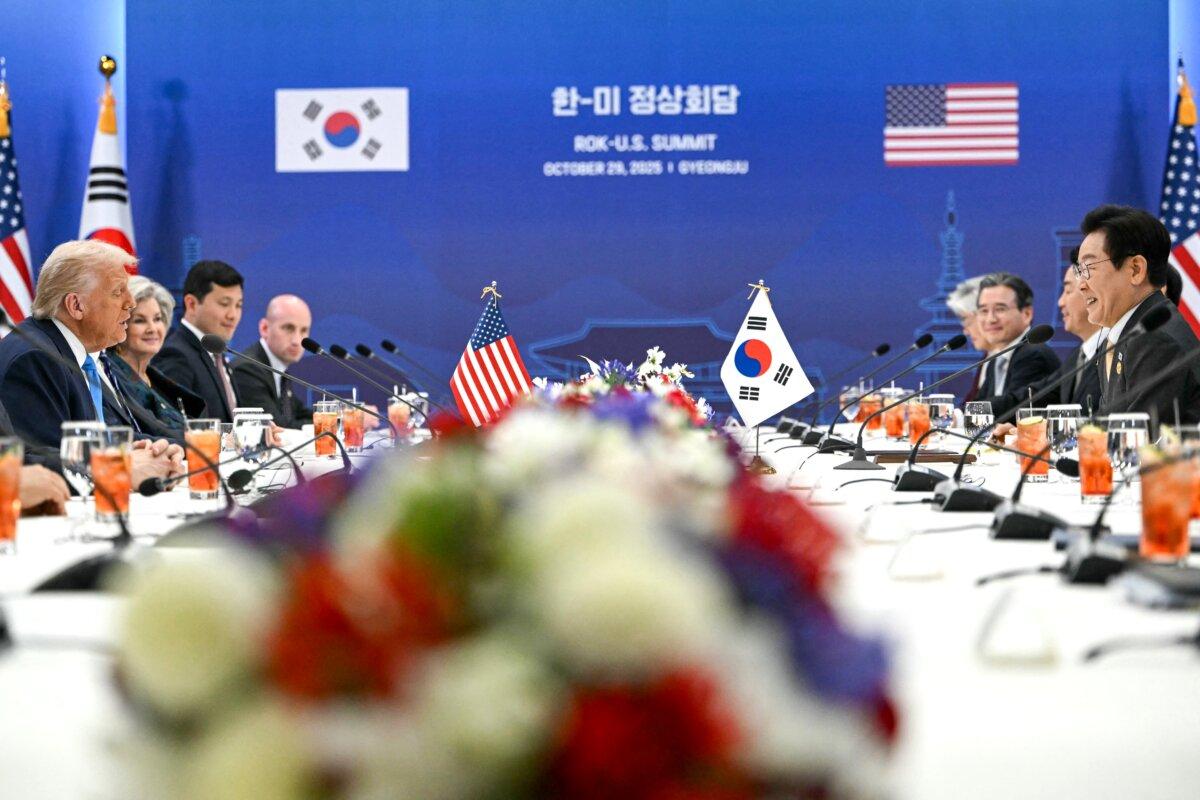
Trump ordered the resumption of nuclear testing ahead of a meeting with Chinese President Xi Jinping on Wednesday in South Korea’s southern port city of Busan. He said via his Truth Social network that the process of testing “will begin immediately” to be “on equal basis” with other countries that have “testing programs.”
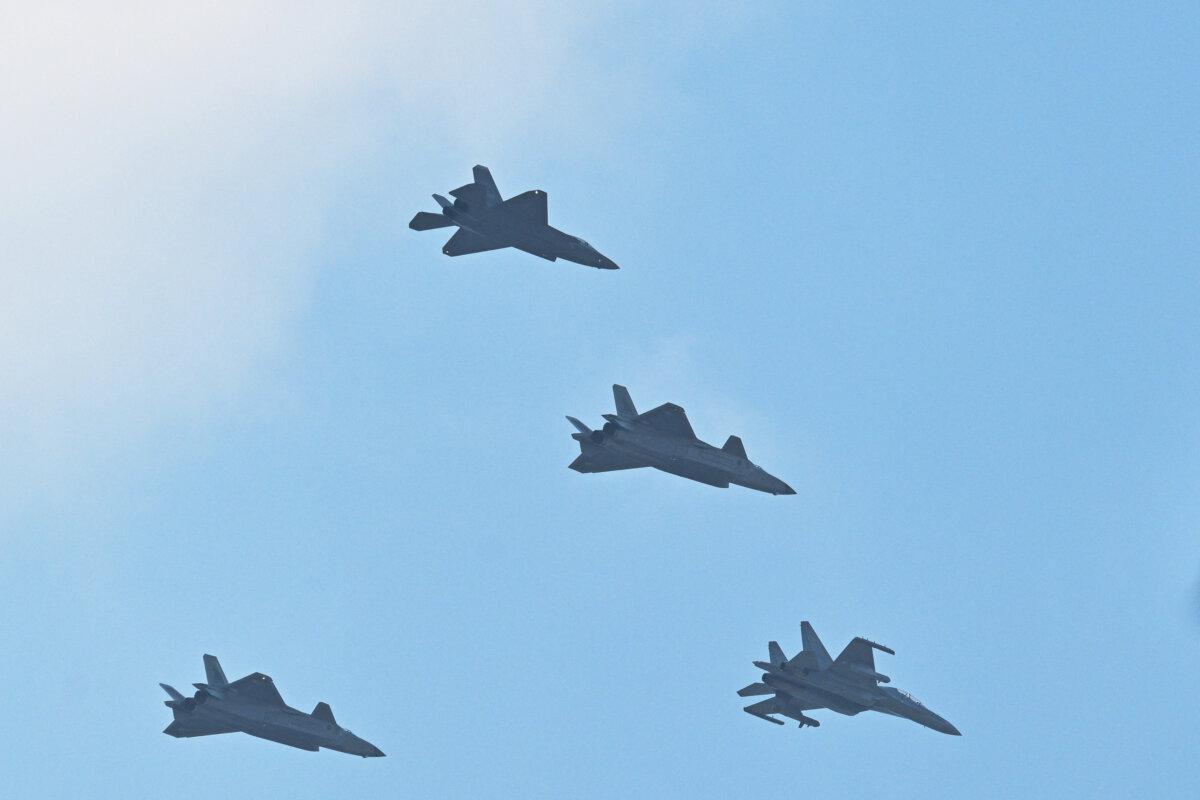
Aside from naval, missile, and nuclear advancements, China is the second nation after the United States to develop an operational fifth-generation stealth aircraft beginning with its first one, J-20, which entered service in 2017.
China unveiled its newest fifth-generation stealth fighter jet, the J-35A, at an aerospace show held in its southern city of Zhuhai in the Guangdong province in November 2024.
Despite these developments, China’s military is not yet in a position to overtake the United States in military superiority, according to Miles Yu, a senior fellow and director of the China Center at Hudson Institute.
Gao said at a forum held in Manila in September that China “enjoys military superiority above the United States” as he touted a military parade that Beijing held at Tiananmen Square in September.
He added: “If you want to have war, you will get war. If you want to destroy China, you will be destroyed. If you want to impose nuclear war on China, you will be wiped out by nuclear war.”
Yu, who also serves as a professor of East Asian and military and naval history at the U.S. Naval Academy in Annapolis, Maryland, said, “Much of China’s bombastic display of its weapons in Tiananmen Square lately is work-in-progress, half-finished concept prototypes of little practical utility.”
Yu added: “China’s military technology is critically dependent on Western technology and parts. China’s pervasive copycat culture does not produce high-quality weapons.
“China’s nuclear weapons cannot match the U.S. nuclear power in the slightest sense, in lethality, number of warheads, and technical designs. And the U.S. missile defense capabilities are far more advanced than what the CCP propagandists such as Gao can possibly imagine.”
The CCP is an acronym for the Chinese Communist Party.
Gao, a Yale-educated Chinese scholar, said at the forum that a missile displayed at the parade “can contain 60 nuclear warheads plus one hydrogen bomb.”
He added, “That ICBM can cover every corner of the world in less than 20 minutes and destroy any target in any corner of the world without any possibility of being intercepted.”
The missile he mentioned probably refers to the Dongfeng-61 (DF-61) ICBM, according to Peters, who formerly served as the lead strategist at the Defense Threat Reduction Agency.
However, Peters said that “the numbers are way off.”
He added, “The DP-61, at the most, could carry eight warheads—not 60” and emphasized the importance of building the Golden Dome to shield against an attack that could potentially overwhelm U.S. missile defenses.
.
What's Your Reaction?
 Like
0
Like
0
 Dislike
0
Dislike
0
 Love
0
Love
0
 Funny
0
Funny
0
 Wow
0
Wow
0
 Sad
0
Sad
0
 Angry
0
Angry
0















Comments (0)