

China’s Youth Unemployment Continues to Worsen, According to Data


.
China’s youth unemployment rate climbed to a record high in August, with nearly one-fifth of young people not in school being out of work. Analysts say the problem stems from structural issues in the Chinese economy, suggesting the crisis could persist for years.
The communist regime’s National Bureau of Statistics published unemployment rate data for different age groups on Sept. 17, showing that the unemployment rate of the 16-24 year-old labor force, excluding students, was 18.9 percent in August, 1.1 and 0.1 percentage points higher than in July and the same period in 2024 respectively, the highest since the data was released in December 2023.
The unemployment rate of the 25-29 year-old labor force rose by 0.3 percentage points to 7.2 percent, 0.3 percentage points higher than the same period last year; the unemployment rate of the 30-59 year-old labor force, excluding students, was 3.9 percent, the same as in July and the same period in 2024.
Since December 2023, the National Bureau of Statistics has revised the methodology for surveying unemployment rates by age group, excluding students in school from the data and splitting the labor force aged 25-59 into two age groups: 25-29 and 30-59.
The youth unemployment rate and the urban unemployment rate have risen for two consecutive months. The rise in the youth unemployment rate contributed to a 0.1 percentage point increase in the national urban surveyed unemployment rate to 5.3 percent in August, remaining unchanged from the same period last year, according to the official data.
Meanwhile, the number of college graduates in China this year is expected to reach a new high of 12.22 million, an increase of 430,000 from last year, which will exacerbate China’s ongoing unemployment crisis.
The youth unemployment rate reached a record high in August, even after excluding students, which suggests that even adjusted and narrowed-down statistics cannot mask the deteriorating employment situation, Davy J. Wong, a U.S.-based economist, told The Epoch Times.
“Graduation season, coupled with job losses, has also led to rising unemployment among those aged 25-29, suggesting that businesses are practically putting the brakes on creating new jobs,” he said.
As to the credibility of the ruling regime’s official data, Wong said that the official figures are “reliable but conservative, excluding a large number of those in ‘flexible employment’ and ‘discouraged job seekers,’ so the true level of unemployment is likely higher.”
He added that the overall unemployment rate of 5.3 percent “appears stable”, but it’s actually “an illusion of the average, and the real pressure is on young people and those entering the workforce.”
“The stable unemployment rate for those aged 30-59 is due to the strong retention of existing jobs; the worsening youth unemployment is because of the stagnation of new job creation,” he said.
System Under Pressure
The unemployment rate continues to hit new highs primarily due to two factors, which will likely cause the unemployment issue to persist for years, even decades, Xu Zhen, a senior professional in China’s capital market, told The Epoch Times.“China currently faces two major challenges. First, it faces a balance sheet recession compounded by a deflationary spiral and an aging population. This manifests itself in high debt levels in real estate projects, including those by the government, companies across the entire real estate supply chain, and individuals,” Xu said.
In new-energy sectors like photovoltaics, wind power, electric vehicles, and chips, “these industries are capital-intensive, technology-intensive, and talent-intensive, resulting in high debt ratios,” he said. “This high level of debt across society has resulted in businesses being hesitant to invest and individuals being hesitant to consume, instead saving to pay off their loans. The deflationary spiral and aging population will also result in shrinking investment and reduced consumption. This has led to the failure of the Chinese communist regime’s internal circulation strategy.”
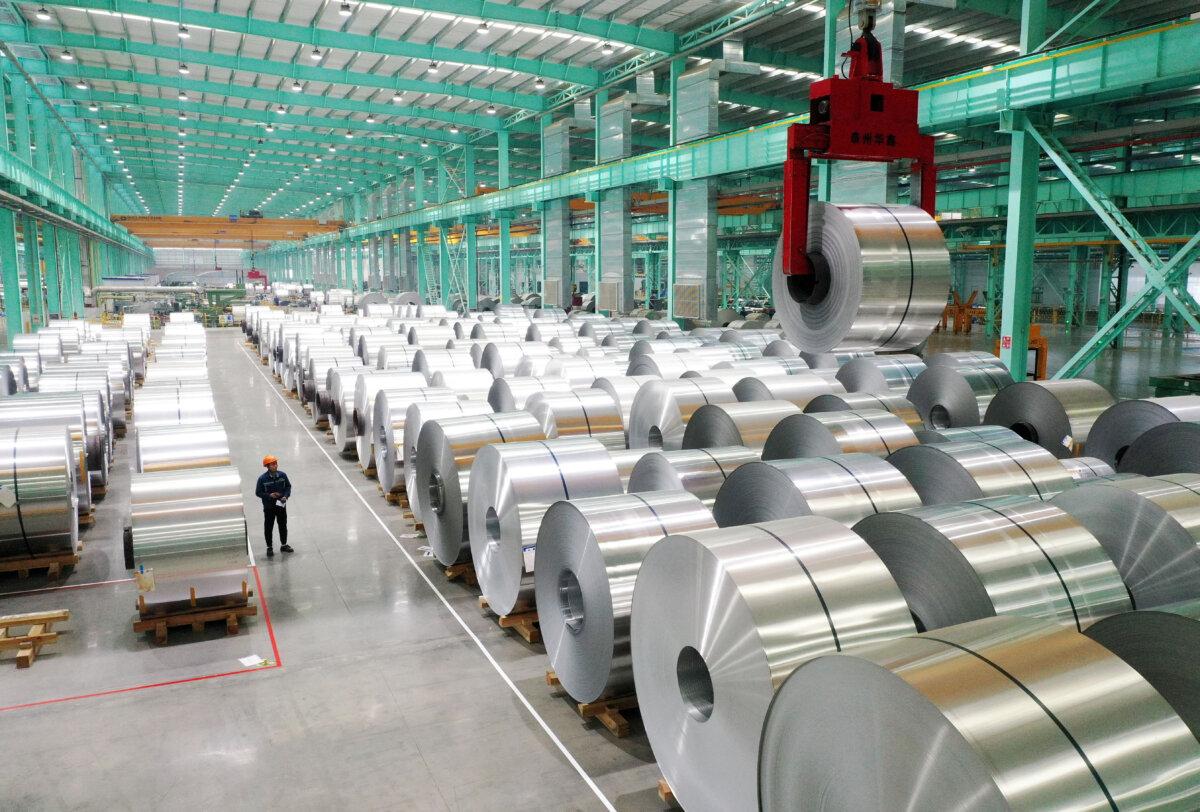
The other factor that has caused the high unemployment rate to persist is that the trade war with the West has led to weakened external demand, Xu said.
“China’s global dumping of excess production capacity has impacted industries in Europe and the United States, among other countries,” he said.
Coupled with the regime weaponizing rare earths and key chemicals, he said, “the world has clearly seen the CCP’s intentions to dominate the world.” Consequently, European and American countries are curbing China’s exports, Xu said, “under this pressure, a wave of export companies has gone bankrupt.”
.
The Chinese regime may need to issue more focused subsidies to achieve its targeted 5 percent GDP growth in the fourth quarter of this year, Wong said.
Xu is more skeptical about the Chinese regime’s official numbers. “The GDP and unemployment data are merely a facade to maintain its political stability and are not very credible,” he said, adding that “the current policy of encouraging college students to enter the domestic service industry is a reflection of this reality.”
Hidden Unemployment
Post-COVID, a large number of young Chinese people haven’t been able to find a job or to gain a foothold in the workplace amid China’s sluggish economy. They have chosen to return to their hometowns to serve as “full-time children or grandchildren” at home, taking care of elderly family members in exchange for free food, free housing, and pocket money from their parents or grandparents, forming a new social phenomenon.
Peking University Associate Professor Zhang Dandan wrote in an article in 2023 that if the approximately 16 million young people who are not working, such as those who are simply doing nothing and relying on their parents, are considered unemployed, the actual youth unemployment rate in March 2023 could reach as high as 46.5 percent, far higher than the official figure of 19.7 percent.
Wong warned that “If private enterprise expectations are not quickly restored, public service jobs are expanded, and direct subsidies are not provided to first-time employees, the unemployment problem will evolve into a social mobility gap and a crisis of trust.”
What's Your Reaction?
 Like
0
Like
0
 Dislike
0
Dislike
0
 Love
0
Love
0
 Funny
0
Funny
0
 Wow
0
Wow
0
 Sad
0
Sad
0
 Angry
0
Angry
0














Comments (0)