.
China’s exports surged in July and topped market expectations, as a decline in shipments to the United States was offset by strong exports to the Southeast Asian nations and other markets, according to official data.
Outbound shipments rose by 7.2 percent in July from a year earlier, China’s General Administration of Customs said on Aug. 7. The figure was better than the 5.4 percent growth tipped by a Reuters poll of economists and represented an improvement from the
5.8 percent growth reported in June.
Shipments to the United States, however, dropped for the fourth consecutive month, falling by 21.7 percent in June from a year earlier, according to calculations made by The Epoch Times based on official data.
In contrast, exports to the Association of Southeast Asian Nations (ASEAN)—where Chinese manufacturers have set up factories to
circumvent U.S. trade restrictions—rose by 16.6 percent last month. Among them, outbound shipments to Vietnam surged by 27.9 percent, while exports to Indonesia increased by nearly 12 percent.
Meanwhile, China’s exports to the European Union recorded a 9.2 percent increase over the same period.
Xu Tianchen, senior economist at the Economist Intelligence Unit, said in a note that China’s trade data suggested that Southeast Asia economies “play an ever more important role in U.S.–China trade.”
“I have no doubt Trump’s transshipment tariffs are aimed at China, since it was already an issue during Trump 1.0,” he said.
“China is the only country for which transshipment makes sense, because it still enjoys a production cost advantage and is still subject to materially higher U.S. tariffs than other countries.”
China’s customs data came on the same day that U.S. President Donald Trump’s new tariffs on dozens of nations
took effect. Several Asian countries, including Vietnam, the Philippines, and Indonesia, were hit with levies ranging from 19 percent to 40 percent. His executive order also targets indirect shipments, imposing a 40 percent tariff on transshipped goods, along with additional fees and penalties.
.
Exports remain a vital growth driver for China, the world’s second-largest economy, especially amid weak domestic demand and a persistent slump in the real estate sector. In the first half of this year, nearly
one-third of China’s economic growth came from exports, according to a top official at the country’s National Statistics Bureau.
In July, China’s imports rose by 4.1 percent year over year, customs data show, surpassing economists’ estimates and accelerating from the 1.1 percent growth reported in June.
That pushed the trade surplus to $683.5 billion for the year so far, representing a nearly 32 percent increase from the same period last year.
The widening gaps between China’s imports and exports, coupled with the Chinese regime’s trade-distorting practices such as
intellectual property theft, have stoked tensions with major trade partners. During a July visit to Beijing, European Union chiefs
pressed the Chinese communist regime to address the trade imbalance, saying that the bloc’s trade deficit with China had reached 305 billion euros ($358 billion) in 2024. Trump also pointed to the massive trade imbalance as a primary reason for charging extra taxes on Chinese products.
.
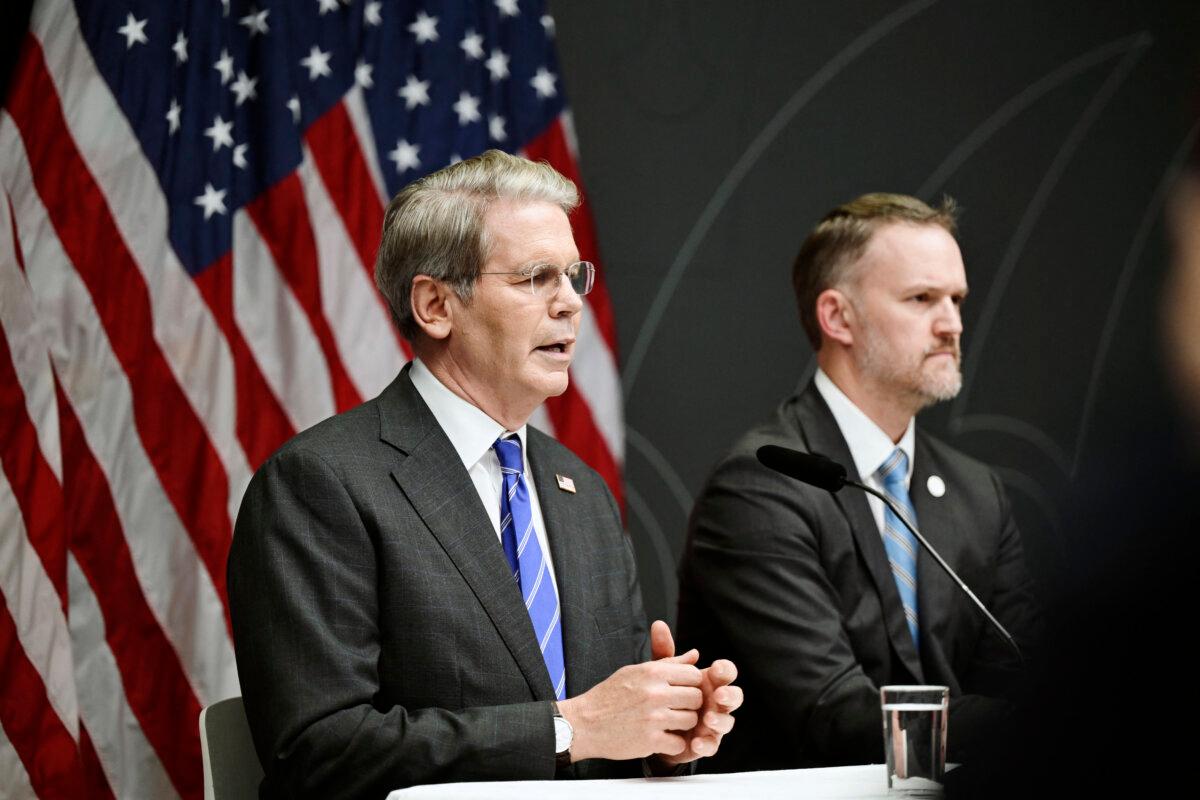
U.S. Treasury Secretary Scott Bessent (L) and U.S. Trade Representative Jamieson Greer address a press conference in Rosenbad after the trade talks between the United States and China concluded, in Stockholm, Sweden, on July 29, 2025. Magnus Lejhall/TT News Agency/AFP via Getty Images
.
At present, Chinese goods are subjected to a 20 percent U.S. tariff—aimed at pressuring Beijing to take concrete measures to stop the incoming flow of
fentanyl—in addition to a 10 percent baseline levy that is generally placed on all of America’s trading partners.
.
These tariffs are set to sharply increase unless China reaches an agreement with the Trump administration ahead of the Aug. 12 deadline. Following the latest round of high-level
talks in Stockholm last month, a Chinese trade official said the two sides agreed to extend the 90-day tariff pause. However, U.S. negotiators indicated that any trade agreement would require Trump’s approval.
.
In an interview with CNBC on Aug. 5, Trump
said his administration is getting “very close to a deal” with China.
Trade
data released by the United States earlier this week show that the United States’ trade deficit with China shrank to the lowest in two decades, standing at $9.5 billion in May.
However, China’s latest customs data show that its exports to the United States still exceeded the imports of American goods by a substantial $23.7 billion in July.
The reliability of statistics published by Beijing has long faced skepticism, due to the Chinese Communist Party’s
record of concealing information deemed harmful to its image. For example, in a recent
interview with The Epoch Times, a government employee in Guangdong, China’s export hub, recounted how authorities manipulated animal farming statistics to meet economic growth targets.
.
Reuters contributed to this report.
.




 Like
0
Like
0
 Dislike
0
Dislike
0
 Love
0
Love
0
 Funny
0
Funny
0
 Wow
0
Wow
0
 Sad
0
Sad
0
 Angry
0
Angry
0















Comments (0)