

China’s Baidu to Deploy Its Self-Driving Taxis Globally Through Deals With Lyft, Uber
China’s Baidu to Deploy Its Self-Driving Taxis Globally Through Deals With Lyft, Uber - Experts warn of the security risks with the the overseas deployment of the China-made electric robotaxis.

.
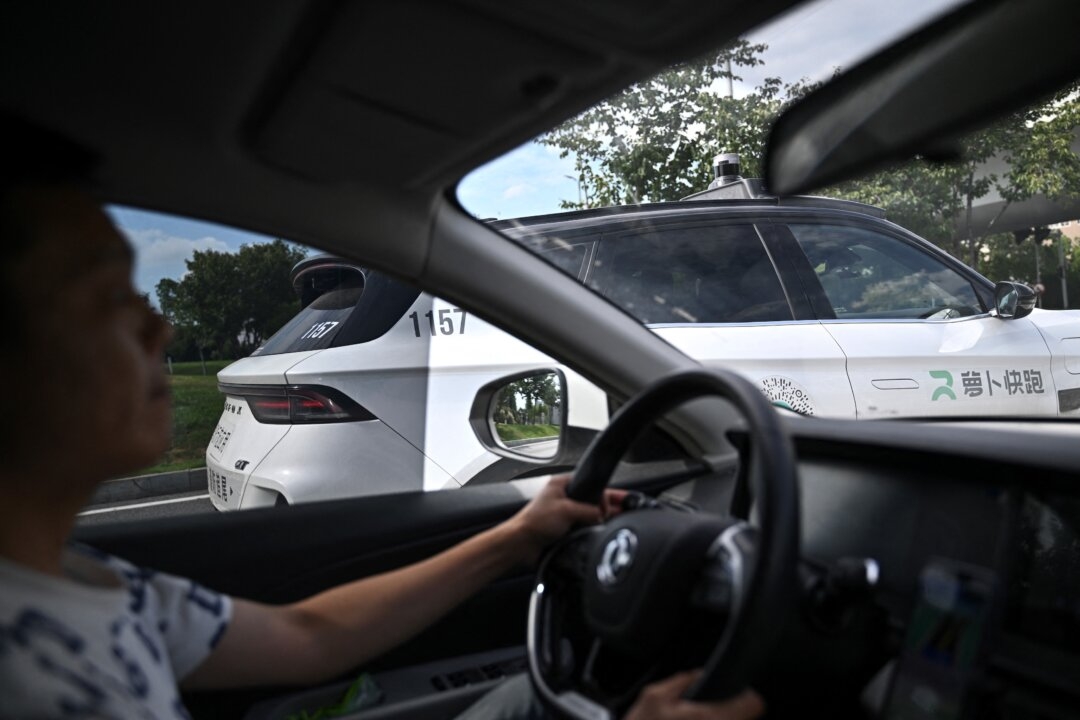
The “Google of China,” Baidu, and U.S. ride-hailing company Lyft announced on Aug. 4 that they have reached a deal to deploy self-driving taxis in Europe next year.
The plan, which is still pending regulatory approval, is to use Baidu’s electric RT6 robotaxis to operate on Lyft’s platform. The service will first launch in the UK and Germany.
The two companies aim to deploy thousands of China-made vehicles across Europe in the coming years. Lyft has access to operations in nine countries and over 180 cities in Europe, after its recent acquisition of European mobility app FreeNow.
The deal with Lyft comes just weeks after Baidu signed a similar agreement with Uber. On July 15, the owners of China’s largest search engine and Uber reached a deal to deploy Baidu’s Apollo Go autonomous vehicles across Uber’s multiple global markets outside of the United States and mainland China, where Uber cannot operate after it agreed to hand over some of its intellectual property to China-based rival Didi.
“The first deployments are expected in Asia and the Middle East later this year,” announced Uber in its press release.
By partnering with Uber, Baidu has found a widely used platform that operates in 15,000 cities globally.
“As the world’s largest platform of its kind, spanning mobility, delivery, and freight, Uber is uniquely positioned to help AV leaders like Baidu bring their autonomous technology to the world,” Uber CEO Dara Khosrowshahi said in the press release.
Since 2021, Baidu has been operating its own self-driving taxi service, Apollo Go, in major Chinese cities, including Beijing. Users can hail a ride through its app.
.

Baidu has been expanding into overseas markets rapidly this year. In May, it announced a partnership with the Roads and Transport Authority of Dubai to launch autonomous driving services in the city. Baidu will first deploy 100 Apollo Go autonomous vehicles to the UAE by the end of 2025—its first international deployment. It aims to expand to 1,000 vehicles by 2028.
Baidu’s partnership with Lyft and Uber “aims to enhance its global brand influence and to seize opportunities to expand in the international smart mobility market to compete with American giants like Waymo and Cruise, and South Korea’s Pony.ai,” Sun Kuo-hsiang, a professor of international affairs and business at Nanhua University in Taiwan, told The Epoch Times on Aug. 5.
However, the entry of China-made self-driving car fleets into Europe is likely to spark political and security controversy amid the ongoing tech and trade disputes between China and Europe, and between China and the United States, Sun said.
With Europe and the United States taking up de-risking policies in relation to the national security risks posed by China’s ruling Chinese Communist Party (CCP), “regulators in the European Union and the UK are generally cautious about Chinese companies’ involvement in data and transportation infrastructure.
Safety and Security Risks
Baidu’s electric self-driving cars use cloud remote control, which allows for remote monitoring and direction, Sun said.“This type of functionality is considered highly risky and is not recommended in the European and American self-driving car industry, as remote intervention can pose significant risks due to network latency or exploitation,” he explained.
.

In addition, the Chinese-made self-driving vehicles are equipped with various data collection features, including facial recognition, driving history, and user app management, which Sun said raises concerns over Beijing’s potential access to collected data.
“There are concerns that personal and behavioral data may be collected by the Chinese government as required by Chinese security laws. Chinese authorities could demand that Chinese companies hand over user data, posing a threat to personal privacy,” Sun said.
U.S.-based China affairs observer Wang He warned of another type of risk posed by Baidu’s electric self-driving cars. Autonomous vehicles have many sensors and “automatically capture a large number of terrain images for the unmanned driving,” which may include images of sensitive areas and sensitive data in other countries, Wang said. These may be transmitted back to China.
Luo Ya and Reuters contributed to this report.What's Your Reaction?
 Like
0
Like
0
 Dislike
0
Dislike
0
 Love
0
Love
0
 Funny
0
Funny
0
 Wow
0
Wow
0
 Sad
0
Sad
0
 Angry
0
Angry
0
















Comments (0)