

2026 Threat Assessment Decenters China, Underscoring Adversary Cooperation

.
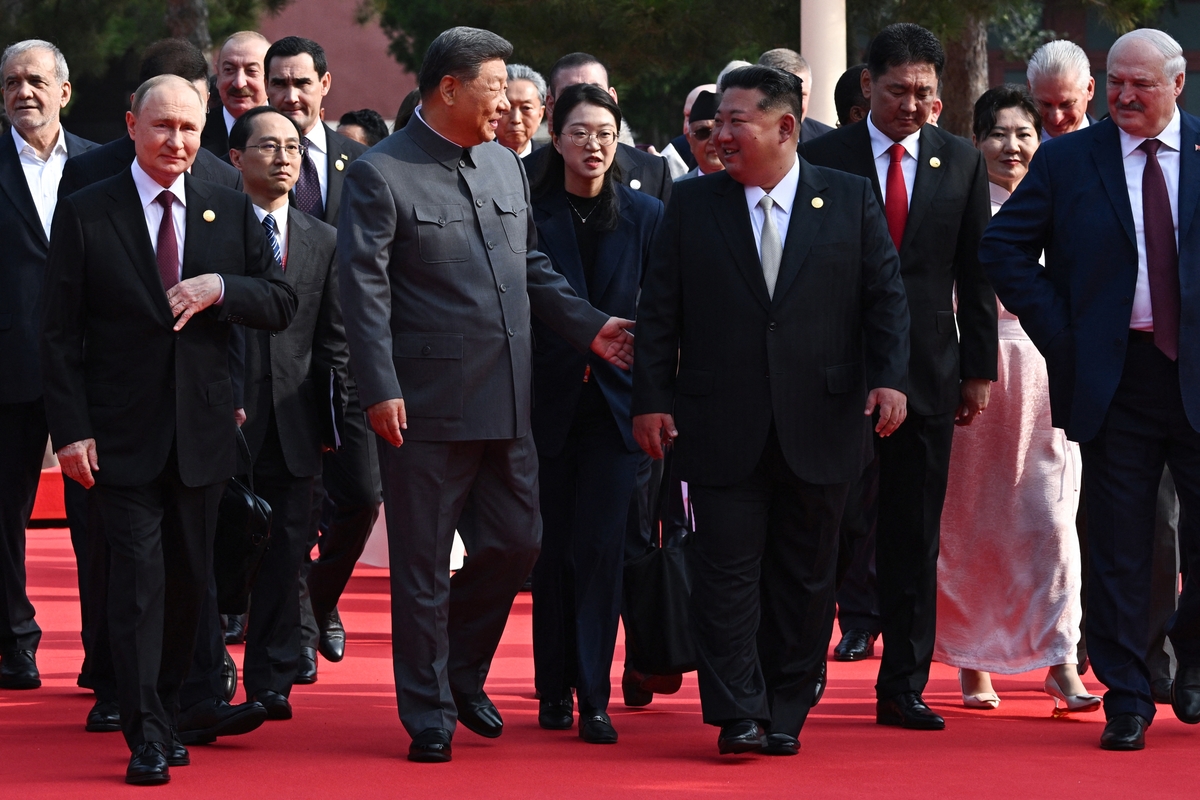
“Selective cooperation among China, Russia, Iran, and North Korea, driven by the common goal of balancing U.S. efforts and actions and supporting their own strategies, is bolstering the threat that each of them poses to the U.S.,” states the report, published on March 18, that coincided with two days of congressional testimony on threats to U.S. security.
The report notes that these nations do not have true alliances, and that “the concept of ‘adversary alignment’ overstates the depth of cooperation that is currently occurring.” It assesses that although the nations will continue to look for opportunities to collaborate, they also maintain “divergent interests as well as concerns over directly confronting” the United States, which “will constrain the actual scale and scope of their relationships.”
Weapons Development
China, Russia, North Korea, Iran, and Pakistan are researching and developing missile systems capable of hitting the United States, according to the report, with more than 3,000 such missiles currently and a projection of 16,000 such missiles by 2035.According to the report, despite the development of suicide drones, these nations “will continue to prioritize advanced missiles that can threaten the U.S.”
The United States’ “Golden Dome” missile defense project has likely affected the trajectory of adversary priorities, according to the report, and may be serving as a deterrence against Chinese action.
“Chinese officials probably fear that the Golden Dome for America will reduce Washington’s threshold for initiating military action against Beijing in a crisis, which is likely driving China to focus on using international arms control discussions, particularly on its space-based elements,” the report reads.
Space is becoming a less expensive and therefore more contested domain for the United States and adversaries, with China taking a recent lead against Russia as the top threat as sanctions deprive the Russian space industry of funding.
“Beijing’s rapid deployment of space capabilities positions it to use space to advance its foreign policy goals, challenge U.S. military and technological superiority in space, and project power on a global scale,” the report reads.
The low barrier of entry also means “a broader range of actors” can become a threat to the United States, with space-based disruption becoming more common and expected to “be normalized during crises or periods of strained relations between nations.”
This overlaps with cyberthreats, where China remains “the most active and persistent cyber threat to U.S. Government, private-sector, and critical infrastructure networks.”
Alliances, Tensions
The Chinese regime will seek to reduce tension with Washington “when they believe that such efforts benefit Beijing, protect China’s core interests, and buy time to strengthen its position,” according to the report.China is expected to continue to pursue dominance in critical minerals, energy storage systems, pharmaceutical ingredients, and drones, “working to maintain U.S. dependence,” while trying to reduce its own dependence on the United States in strategic areas including artificial intelligence and semiconductors.
In addition to cooperating with other U.S. adversaries when it benefits Beijing, it will also continue to court the “Global South” in areas of manufacturing and trade.
These efforts can strengthen other adversaries as threats against the United States, such as Chinese trade with Iran and Russia doubling as opportunities for Iran and Russia to evade the impacts of financial sanctions by the West.
China also continues to exert dominance in its region, increasing military aggression against neighbors Taiwan, the Philippines, and Japan.
.
What's Your Reaction?
 Like
0
Like
0
 Dislike
0
Dislike
0
 Love
0
Love
0
 Funny
0
Funny
0
 Wow
0
Wow
0
 Sad
0
Sad
0
 Angry
0
Angry
0














Comments (0)