

US and China Compete in AI-Enabled Combat Drones


.
The United States and China are locked in a technological arms race to dominate the future of warfare through AI-enabled drones, manned-unmanned teaming, and autonomous naval platforms that could redefine global military power.
The U.S. Navy recently awarded a contract to General Atomics Aeronautical Systems (GA-ASI) to design a collaborative combat aircraft, a next-generation unmanned fighter intended to operate alongside piloted jets. These semi-autonomous drones, often called “loyal wingmen,” will extend the range, strike capability, and survivability of human-piloted aircraft while reducing the risks to aircrews in high-threat environments.
Collaborative combat aircraft represent a major leap in the evolution of air power, blending artificial intelligence, autonomy, and human command. Designed to be modular, stealthy, and relatively low-cost, they can be quickly reconfigured for missions such as air defense, reconnaissance, or electronic warfare. Operating under human supervision, they enhance both the firepower and situational awareness of traditional fighter formations.
Their advantage lies in scale and cost. While training a single U.S. Air Force jet pilot can take six to seven years and cost between $5.6 million for an F-16 and more than $13 million for an F-22 pilot, thousands of unmanned aircraft can be produced and deployed in the same time frame at a fraction of the cost. Built for rapid manufacturing and mass deployment, these drones act as expendable extensions of piloted aircraft, capable of overwhelming enemy defenses through coordinated swarms or executing high-risk missions too dangerous for manned jets.
Another advantage of collaborative combat aircraft over human pilots is their ability to evolve as quickly as technology advances. Unlike manned aircraft, which are limited by training cycles and human endurance, AI-driven drones can be upgraded almost instantly through software and hardware updates. This allows militaries to continually refine combat performance, reaction time, and coordination across fleets without grounding aircraft or retraining personnel.
.
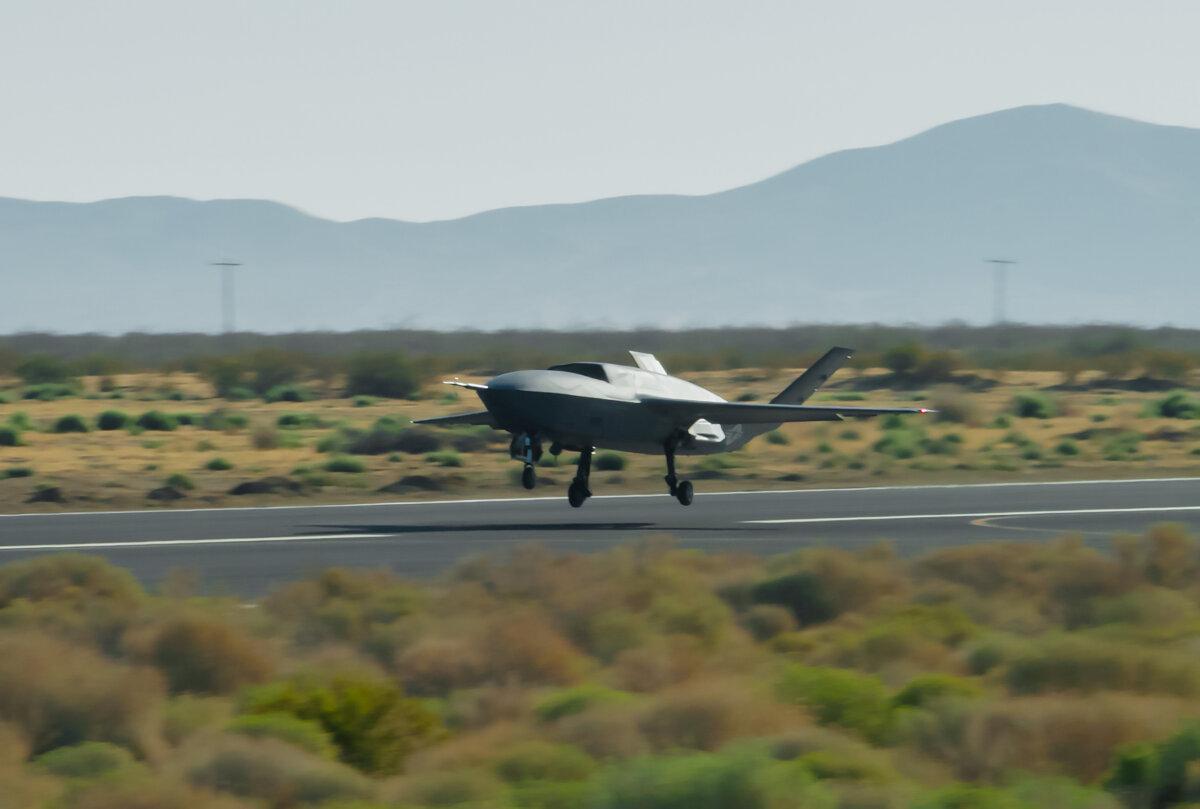
As the United States pushes forward with its collaborative combat aircraft program, China is rapidly advancing its own. During the Victory Day parade in Beijing on Sept. 3, China showcased a new generation of unmanned combat aircraft. The display included two large stealth drones, known as unmanned air superiority fighters, and at least two smaller collaborative combat aircraft drones modeled after American designs, such as the Kratos XQ-58A Valkyrie and the Boeing Ghost Bat. The exhibition revealed that Beijing is developing both cost-effective collaborative combat aircraft and high-end stealth drone fighters alongside its sixth-generation manned jets and new stealth bomber.
The larger Type B unmanned air superiority fighter resembles a single-engine stealth fighter and is believed to be capable of supersonic speeds. The smaller Type A version appears optimized for deployment from aircraft carriers. The parade also introduced an updated GJ-11 Sharp Sword stealth unmanned combat aerial vehicle with folding wings for carrier deployment, as well as a compact unmanned naval helicopter now in service.
The technological contest between the United States and China over high-end semiconductors adds a critical dimension to the race for collaborative combat aircraft. The United States retains a lead in chip design and research and development, a foundation for AI, autonomy, and next-generation weapons systems. U.S. export controls on cutting-edge chips aim to slow China’s access to the scale and speed of AI-driven systems. As collaborative combat aircraft and unmanned teaming depend on increasingly advanced sensors, processors, and connectivity, maintaining the United States’ semiconductor technology lead gives it an advantage over the Chinese People’s Liberation Army (PLA).
Having a larger and more advanced carrier fleet gives the United States a platform to implement manned-unmanned integration on a global scale. China may be rapidly expanding its carriers and improving training and doctrine, but the United States still leads in numbers, experience, and logistics.
Meanwhile, China is experimenting with new forms of unmanned power projection, including both aerial and sea-based “drone carrier” concepts. The Jiutian SS unmanned aerial vehicle is a high-altitude, long-endurance aircraft designed to carry and launch swarms of up to 100 smaller drones over thousands of miles. At the same time, China is developing the Type 076 amphibious assault ship, equipped with a full-length flight deck, electromagnetic catapult, and arresting gear, built to operate unmanned combat aerial vehicles and fixed-wing drones rather than traditional manned jets.
While the United States does not have the same large-scale drone “mothership” concept that China has unveiled, the U.S. Navy is pursuing a more practical version focused on maritime operations. In 2022, the Navy issued a call for proposals to build a low-cost, attritable unmanned vehicle mother ship, designed to tow or launch smaller unmanned vessels into contested waters. The vessel will be modular, GPS-guided, and capable of operating more than three nautical miles offshore, carrying or towing 20-foot containers loaded with smaller drones that can be released at designated drop zones.
While less grand in scale than China’s drone carrier ambitions, the U.S. Navy’s unmanned mothership program, combined with its collaborative combat aircraft development, underscores a broader shift in warfare toward autonomy, adaptability, and integrated manned-unmanned operations. Both countries are investing heavily in AI-driven systems that link air, sea, and space operations into unified networks.
Winning the AI-driven race for autonomous weapons is essential for the United States to preserve its position as the world’s preeminent military power. For now, the United States remains ahead in numbers and technology, supported by superior logistics, a vast satellite network, and an extensive system of overseas bases. But as with every new stage of military innovation, America must keep investing in defense technology, continuing to research, develop, and produce newer and more advanced weapons systems to stay ahead of the Chinese communist regime.
What's Your Reaction?
 Like
0
Like
0
 Dislike
0
Dislike
0
 Love
0
Love
0
 Funny
0
Funny
0
 Wow
0
Wow
0
 Sad
0
Sad
0
 Angry
0
Angry
0
















Comments (0)