.
U.S. President Donald Trump deserves the Nobel Peace Prize if he manages to persuade Chinese leader Xi Jinping to abandon the plan to annex Taiwan by force, Taiwan’s President Lai Ching-te said in a radio show broadcast on Oct. 6.
“China has been holding military exercises in the Taiwan Strait, undermining peace and stability in the region. So it is China—not Taiwan—that is disrupting the cross-strait status quo,” Lai
told The Clay Travis and Buck Sexton Show, according to a
transcript released by his office.
.
The Chinese Communist Party, which has never ruled Taiwan, views the island as a breakaway province and
refuses to rule out the use of force to bring it under its control.
To achieve this goal, the communist regime has ramped up
pressure on Taiwan across multiple fronts. That includes carrying out large-scale military drills and flying warplanes near the self-ruled island on a nearly daily basis, heightening concerns about a potential
war in the Taiwan Strait.
.
Trump told Fox News in an August
interview that Xi assured him Beijing would not take Taiwan by force during his time in office.
Lai, speaking on the radio show, expressed hope that Taiwan could continue to have Washington’s support.
“If he is able to convince Xi Jinping to permanently renounce the use of force against Taiwan, President Trump will surely win the Nobel Peace Prize,” Lai said.
The United States is bound by law to provide Taiwan with the means to defend itself and has made it clear that any attempt to change the status quo by force is
unacceptable. But U.S. administrations have been deliberately vague on how far it would go to defend the island in the event of a Chinese invasion.
China’s Expansion in Indo-Pacific
If given the chance to speak directly to Trump about Taiwan’s situation, Lai indicated he would bring up the Chinese armed forces
expanding their footprint across the Indo-Pacific.
“I would suggest that he take note of the fact that Xi Jinping is not just holding ever-larger military exercises in the Taiwan Strait but expanding China’s military deployment in the South and East China Seas,” Lai said.
.
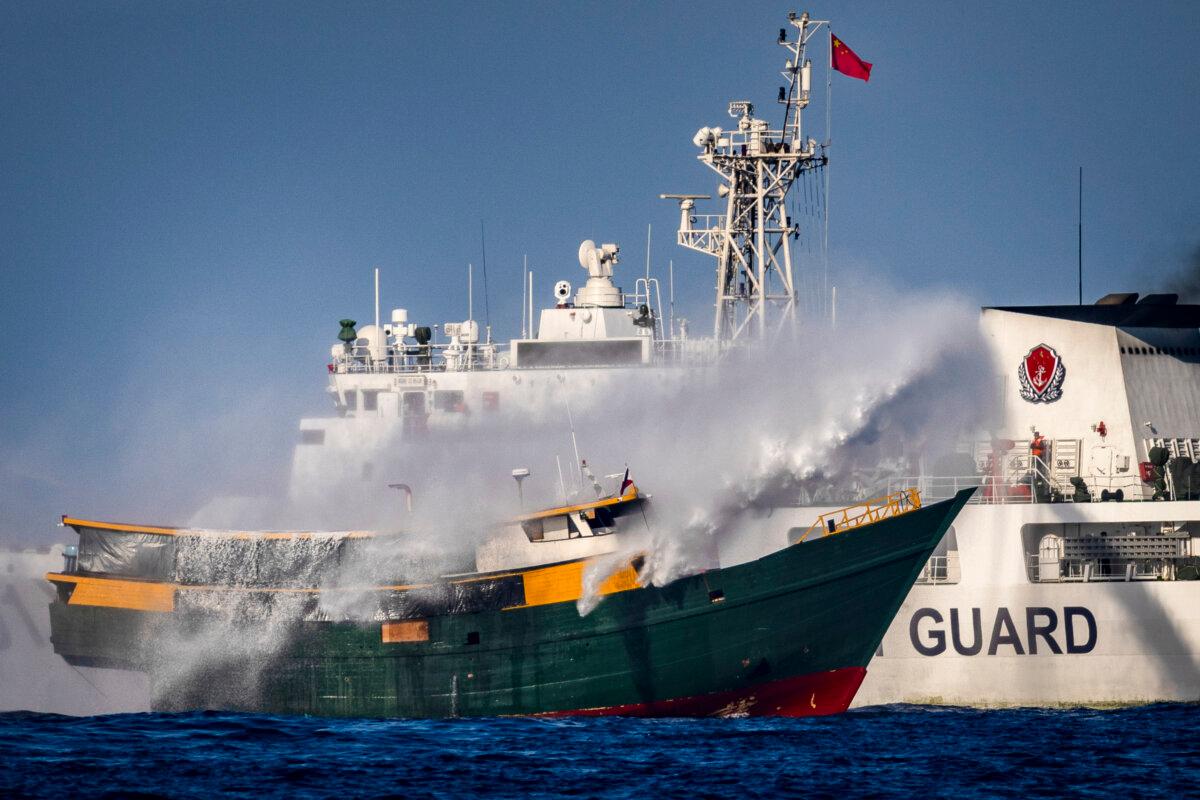
A Chinese Coast Guard ship fires a water cannon at Unaizah May 4, a Philippine Navy chartered vessel, conducting a routine resupply mission to troops stationed at Second Thomas Shoal in the South China Sea on March 5, 2024. Four Phillipine sailors were injured as the Coast Guard collided into two ships. Ezra Acayan/Getty Images
.
“China’s military exercises now extend across the Indo-Pacific region,” he continued. “Its aircraft carriers are moving beyond the first island chain and second island chain. And its northern fleet even sailed around Japan for a week. Chinese naval vessels also conducted live-fire exercises in Australia’s exclusive economic zone.”
On Oct. 7, the day Lai’s office released the interview’s transcript, Taiwan detected 23 military aircraft near the island, dispatched by the People’s Liberation Army (PLA) of China, according to the
defense ministry in Taipei.
Of that, 17 crossed the Taiwan Strait’s median line, an unofficial boundary drawn by the U.S. military decades ago to help de-escalate tensions between Taipei and Beijing. Taiwan also tracked drones and PLA vessels as Beijing carried out a “joint combat readiness patrol” in the air and sea around the island that day, the ministry added.
Lai cautioned that as the tensions escalate in the Indo-Pacific region, the issue goes beyond a potential invasion of Taiwan.
“If it is able to annex Taiwan, China will be in a stronger position to compete with the United States and alter the rules-based international order,” he said. “This would eventually also impact U.S. interests.”
.
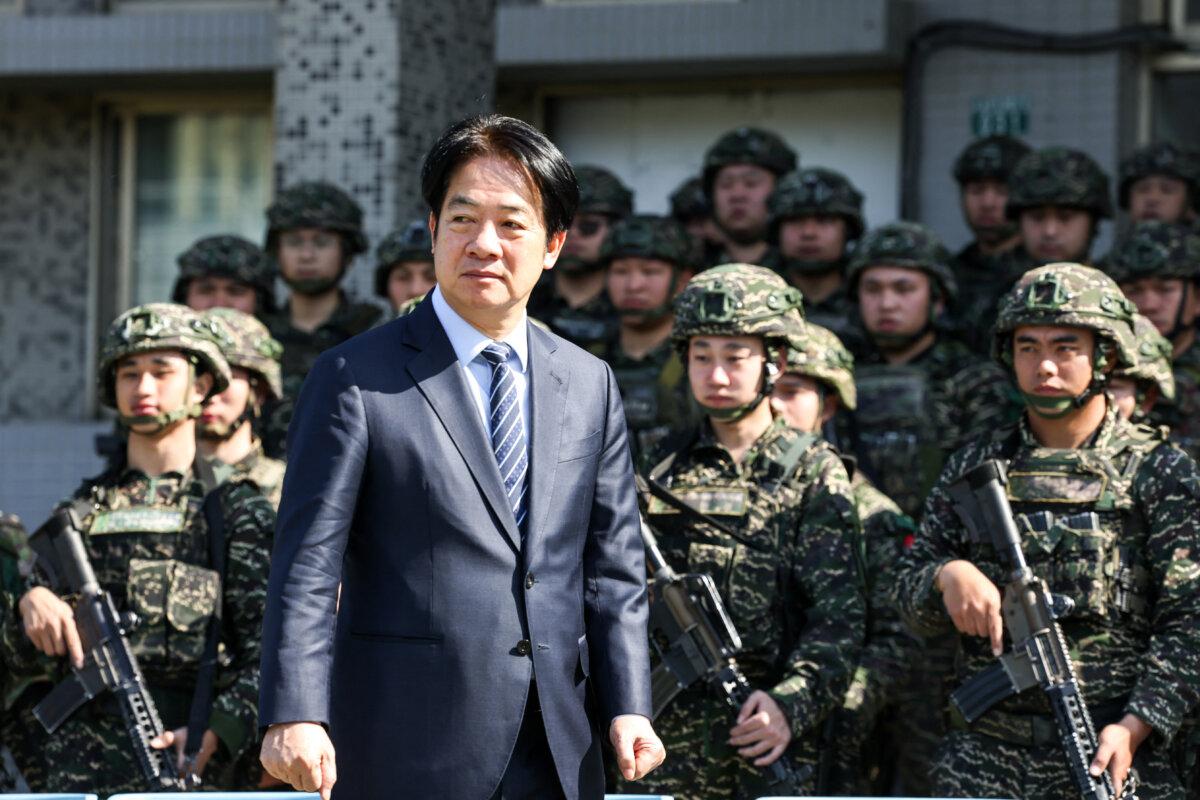
Taiwan's President Lai Ching-te inspects the troops taking part in the Rapid Response Exercise during a visit at the Songshan military airbase in Taipei on March 21, 2025. I-Hwa Cheng/AFP via Getty Images
.
Trump is expected to sit down with Xi in the coming weeks. The president
said in September that he would meet with Xi at the Asia-Pacific Economic Cooperation (APEC) summit, which is set to kick off in South Korea in late October.
Direct engagement between the U.S. and Taiwanese presidents is rare. One exception occurred in December 2016 when Trump accepted a
call from then-President of Taiwan Tsai Ing-wen after his first electoral victory. Trump is
believed to be the first U.S. president or president-elect to speak directly with Taiwan’s leader since 1979, when Washington switched diplomatic recognition from Taipei to Beijing.
Taiwan’s Deterrence
When asked how he would demonstrate to the American people Taiwan’s resolve to defend itself, Lai pointed to the government’s increased defense spending and robust civil defense, among other efforts.
Lai’s administration has
proposed to boost the defense budget to 3.32 percent of gross domestic product (GDP) in 2026 and aims to achieve 5 percent of GDP by 2030.
After Taiwan
designated the Chinese Communist Party as a foreign hostile force in March, efforts have been underway to amend national security laws to combat the regime’s infiltration and espionage activities. In September, the defense ministry
issued a new civil defense handbook, aimed at preparing its citizens for natural disasters and potential military invasion by Beijing.
“I would tell them that Taiwan is absolutely determined to ensure its own national security,” Lai said. “Only by helping ourselves can we expect help from others. And when we show unity and work together, that is when deterrence is at its strongest; and that is when we will be able to safeguard peace and stability in the world.”
.