

Seoul Before Beijing: U.S. and China Hold Last-Minute Trade Talks Before Historic Summit
Senior trade officials from the United States and China are meeting in Seoul, South Korea, on May 12–13 — just days before President Donald Trump travels to Beijing for a high-stakes summit with Chinese leader Xi Jinping. The talks are seen as a critical warm-up round ahead of what could be the most consequential U.S.-China diplomatic meeting in years.

.
A Stopover With Consequences
Before the big show in Beijing, there is Seoul. Chinese Vice Premier He Lifeng will travel to South Korea this week for trade talks with U.S. Treasury Secretary Scott Bessent — the final round of negotiations before Trump's state visit to China on May 14 and 15.
Bessent confirmed the meeting in a post on X, saying he would first meet Japanese officials in Tokyo before heading to Seoul for the discussion with He Lifeng.
The choice of Seoul as a neutral venue is no accident. South Korea maintains close security ties with Washington while simultaneously running deep economic relationships with Beijing — making it a geographically and diplomatically convenient middle ground for both sides.
Who Is He Lifeng?
A 70-year-old long-time confidant of Xi Jinping, He Lifeng has served as Beijing's lead negotiator on economic and trade affairs with Washington since taking office as vice premier in March 2023. He is, in effect, China's chief dealmaker on all things trade-related with the United States.
On the American side, Treasury Secretary Scott Bessent has become the administration's primary economic voice in these negotiations — a signal that Washington is treating the Seoul talks as serious diplomatic groundwork, not a formality.
What the Two Sides Will Discuss
The talks will be "guided by the important consensus" reached between the two heads of state at their meeting in Busan, South Korea, in October 2025, and in previous phone calls — addressing "economic and trade issues of mutual concern."
Those issues are substantial. The path to this meeting has been long and turbulent: after Trump introduced sweeping "Liberation Day" tariffs in early 2025, Beijing retaliated aggressively — raising levies on both sides beyond 100% and tightening restrictions on rare earth exports, a sector where China holds significant global leverage.
A breakthrough came at the Busan summit, where the two leaders agreed to a new trade truce. Under the deal, the U.S. scaled back tariffs while China committed to targeting illicit fentanyl trafficking, resuming American soybean purchases, and pausing rare earth export curbs.
The Bigger Picture: Trump Goes to Beijing
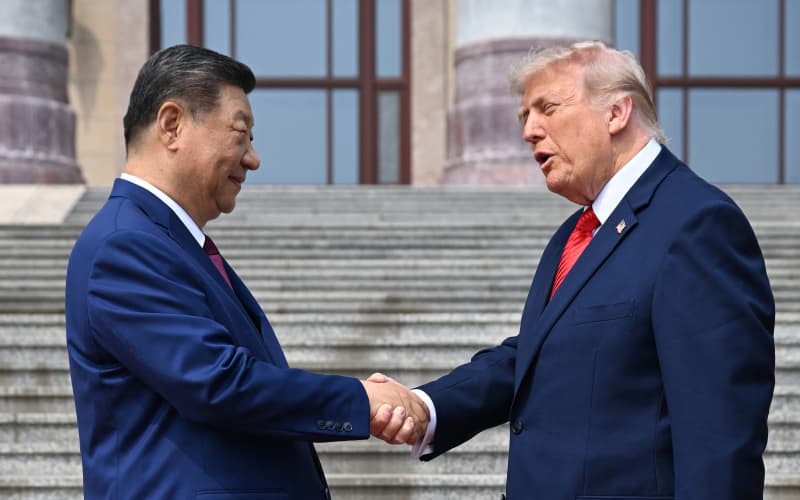
The Seoul meeting is a prelude, not the main event. Trump's upcoming visit to Beijing will mark the first visit to China by a U.S. president since November 2017 — when Trump last visited during his first term.
China's top priority heading into the summit is greater stability and predictability in the bilateral relationship, especially on tariffs. Beijing also hopes that successful leader-level engagement will sideline those within the Trump administration who favor a more confrontational approach.
The American side, for its part, is expected to push for tangible economic commitments. Washington is pushing for continued access to critical and rare earth minerals alongside major commercial deals — including a potential Chinese purchase of 500 Boeing aircraft and sustained imports of U.S. agricultural products.
Meanwhile, the war in the Middle East is likely to take center stage at the Trump-Xi summit as well, leaving less room to fully resolve trade issues like tariffs and rare earth supplies.
What Is Actually at Stake?
The Seoul talks and the Beijing summit combined represent a pivotal moment for the global economy. When Trump and Xi met in Busan in October 2025, they negotiated a one-year truce and agreed on guidelines aimed at stabilizing what both sides described as mutually beneficial economic relations. The truce expires in November 2026 — and with it, much of the political space that makes even limited cooperation possible.
Even so, Chinese exports to the U.S. have continued to fall, dropping by 11% year-on-year in early 2026. In response, China has increasingly diversified its trade relationships beyond the United States.
That context explains why both sides want this week to succeed. A collapse of the current diplomatic framework would send shockwaves through global supply chains, financial markets, and energy prices at a time when the world can barely afford more instability.
.
Sources
- Reuters – China's He to hold trade talks with US delegation in South Korea — https://www.reuters.com/world/china/chinas-he-hold-trade-talks-with-us-delegation-south-korea-2026-05-10/
- South China Morning Post – China, US confirm Seoul trade talks days before Trump-Xi summit in Beijing — https://www.scmp.com/news/china/diplomacy/article/3353067/china-us-confirm-seoul-trade-talks-days-trump-xi-summit-beijing
- World Economic Forum – US-China relations: What to expect from the Trump-Xi summit — https://www.weforum.org/stories/2026/05/what-to-expect-trump-xi-summit-china-us/
- CSIS – Trump-Xi Summit in Beijing: Managing the World's Most Important Relationship — https://www.csis.org/analysis/trump-xi-summit-beijing-managing-worlds-most-important-relationship
- CNBC – Iran focus at Trump-Xi summit may delay progress on tariffs, rare earths — https://www.cnbc.com/2026/05/08/iran-focus-at-trump-xi-summit-may-delay-progress-on-tariffs-rare-earths.html
- Brookings Institution – Beyond trade: Issues in a Trump-Xi summit — https://www.brookings.edu/articles/beyond-trade-issues-in-a-trump-xi-summit/
.
What's Your Reaction?
 Like
0
Like
0
 Dislike
0
Dislike
0
 Love
0
Love
0
 Funny
0
Funny
0
 Wow
0
Wow
0
 Sad
0
Sad
0
 Angry
0
Angry
0













Comments (0)