

Red Alerts, Closed Valleys: Northwest China Braces for New Wave of Floods and Landslides
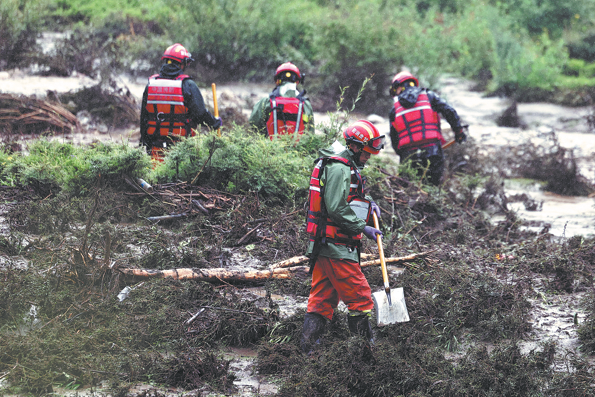
Authorities in China's Shaanxi and Gansu provinces have declared their highest-level weather emergencies, shutting down dozens of tourist sites and mountain valleys as torrential rain threatens to trigger fresh flash floods and landslides. The alerts come just weeks after similar disasters in the same region killed dozens of people, raising fresh questions about whether China's disaster-warning systems are keeping pace with an increasingly extreme monsoon season.*

.
Red Alert Over Xi'an
The ancient capital city of Xi'an, home to roughly 13 million people, raised its rainstorm warning to red — the highest level in China's four-tier system — on Thursday evening. Heavy downpours had already caused flooding in parts of the city, according to Chinese state broadcaster CCTV.
In response, authorities shut every valley along the nearby Qin Mountains, a popular hiking and sightseeing range, and temporarily closed several forest parks. The closures reflect a pattern that has repeated itself across China this summer: officials moving to seal off scenic, mountainous terrain the moment rainfall intensifies (a shift from years past, when many sites stayed open despite warnings).
.
Gansu Steps Up Its Response
Roughly 500 kilometers (300 miles) to the west, meteorological officials in Gansu province raised their emergency response level for heavy rain on Thursday, warning of a heightened danger of flash floods, landslides, and urban flooding, according to the state-run Xinhua news agency.
The province separately issued a red alert for geological disasters — the term Chinese authorities use for landslides, mudslides, and similar ground failures — in parts of Longnan city, citing a high risk over the following 24 hours. By mid-afternoon, 61 tourist attractions across Longnan had already been shut down, CCTV reported.
.
A Region Already Reeling
The new alerts land on a province still recovering from two deadly disasters in the space of three weeks. In early July, a landslide tore through a valley in Gansu and killed 21 people. Search-and-rescue teams needed weeks to complete the recovery effort.
Days later, flash floods swept through the Shuangshimen scenic area in Gansu's Weiyuan county, killing 10 campers and injuring 23 others after intense rainfall sent a mountain torrent through a narrow gully. More than 240 people had to be pulled from the area by rescue crews.
Independent reporting on the Weiyuan disaster noted that a yellow rain alert — the lowest of China's four warning levels — had been issued before the flood but appears to have gone largely unheeded by campers in the area, underscoring a recurring problem in China's disaster-response system: warnings exist, but enforcement and public compliance often lag behind.
.
A Pattern the Government Itself Has Acknowledged
Notably, Chinese authorities have not simply blamed the weather. Four national government departments jointly issued a directive this month acknowledging that the deadly Gansu and Chongqing landslides exposed real gaps in routine geological hazard inspections, including insufficient coverage of at-risk areas and failures to catch early warning signs in time.
That admission is unusually candid for a system that has often prioritized economic activity — including tourism revenue from scenic mountain sites — over caution during China's flood season. Critics of Beijing's governance model have long argued that local officials, under pressure to hit growth targets, are slow to close profitable attractions until disaster has already struck. This summer's rapid site closures in Xi'an and Longnan suggest at least a partial, reactive course correction, though it remains to be seen whether inspection and early-warning failures will be addressed structurally rather than site by site.
.
What Comes Next
China's Ministry of Water Resources has described the 2026 flood season — which typically peaks in late July and August — as "grim and complex," forecasting above-average rainfall across large parts of the country. Typhoon Noul, which made landfall in southern China in late July, has already contributed to a string of flood and landslide events stretching from Sichuan to Shaanxi.
With Xi'an under its highest alert and Gansu's emergency response freshly escalated, authorities in the region face a narrow window to prevent a repeat of July's fatal incidents. For residents and tourists alike, the closures of valleys and scenic parks — however disruptive — appear for now to be the primary line of defense.
.
Sources:
- Reuters — "Northwest China on high alert as heavy rain raises risk of floods and landslides," July 30, 2026: https://www.reuters.com/business/environment/northwest-china-high-alert-heavy-rain-raises-risk-floods-landslides-2026-07-30/
- Reuters — "At least 21 killed in landslide in China's Gansu province, rescue efforts end, Xinhua says," July 2026: https://www.reuters.com/business/environment/least-21-killed-landslide-chinas-gansu-province-rescue-efforts-end-xinhua-says-2026-07-08/
- The Star / Xinhua-Reuters — "Rain-triggered flash flood kills 10, injures 23 in China's scenic area of Gansu as Typhoon Noul makes landfall": https://www.thestar.com.my/aseanplus/aseanplus-news/2026/07/26/rain-triggered-flash-flood-kills-10-injures-23-in-china039s-scenic-area-of-gansu-as-typhoon-noul-makes-landfall
- RTHK — "Alerts up as deluge to hit Guangdong, other provinces," July 30, 2026: https://gbcode.rthk.hk/TuniS/news.rthk.hk/rthk/en/component/k2/1864328-20260730.htm
.
What's Your Reaction?
 Like
0
Like
0
 Dislike
0
Dislike
0
 Love
0
Love
0
 Funny
0
Funny
0
 Wow
0
Wow
0
 Sad
0
Sad
0
 Angry
0
Angry
0














Comments (0)