

Iran’s “Ghost Fleet” Slips Through the U.S. Blockade, Delivering Sanctioned Gas to China
Despite a tight U.S. naval blockade, a handful of small Iranian tankers are still getting sanctioned fuel out of the Gulf and onto Chinese markets. Investigators from the advocacy group United Against Nuclear Iran (UANI) filmed one of them, the SOGL, at a remote anchorage off Malaysia. The leaks are small, and Iran’s crude oil exports are mostly frozen. But the case shows how Tehran and its biggest customer, China, keep looking for loopholes.

.
A tanker caught on camera
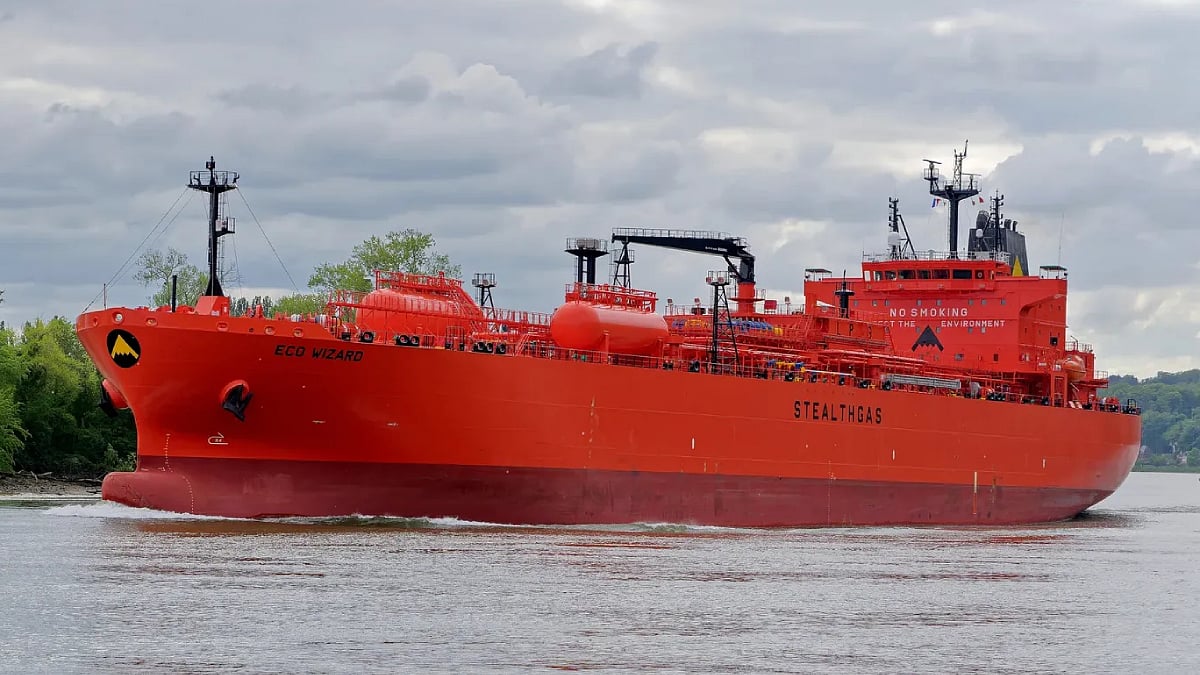
On September 16, UANI investigators chartered a supply vessel and sailed about 100 nautical miles into a waiting area off Malaysia's coast. There they filmed the SOGL, a small tanker riding low in the water under a full load of liquefied petroleum gas (LPG), the fuel used for cooking, heating and industry.
According to UANI, the ship had loaded roughly 500,000 barrels of Iranian LPG at Assaluyeh in late August and passed the U.S. blockade line on September 1. After a stop off Malaysia, where it was filmed taking on supplies, it continued to China and unloaded at Xinzhou Port.
The U.S. Treasury added the SOGL to its sanctions list on October 8, according to the reporting. The tanker has sailed under several flags and has been linked to a company named Gravion Maritime.
How the blockade works, and where it leaks
Washington imposed the blockade on Iranian ports on April 13. It was lifted in June after a draft understanding with Tehran, and reinstated on July 14 when that agreement collapsed, Reuters reported.
By most accounts it is working. UANI says it has not tracked a single laden Iranian crude tanker successfully leaving the Gulf of Oman since July. In September, only three small tankers crossed the line, carrying about 1.5 million barrels of LPG and methanol in total. China received no newly exported Iranian crude that month, by UANI's count.
The gaps are small and specific. U.S. forces focus on very large crude carriers, and their usual first step is to turn suspicious ships around. Using force against a tanker full of LPG, a highly flammable cargo, would be far riskier. Smaller vessels exploit this.
UANI analyst Jemima Shelley says the smugglers switch off their tracking transponders (AIS, which broadcast a ship's position), fly false flags and hide behind complicated front companies. Some cargoes are transferred from ship to ship in the Gulf of Oman before one vessel makes a run for open water. UANI counts eight or nine such small tankers since mid-July, depending on the tally.
The Malaysian hub
Most of these cargoes head to the Eastern Outer Port Limits anchorage, an offshore area about 70 kilometers from Malaysia's coast. Ships can wait there, refuel, take on food and supplies, and move cargo between tankers. UANI recorded dozens of such transfers there after the Iran war began on February 28.
Malaysian authorities have not simply looked away. UANI says enforcement actions around the anchorage shortly before its September investigation caused at least 25 ghost-fleet tankers to leave, though about 20 stayed and others moved farther north into the South China Sea. Iran's floating oil stocks at sea are reportedly shrinking fast.
Why China matters
China is the key outlet. According to Vortexa data cited by industry service OPIS, Iran supplied 9.62 million metric tons of China's 35.86 million tons of LPG imports in 2025, making it China's second-largest LPG source after the United States. Chinese buyers are often small independent "teapot" refineries, which Al Jazeera reported pay in renminbi through a Chinese payment system, keeping them largely outside the Western banking system.
Beijing has openly shielded this trade. In May, China's Commerce Ministry ordered a block on U.S. sanctions against five teapot refineries, calling the measures a breach of international law. Washington, for its part, says the blockade and sanctions target the regime's main source of revenue.
What to watch
The scale is modest next to Iran's pre-war exports, and UANI itself calls the blockade a clear success on crude. Still, each leak shows that sanctions enforcement depends on tracking small, evasive ships across thousands of miles of ocean. Further U.S. sanctions on tankers, front companies and Chinese buyers are likely, and pressure on Malaysia and other transit points will probably grow.
A caveat for readers: much of the detail comes from UANI, an advocacy organization that opposes the Iranian regime, and has not been independently verified in full. Beijing and Tehran have not publicly addressed this specific case in the sources reviewed.
.
Sources
- Fox News: "Iranian 'ghost fleet' filmed evading US blockade en route to China, UANI says" – https://www.foxnews.com/world/iranian-ghost-fleet-filmed-evading-us-blockade-en-route-china-uani-says
- Reuters (via Hydrocarbon Processing): "Iran ships some LPG, jet fuel despite U.S. blockade" – https://hydrocarbonprocessing.com/news/2026/10/iran-ships-some-lpg-jet-fuel-despite-us-blockade/
- gCaptain: "Iran's Offshore Oil Stockpile Nears Exhaustion as Blockade Chokes New Supply" – https://gcaptain.com/irans-offshore-oil-stockpile-nears-exhaustion-as-blockade-chokes-new-supply/
- UANI: "Iran War Shipping Update – June 9, 2026" – https://www.unitedagainstnucleariran.com/node/46273
- OPIS: "No LPG Tankers Cross Strait of Hormuz After US Blockade on Iranian Ports" – https://www.opis.com/resources/energy-market-news-from-opis/strait-of-hormuz-lpg-blockade-iran-ports/
- Al Jazeera: "China blocks US sanctions against five 'teapot' refineries" – https://www.aljazeera.com/economy/2026/5/3/china-blocks-us-sanctions-against-five-teapot-refineries
- Al Jazeera: "How China's 'teapot' refineries are cushioning it from Iran war oil crisis" – https://aljazeera.com/news/2026/4/3/how-chinas-teapot-refineries-are-cushioning-it-from-iran-war-oil-crisis
- U.S. Treasury press release on sanctions against Iranian LPG tankers – https://home.treasury.gov/news/press-releases/sb0502
.
What's Your Reaction?
 Like
0
 Dislike
0
 Love
0
 Funny
0
 Wow
0
 Sad
0
 Angry
0












Comments (0)