

Ancient Herbs, Modern Science: How Traditional Chinese Medicine Can Help Protect Your Eyes
Millions of people worldwide suffer from dry, tired, or strained eyes — often without realizing the damage has already begun. Traditional Chinese medicine offers a centuries-old perspective on eye health that modern research is increasingly taking seriously. From herbal teas to acupuncture, here is what science and ancient wisdom have to say.

.
Your Eyes Are Paying the Price for Screen Time
Most people don't think about their eye health until something goes wrong. But dry eyes, blurred vision, and chronic fatigue of the eyes are becoming increasingly common — and not just among the elderly. Prolonged screen use, poor sleeping habits, and nutritional gaps are quietly accelerating the decline of our vision.
Western medicine typically addresses the symptoms: artificial tears for dry eyes, corrective lenses for blurred vision, and surgery when things get serious. Traditional Chinese medicine (TCM) takes a fundamentally different approach. It focuses on the whole body — not just the eyes — and prioritizes prevention over intervention.
The TCM View: Eyes Are a Window to Your Inner Health
In TCM philosophy, the eyes are directly connected to the liver. The ancient medical text Huangdi Neijing — one of the foundational works of Chinese medicine — states that "the liver opens into the eyes." This means that poor liver function, insufficient blood circulation, or depleted kidney energy are believed to directly affect eyesight.
This is not merely poetic metaphor. TCM practitioners use this framework to treat conditions ranging from dry eyes to optic nerve weakness — by addressing the underlying systemic imbalance rather than just the symptoms in the eye itself.
Two Herbs With Surprising Science Behind Them
Astragalus — More Than a Folk Remedy
Astragalus (Huang Qi) is the dried root of a legume plant that has been used in Chinese medicine for thousands of years as an energy tonic. In TCM terms, it replenishes qi — the body's vital life force. But modern research is now shedding light on why it may also benefit the eyes specifically.
Multiple peer-reviewed studies have found that astragalus polysaccharides — the active compounds extracted from the root — show protective effects on the retina. Research published in the journal Molecular Medicine found that astragalus polysaccharides helped suppress cell damage in retinal tissue under high-glucose conditions, suggesting potential benefits for people at risk of diabetic retinopathy. A separate 2024 study published in Current Eye Research confirmed neuroprotective effects of these compounds on retinal ganglion cells.
Dendrobium — The Orchid That Nourishes the Eyes
Dendrobium is a stem from the orchid family used in TCM to nourish yin — the body's cooling, moistening energy — and support liver and kidney function. In TCM, dryness of the eyes is often attributed to a deficiency of this yin energy.
Modern clinical interest in dendrobium for dry eye disease is growing. A randomized, double-blind clinical trial currently being conducted by the Chinese University of Hong Kong — registered with ClinicalTrials.gov — is specifically investigating dendrobium caulis extracts as a treatment for dry eye disease. The researchers are comparing its effectiveness against other herbal compounds and standard artificial tear treatment.
A 2021 review published in Tzu Chi Medical Journal found that several TCM herbal therapies demonstrated meaningful improvements in dry eye symptoms — with minimal side effects compared to conventional pharmaceuticals.
The Eye-Refreshing Tea: A Simple Daily Ritual
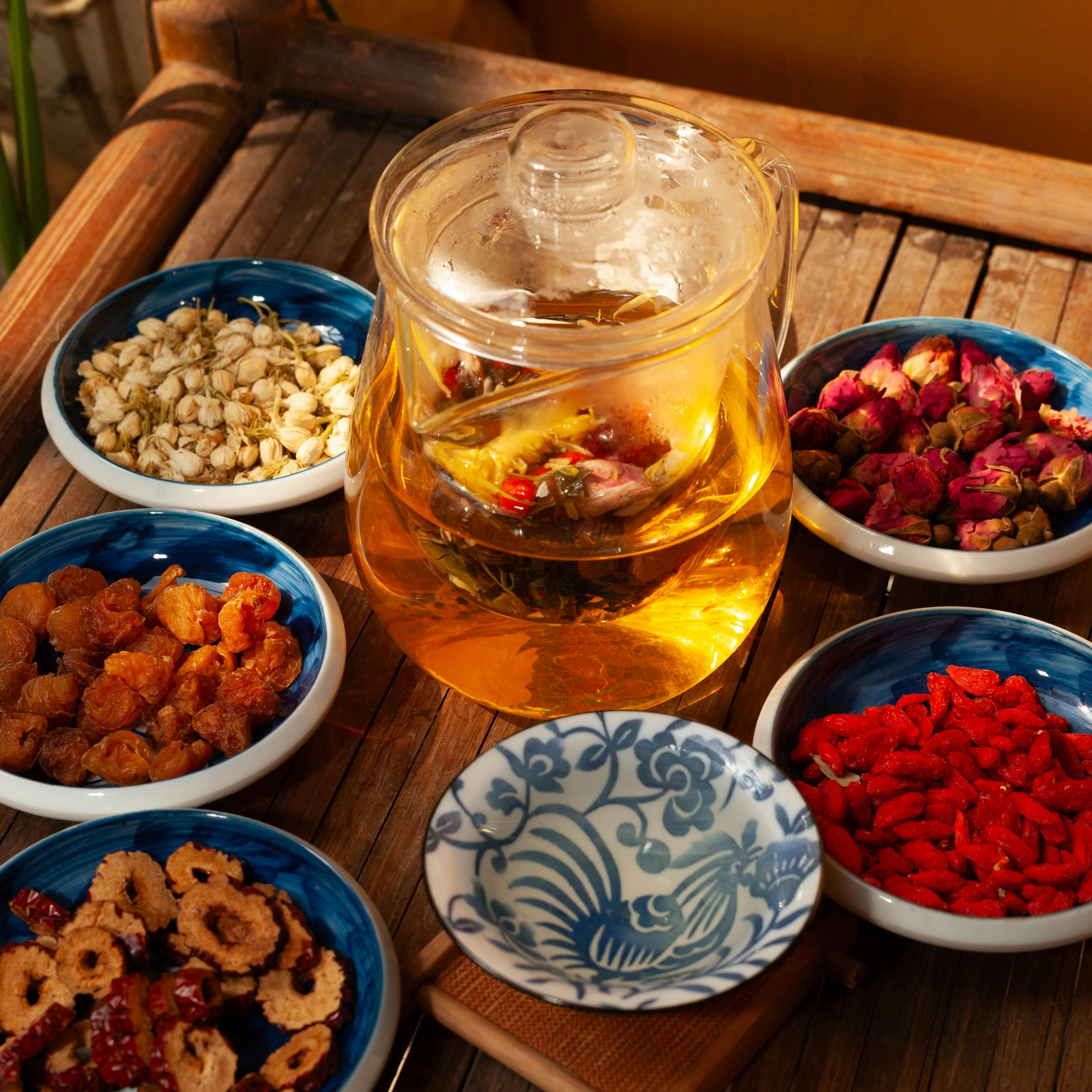
TCM practitioners frequently combine astragalus and dendrobium with two other well-known herbs: goji berries and chrysanthemums. Together, these four ingredients form a classic eye-protecting tea that is easy to prepare at home.
Why goji berries? A randomized clinical study from the University of California, Davis, found that participants aged 45 to 65 who ate a small daily serving of dried goji berries five times a week for 90 days significantly increased the density of protective pigments in their eyes — specifically lutein and zeaxanthin. These pigments act like natural sunscreen for the retina, filtering out damaging blue light and guarding against age-related macular degeneration (AMD), the leading cause of vision loss in older adults. Notably, participants who took commercial eye-health supplements over the same period showed no such increase.
Why chrysanthemums? Chrysanthemum flowers contain flavonoids and antioxidants that have long been used in TCM to soothe inflamed or irritated eyes and reduce redness.
Eye-Refreshing Tea — Recipe
Ingredients:
- 0.4 oz (approx. 11g) dried goji berries
- 0.2 oz (approx. 6g) dried chrysanthemum flowers
- 0.1 oz (approx. 3g) dendrobium stem
- 2 slices of astragalus root
- 3–4 cups of water
Preparation:
- Rinse all ingredients briefly under clean water.
- Add everything to a pot and bring to a gentle boil.
- Reduce heat and simmer for 15–20 minutes.
- Turn off heat, cover the pot, and let steep for an additional 20–30 minutes.
- Strain and drink warm — one cup daily is recommended.
Caution: Not suitable during a cold or fever. Pregnant or menstruating women should consult a healthcare provider before use.
Optional additions: For stress-related symptoms, red eyes, or high intraocular pressure, cassia seeds and prunella vulgaris (selfheal) can be added. Women in postpartum recovery or going through menopause may benefit from dried longan and red dates to address blood deficiency.
A Nourishing Herbal Porridge for Heavy Screen Users
For those who spend many hours in front of screens and experience eye strain, TCM also offers a gentle restorative dish. This porridge is designed to support digestion, replenish energy, and indirectly nourish the eyes — all of which are interconnected in the TCM framework.
Eye-Protecting Herbal Porridge — Recipe
Ingredients:
- 0.1–0.2 oz each of: astragalus (sliced), goji berries, dried mulberries, and fresh Chinese yam (peeled, diced)
- 4 pitted red dates
- 1 cup japonica rice
- 6–8 cups of water
Preparation:
- Rinse all ingredients thoroughly.
- Add astragalus slices to the water and bring to a boil. Simmer 20–30 minutes, then strain and discard the astragalus.
- Add all remaining ingredients to the herbal broth and bring back to a boil.
- Reduce to low heat and simmer 30–40 minutes, stirring occasionally, until the rice becomes a soft porridge.
- Serve warm — ideally for breakfast, two to three times per week.
Acupuncture: Where Ancient Practice Meets Clinical Evidence
Beyond herbal remedies, TCM also uses acupuncture to treat eye conditions — and here too, modern research is paying attention.
One of the most studied applications is amblyopia, commonly known as "lazy eye." A landmark randomized clinical trial published in Archives of Ophthalmology found that acupuncture applied five times per week produced visual improvement in children with amblyopia that was statistically equivalent to — and in some measures superior to — the standard patching therapy. A 2025 meta-analysis published in Frontiers in Medicine, covering ten clinical trials with 918 eyes in total, concluded that acupuncture combined with conventional treatment significantly improved visual acuity in amblyopic children, likely by enhancing blood microcirculation in the eye and stimulating specific neural pathways.
For those who cannot access a professional acupuncturist, even simple self-massage of the acupressure points around the eyes — such as those at the inner and outer corners of the eye socket — is believed to support circulation and reduce strain.
The 70/30 Rule: What You Can Do Every Day
Perhaps the most important takeaway from the TCM approach is this: most of the responsibility for eye health lies with the individual, not the doctor.
Simple daily habits matter enormously. Regular breaks from screens (the widely recommended 20-20-20 rule: every 20 minutes, look at something 20 feet away for 20 seconds), adequate sleep, avoiding phones in dark environments, maintaining good posture, eating a diet rich in antioxidants, and managing stress all play a documented role in eye health.
The integration of ancient TCM wisdom with modern dietary science — as seen in the emerging research on astragalus, goji berries, and acupuncture — suggests that the two systems need not be in conflict. Together, they offer a practical, low-risk toolkit for protecting one of our most precious senses.
.
Sources
- Liu P. et al., "Astragalus polysaccharides suppresses high glucose-induced metabolic memory in retinal pigment epithelial cells," Molecular Medicine, 2019 — https://pubmed.ncbi.nlm.nih.gov/31117931/
- UC Davis Health, "Dried Goji Berries May Provide Protection Against Age-Related Macular Degeneration," January 2022 — https://health.ucdavis.edu/news/headlines/dried-goji-berries-may-provide-protection-against-age-related-macular-degeneration/2022/01
- ClinicalTrials.gov, "Traditional Chinese Medicine Ultrasonic Atomization Treatment for Dry Eye Disease" (NCT06089317) — https://clinicaltrials.gov/study/NCT06089317
- PMC / Tzu Chi Medical Journal, "Retrospective evaluation of the curative effect of traditional Chinese medicine on dry eye disease," 2021 — https://pmc.ncbi.nlm.nih.gov/articles/PMC8532587/
- PubMed, "Randomized controlled trial of patching vs acupuncture for anisometropic amblyopia in children," Archives of Ophthalmology, 2011 — https://pubmed.ncbi.nlm.nih.gov/21149771/
- Frontiers in Medicine, "Meta-analysis of acupuncture combined therapies for amblyopia: efficacy and safety insights," 2025 — https://pmc.ncbi.nlm.nih.gov/articles/PMC12185389/
- Cooper et al., "Dietary blueberries and goji berries in the prevention of age-related macular degeneration," Annals of Eye Science, 2026 — https://aes.amegroups.org/article/view/8912/html
.
What's Your Reaction?
 Like
0
Like
0
 Dislike
0
Dislike
0
 Love
0
Love
0
 Funny
0
Funny
0
 Wow
0
Wow
0
 Sad
0
Sad
0
 Angry
0
Angry
0
















Comments (0)