

Rand Paul Confronts Fauci: "No One Has Ever Heard Him Say Sorry"
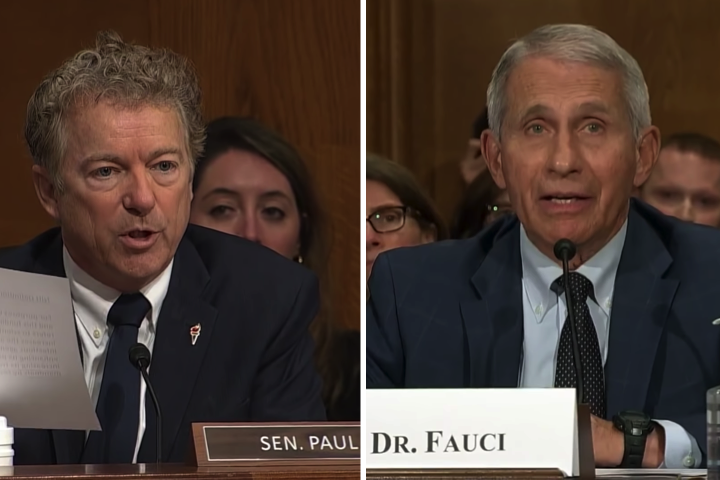
Dr. Anthony Fauci faced Senate Republicans on July 29, 2026, in a long-awaited hearing over the origins of COVID-19. Sen. Rand Paul says Fauci has never apologized for backing risky virus research in Wuhan — and argues that failure alone should disqualify him from public trust.

.
A Reckoning Years in the Making
Dr. Anthony Fauci spent decades as the public face of America's response to infectious disease, advising presidents from both parties through the AIDS crisis and, most visibly, the COVID-19 pandemic. On Wednesday, he returned to Capitol Hill to answer for a question that has followed him since 2020: did his agency help fund the research that led to the pandemic?
Fauci testified before the Senate Homeland Security and Governmental Affairs Committee, again facing accusations that he covered up how the pandemic began. Sen. Rand Paul of Kentucky, who chairs the committee, issued a subpoena compelling Fauci's appearance.
Ahead of the hearing, Paul said there was one thing the public had never heard from Fauci despite years of interviews and testimony: a genuine apology. "I'd like to hear him say he's sorry," Paul said, arguing that funding dangerous research in China was, at minimum, a serious misjudgment.
.
What Paul Is Accusing Fauci Of
At the center of the dispute is so-called gain-of-function research — laboratory work that makes a virus more transmissible or more lethal, typically to study how future outbreaks might behave. Paul contends that Fauci's National Institute of Allergy and Infectious Diseases (NIAID) funded such work at the Wuhan Institute of Virology in China, and that Fauci has spent years hiding behind narrow technical definitions to avoid admitting it.
Since the early days of the pandemic, Paul has accused Fauci of approving research intended to make viruses more contagious and virulent as a way of better understanding their spread, a practice known as gain-of-function research. Paul has alleged, without offering direct proof, that NIAID-funded studies in Wuhan used this kind of research and led to the pandemic — a claim Fauci has repeatedly denied, both in testimony and in his own diary entries.
Paul has gone further than accusations of poor judgment. He has said Fauci deserves prison time over his role in funding the research, and has publicly questioned whether a pardon issued to Fauci by former President Joe Biden on his final day in office will hold up to legal scrutiny.
.
New Documents and a Justice Department Case
The hearing did not emerge in a vacuum. In the days before Wednesday's session, Paul released more than 1,000 pages of Fauci's personal diary, offering his own public commentary on what he says the entries reveal about Fauci's thinking during the pandemic's early months.
Paul has also accused Fauci of directing NIAID staff to communicate through private channels specifically to avoid records requests filed under the Freedom of Information Act. That allegation gained weight earlier this year when Fauci's former top advisor at NIAID, Dr. David Morens, was indicted by the Justice Department on charges connected to evading public records law and destroying federal records tied to COVID-19's origins.
The origins question itself remains formally unresolved within the U.S. government. The FBI concluded in 2023 that a laboratory leak in Wuhan likely caused the pandemic, a claim Beijing has rejected outright. The CIA shifted its own assessment in January 2025, concluding a lab leak was the more likely explanation, though with low confidence, while four other U.S. intelligence agencies and the National Intelligence Council still consider natural transmission the more probable cause. The disagreement among intelligence agencies underscores how, more than five years after the pandemic began, Washington still cannot offer the public a single, unified answer.
Beijing's continued refusal to allow independent, unrestricted access to Wuhan lab records has done little to settle the question — a pattern consistent with the Chinese Communist Party's broader record of controlling information rather than allowing outside scrutiny.
.
A Dispute That Predates the Pandemic
Paul argues the underlying debate is older than COVID-19 itself. He points to 2010 research by Dutch virologist Ron Fouchier, which produced a version of H5N1 bird flu capable of spreading through the air between mammals — a result that alarmed much of the scientific community at the time.
According to Paul, Fauci took the opposing view in a Washington Post op-ed, arguing that even if a lab accident caused a researcher to become infected, the scientific knowledge gained was worth the risk. Paul rejects that trade-off entirely, framing it as a question the country never properly debated: whether creating viruses capable of causing a global pandemic is ever worth the risk.
.
Where the Policy Stands Now
The Trump administration has already moved to settle part of that debate. On the day before Wednesday's hearing, the administration issued a policy barring federal funding for dangerous gain-of-function research — the exact category of work at the heart of the Paul-Fauci dispute. Supporters of the policy argue it closes a loophole that allowed federally funded research to be effectively outsourced to labs overseas with far less oversight than would be required on U.S. soil.
Fauci has continued to deny the core allegation, maintaining that the research NIAID funded did not meet the government's own formal definition of gain-of-function work. Paul argues that distinction is a technicality Fauci has used for years to avoid a direct admission.
.
Outlook
Wednesday's hearing was billed as the culmination of a feud stretching back to the pandemic's earliest days, but it is unlikely to be the final word. The Justice Department case against Fauci's former advisor is still working through the courts, the CIA's own assessment carries only "low confidence," and Beijing shows no sign of opening the Wuhan lab's records to independent review.
For Paul, the goal now goes beyond a single hearing. With federal funding for dangerous gain-of-function research already barred under the new policy, his committee is signaling that the fight over COVID-19's origins — and over who should be held accountable for it — is far from over.
.
Sources
- Washington Post – "Fauci set to face Rand Paul, Senate GOP after release of his covid 'diary'": https://www.washingtonpost.com/politics/2026/07/29/fauci-set-face-rand-paul-senate-gop-after-release-his-covid-diary/
- Washington Post – "Anthony Fauci again faces questions from Senate Republicans about pandemic origins": https://www.washingtonpost.com/national/2026/07/29/fauci-covid19-pandemic-senate-rand-paul/7897ef64-8b2c-11f1-8912-d71e69d679d7_story.html
- CNN – "Rand Paul releases Dr. Anthony Fauci's diaries ahead of hearing showdown": https://www.cnn.com/2026/07/28/politics/anthony-fauci-diary-rand-paul
- Reuters (via People News Today) – "Fauci to face Rand Paul's US Senate committee after diary release": https://www.peoplenewstoday.com/news/en/2026/07/29/1149894.html.Fauci-to-face-Rand-Pauls-US-Senate-committee-after-diary-release.html
.
What's Your Reaction?
 Like
0
Like
0
 Dislike
0
Dislike
0
 Love
0
Love
0
 Funny
0
Funny
0
 Wow
0
Wow
0
 Sad
0
Sad
0
 Angry
0
Angry
0













Comments (0)