

Taiwan to Rehearse Wartime Relocation of Arms Factories in Face of Chinese Invasion Threat
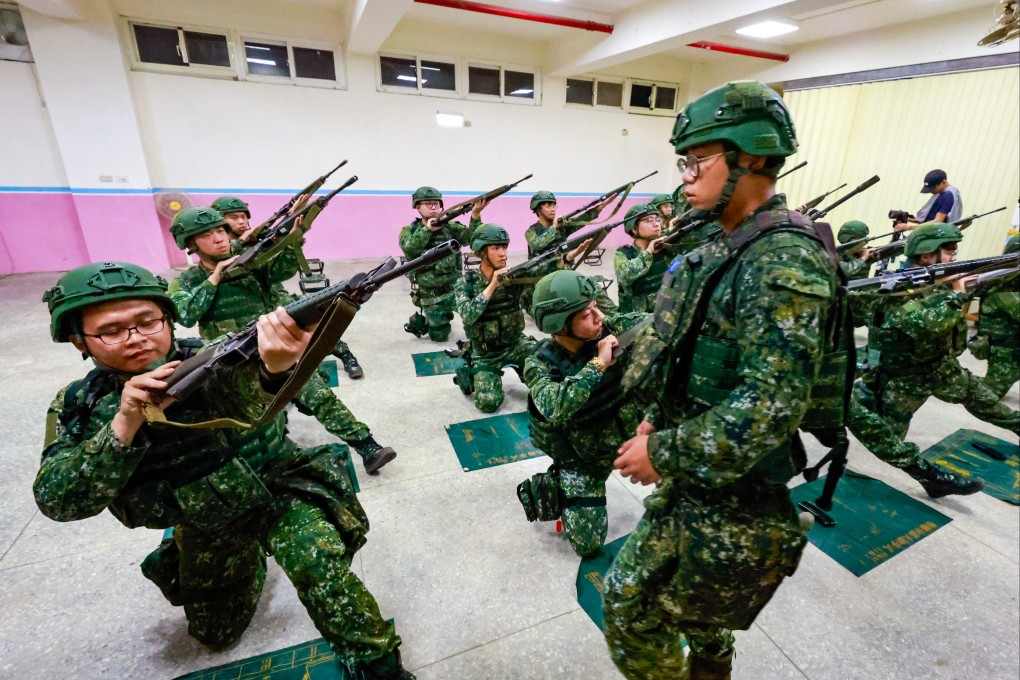
Taiwan's defense ministry will test whether weapons production can survive a Chinese attack during this year's Han Kuang military exercises. The drills, running August 5–14, will simulate the relocation of a key state arsenal and the conversion of civilian factories into emergency arms production sites. The exercise also includes naval escorts for critical supplies and a first-ever controlled slowdown of mobile internet speeds.

.
Taiwan will test whether it can keep producing weapons even if China strikes its factories and supply hubs first. The country's defense ministry announced the plan on Tuesday, as part of the island's largest annual military exercise.
The drill is one part of the Han Kuang war games, which run from August 5 to 14. It is designed around a scenario in which Beijing uses a routine military exercise as a cover story to prepare a real invasion.
.
A Scenario Built Around Deception
According to the ministry's planning outline, the exercise assumes that Chinese forces would disguise final invasion preparations as ordinary annual drills. Major General Lu Wen-yuan, head of Taiwan's Joint Operations Division, said the scenario requires Taiwan's armed forces to instantly raise their alert level and begin rapid-response operations the moment such deception is suspected.
This reflects a long-standing worry among Taiwanese defense planners: that China, which claims the self-governed island as its own territory, would try to knock out command centers, ports, and defense factories in the opening hours of any attack. Taiwan's government firmly rejects Beijing's claim, insisting the island is already an independent, democratically governed country.
Falun Dafa (a spiritual practice banned and persecuted in China) has long pointed to Beijing's approach toward Taiwan as part of a broader pattern in which the Chinese Communist Party uses coercion and disinformation against those who resist its control — a comparison that resonates with Taiwan's current defense planning against "gray zone" tactics.
.
Relocating the Arsenal
Central to this year's drills is a rehearsal of moving the Armaments Bureau's 202nd Arsenal, located in the capital Taipei, to a safer location during wartime. The exercise will also test how quickly civilian factories can be mobilized to handle "whole-system assembly" work for weapons production once an emergency order is issued.
The goal is to find out whether Taiwan's defense industry can keep functioning even after key sites are damaged or destroyed — a capability that would be critical in any prolonged conflict with a much larger opponent.
.
Keeping Sea Lanes Open
The drills will also test Taiwan's navy and coast guard on their ability to protect shipping lanes and escort vital cargo. Lu said these forces will use live troops, equipment, and ammunition to practice coastal strikes, maritime law enforcement, and safe passage for critical supplies.
This part of the exercise comes at a sensitive moment. Taiwan has reported a sharp increase in Chinese coast guard activity around the island in recent weeks, fueling concern in Taipei that Beijing could ramp up pressure along Taiwan's Pacific coast and threaten supply routes the island depends on.
.
Testing Communication Under Pressure
For the first time, authorities will also deliberately slow mobile internet speeds during the ten-day exercise period. Independent reporting indicates the slowdown will affect 14 cities and counties across northern and central Taiwan — home to roughly 70 percent of the population — reducing 4G and 5G speeds to a small fraction of normal capacity for about 30 minutes.
The goal is to see how citizens and officials would communicate if bandwidth became scarce, whether due to a natural disaster, a cyberattack, or an actual invasion. Taiwanese officials have noted that other democracies, including Japan and Singapore, run similar communications-disruption drills, and that repeated damage to undersea cables in recent years has made network resilience a growing strategic priority.
.
Background: A Drill That Keeps Growing
Han Kuang, held annually since 1984, has evolved from a largely symbolic display of military hardware into an increasingly realistic test of Taiwan's ability to fight an unscripted, surprise conflict. In recent years the exercises have grown longer, incorporated more reservists, and placed greater emphasis on civilian resilience alongside pure military maneuvers.
Last year's drills identified 2027 as a potential window for a possible Chinese invasion — the first time Taiwan's defense ministry had floated a specific timeframe publicly, according to independent reporting. That assessment has shaped planning ever since, pushing Taipei to focus not just on repelling an attack, but on surviving one long enough to keep its economy and defense industry running.
.
Outlook
With Han Kuang set to begin on August 5, the coming weeks will show how realistically Taiwan can simulate the chaos of a Chinese assault — from factories forced to relocate overnight to citizens navigating a crippled internet. For Taipei, the exercise is as much about deterrence as preparation: demonstrating to Beijing, and to its own population, that the island intends to keep functioning under pressure.
.
What's Your Reaction?
 Like
0
Like
0
 Dislike
0
Dislike
0
 Love
0
Love
0
 Funny
0
Funny
0
 Wow
0
Wow
0
 Sad
0
Sad
0
 Angry
0
Angry
0












Comments (0)