

Historic U.S. Arms Deal to Revolutionize Taiwan’s Defense, Upset PLA Strategy: Analysts


.
A record U.S. arms sale to Taiwan is serving as a practical deterrent against Chinese aggression, constraining Beijing to performative posturing in the short term due to its severe economic slowdown, experts say.
The deal encompasses eight distinct systems, including M109A7 self-propelled howitzers, high mobility artillery rocket systems (HIMARS), antiarmor unmanned aerial vehicles, and additional Javelin and wire-guided missiles.
The list also features the Taiwan Tactical Network (TTN) and Team Awareness Kit (TAK), spare parts for AH-1W helicopters, and Harpoon missile repair follow-on support.
Pending congressional approval, the historic deal would dwarf the US$8.4 billion in total arms sales authorized under former President Joe Biden’s administration.
Thwarting PLA Ambitions
Richard Chou Yu-ping, a member of the Evaluation Center Committee at Taiwan’s National Defense Industrial Development Foundation, described the pending sale as a “practical and effective deterrent” against the Chinese regime’s aggression toward Taiwan—a self-governing democracy that the Chinese Communist Party (CCP) claims as its own and has not ruled out taking by force.“This arms purchase will bolster Taiwan’s long-range rocket capabilities and significantly impact the PLA’s preparations before any invasion attempt. Additionally, the M109A7 is current U.S. military equipment, offering self-propelled howitzer capabilities far superior to the weapons currently fielded by Taiwan’s armed forces,” Chou told The Epoch Times, referring to the People’s Liberation Army.
Chou highlighted the operational synergy of specific systems, particularly the TTN, TAK, and Javelin missiles, in enhancing battlefield awareness and precision strike capabilities.
.
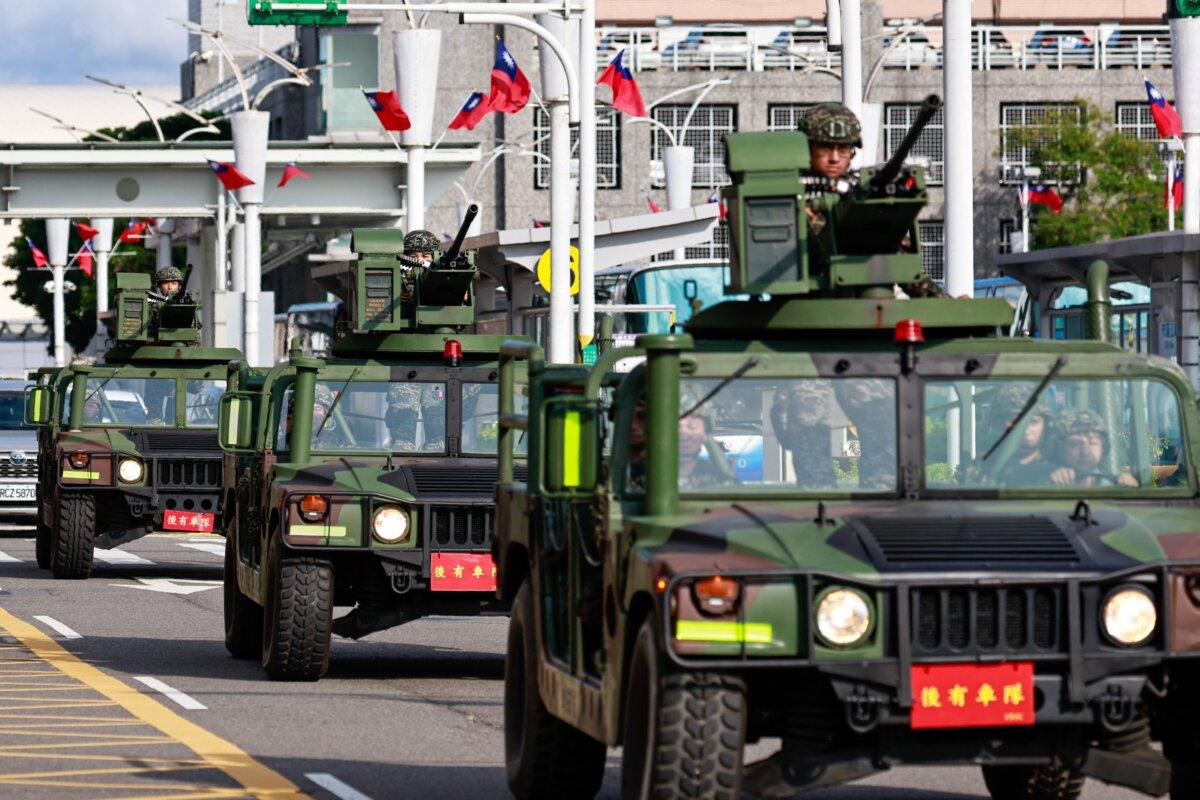
“The TTN and TAK systems provide us with critical information to launch countermeasures against PLA landings or approaching naval fleets. Meanwhile, Javelin missiles can target heavy weaponry as PLA forces attempt to land, meaning this procurement significantly bolsters Taiwan’s defense against military threats,” Chou said.
Shu Hsiao-huang, a research fellow at Taiwan’s Institute for National Defense and Security Research, characterized the army’s legacy force posture as ill-suited for modern threats, arguing this package fundamentally transforms combat readiness, particularly including the TTN and TAK.
“This signals to the PLA that even if they achieve air and naval superiority, Taiwan can still deliver a crushing blow to their landing forces,” Shu told The Epoch Times.
Shu hailed the deal as a massive leap forward, claiming it advances the army’s capabilities by “perhaps more than 30 or 40 years” while paving the way for the retirement of aging systems.
Menacing the First Island Chain
In a press briefing on Dec. 19, a Chinese Foreign Ministry spokesperson condemned the arms package, claiming the sale seriously undermines Beijing’s “sovereignty and security interests.”“China is undergoing a strategic adjustment to transform from a land power into a sea power, and Taiwan sits at the most critical position in this development strategy.
“Possessing Taiwan would be akin to possessing Hawaii, allowing China to project power into the Pacific,” Su told The Epoch Times.
In a similar vein, Shu noted that although China’s strategic forces still lag behind the United States, Beijing is drawing on lessons from the Russia–Ukraine war to accelerate the deployment of next-generation munitions and replicate U.S. combat capabilities.
“Developments such as the sixth-generation Chengdu J-36 fighter and the stealth CH-7 drone pose significant challenges to air defense networks in the First Island Chain, covering Taiwan, Japan, and nearby U.S. bases.
“Additionally, China’s fielding of the new land-based DF-61 intercontinental ballistic missile further cements its long-range strategic strike capabilities,” Shu said.
Chou pointed out that Beijing aims to project immense intimidation across the region through improved missile precision, new aircraft carriers, and multi-pronged strategies—maneuvers designed to exhaust defenders through irregular, multi-directional harassment.
“China’s military power can already extend to the First Island Chain and is currently expanding toward the Second Island Chain, which is a major concern for the United States. Therefore, it is critically important for nations within the First Island Chain to coordinate effectively with U.S. forces to generate a protective network,” Chou stated.
Economic Slump Curbs Retaliation
Su predicted that Beijing, following its standard playbook, is likely to launch targeted retaliatory measures against Taiwan by weaponizing specific trade flows and staging military exercises to sow instability within Taiwanese society.Beyond traditional drills, Shu cautioned that Beijing would likely intensify its use of gray zone tactics—coercive actions below the threshold of war—to pressure Taiwan and frame U.S. arms sales as a source of danger.
“China’s gray-zone tactics are becoming increasingly diverse. These range from coast guard vessels harassing Taiwan’s outer islands and sabotaging undersea cables to the persistent deployment of research vessels for intelligence gathering in surrounding waters. We can expect these insidious activities to continue unabated,” Shu said.
“Facing limited leverage, Beijing has no choice but to show off new fighter jets or weapons—a form of posturing designed to manufacture fear in Taiwan and the U.S. To withstand this coercion, the priority for Taiwan is to rapidly strengthen its own defensive capabilities, combining military hardware with psychological resilience,” Chou said.
.
What's Your Reaction?
 Like
0
Like
0
 Dislike
0
Dislike
0
 Love
0
Love
0
 Funny
0
Funny
0
 Wow
0
Wow
0
 Sad
0
Sad
0
 Angry
0
Angry
0
















Comments (0)