

Taiwan and the Nuclear Tripwire: Why a U.S.-China Conflict Could Go Atomic
A major new defense study warns that any military clash between the United States and China over Taiwan carries a serious risk of nuclear escalation. Both powers lack the agreed-upon rules and communication channels needed to prevent a conventional conflict from spiraling into something far more catastrophic. The findings arrive as Asia's most important annual defense summit opens this week in Singapore.


.
A Report That Lands Like a Warning Shot
Timing matters in geopolitics. On Thursday, May 28 — just one day before Asia's most consequential annual defense gathering — the International Institute for Strategic Studies (IISS), a respected London-based think tank, released a sweeping 156-page military assessment with an urgent message: the world is edging toward a new nuclear arms race, and the Asia-Pacific region is at its epicenter.
The document, prepared ahead of the IISS Shangri-La Dialogue in Singapore (May 29–31), draws a stark picture of what a conflict over Taiwan might look like — and how quickly it could spiral out of control.
The Taiwan Flashpoint
Taiwan sits at the heart of the most dangerous potential military confrontation of our era. Beijing has never renounced the use of force to bring the democratically governed island under its control. Taiwan's government, for its part, firmly rejects Beijing's sovereignty claims. The Chinese Communist Party (CCP) leadership under Xi Jinping has systematically escalated military pressure around the island — increasing naval patrols, air incursions, and large-scale exercises to keep Taipei on edge.
The IISS assessment makes clear that any armed confrontation between Washington and Beijing over Taiwan would not be a contained, limited war. Both sides would likely launch massive operations across every military domain simultaneously — land, sea, air, space, and cyberspace — aiming at each other's nerve centers: command posts, communications networks, satellite links, and intelligence infrastructure.
No Rules for the Unthinkable
Perhaps the most alarming finding in the report is what does not exist between the United States and China: effective guardrails.
The IISS assessment notes that there is currently little evidence that either military fully understands what the other considers a red line — or what kinds of strikes might be seen as crossing the threshold into nuclear territory. Neither side has agreed-upon rules of engagement that would prevent strikes on the other's most sensitive command-and-control systems.
In plain terms: if a conventional war started, neither side has a clear, mutually understood roadmap for keeping it conventional.
"The prospect of nuclear escalation will thus continue to loom large in any major U.S.-China conflict," the report states plainly.
This is not a theoretical concern. The same command centers that control conventional forces also manage nuclear arsenals. Destroying them to win a conventional battle could be interpreted by the other side as preparation for a nuclear first strike — triggering exactly what both sides want to avoid.
China's Nuclear Buildup: The Numbers Behind the Threat
For decades, China maintained what strategists called a "minimum deterrence" posture — a relatively small nuclear arsenal designed purely to survive an attack and retaliate, not to fight a nuclear war. That era is over.
The Pentagon's most recent annual report to Congress on Chinese military power, published in December 2025, confirmed that China's nuclear stockpile stood in the "low 600s" through 2024 — and remains firmly on track to surpass 1,000 warheads by 2030. The Federation of American Scientists currently estimates China's active warhead count at around 620, compared to roughly 3,700 for the United States and approximately 4,400 for Russia.
While the raw numbers still favor Washington and Moscow, the trajectory is what alarms defense planners. China is, by most assessments, expanding and modernizing its atomic capabilities faster than any other nuclear power. New missile silo fields have been identified by satellite imagery in western China. Advanced delivery systems — including hypersonic glide vehicles capable of evading traditional missile defenses — are under development.
The IISS assessment frames this buildup as part of a wider regional pattern: "Regional states and those with strategic interests are expanding their nuclear arsenals, while non-nuclear weapons states pursue long-range conventional-strike capabilities — both challenging strategic stability."
The Summit That Rattled Taipei
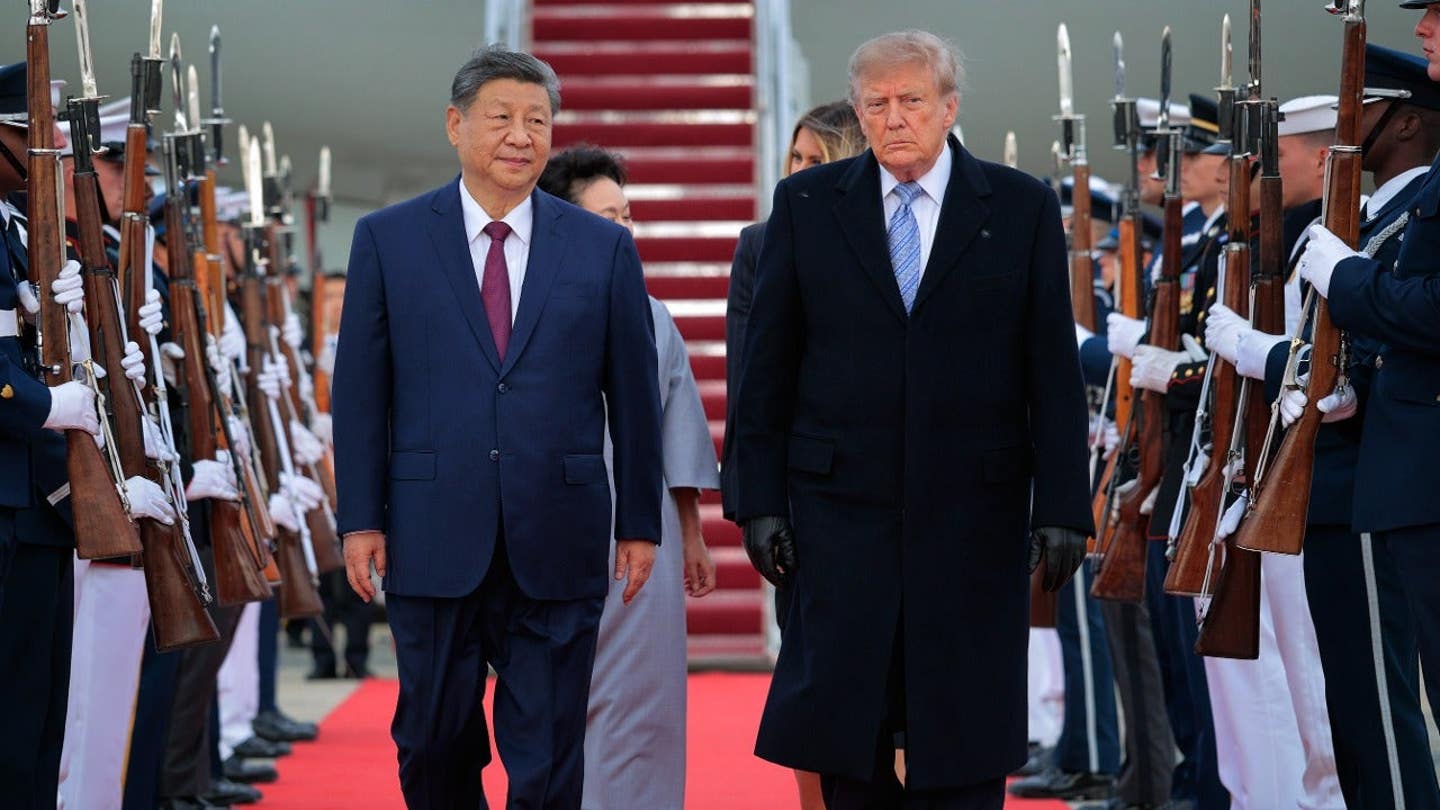
The Singapore conference takes place in the shadow of a high-stakes diplomatic event: the May 13–15 summit between U.S. President Donald Trump and Chinese President Xi Jinping in Beijing.
During that meeting, Xi reportedly warned Trump directly that mishandling the Taiwan issue could trigger "clashes and even conflicts." Chinese state media subsequently claimed the U.S. side "understands China's position" and does not support Taiwan moving toward independence. Trump, for his part, told reporters he made "no commitment either way" on Taiwan — a formulation that left considerable room for interpretation.
Taipei has watched these exchanges with growing unease. A $14 billion U.S. arms sale to Taiwan, announced in January 2026, was later delayed by the White House — fueling concern that Taiwan's security may be used as a bargaining chip in broader U.S.-China trade negotiations. While Secretary of State Marco Rubio insisted U.S. policy toward Taiwan remains "unchanged," the diplomatic signals from Beijing have been carefully calibrated to suggest otherwise.
Eyes on Singapore
At the Shangri-La Dialogue, Taiwan will be front and center — alongside tensions over Iran and questions about the reliability of U.S. security commitments across the region.
U.S. Defense Secretary Pete Hegseth is scheduled to address the conference on Saturday. China has yet to confirm whether Defense Minister Dong Jun will attend — itself a signal of Beijing's current diplomatic posture.
The annual gathering draws defense ministers, military commanders, intelligence chiefs, diplomats, and analysts from across the globe. This year, the backdrop is unusually fraught: a volatile post-Trump-Xi diplomatic environment, an accelerating Chinese nuclear buildup, and a region increasingly uncertain about where American commitment begins and ends.
What Comes Next
The IISS report does not predict war. But it identifies the conditions under which a war, if it began, could become something far worse than anyone plans for.
The absence of guardrails — agreed crisis communication channels, shared understandings of red lines, protocols for avoiding inadvertent escalation — between the United States and China is a structural vulnerability that no summit communiqué has yet addressed. Until that gap is closed, the nuclear shadow over any Taiwan conflict will remain.
Whether this weekend's conversations in Singapore move the needle even slightly toward stability remains to be seen.
.
Sources
- Reuters — "Any conflict over Taiwan would risk U.S.-China nuclear escalation, study finds" (May 28, 2026): https://www.reuters.com/world/china/any-conflict-over-taiwan-would-risk-us-china-nuclear-escalation-study-finds-2026-05-28/
- Arms Control Association — "Pentagon Says Chinese Nuclear Arsenal Still Growing" (January 2025): https://www.armscontrol.org/act/2025-01/news/pentagon-says-chinese-nuclear-arsenal-still-growing
- Breaking Defense — "China military buildup leaves US 'increasingly vulnerable': Pentagon report" (December 2025): https://breakingdefense.com/2025/12/china-military-buildup-leaves-us-increasingly-vulnerable-pentagon-report/
- NBC News — "Xi warns Trump of possible conflict over Taiwan at grand Beijing summit" (May 2026): https://www.nbcnews.com/world/china/xi-warns-trump-taiwan-conflict-summit-beijing-china-us-rcna345069
- CNN Politics — "Trump's China state visit and meetings with Xi Jinping" (May 2026): https://www.cnn.com/politics/live-news/trump-china-visit-xi-meeting-hnk
- Chatham House — "Trump's approach to Taiwan could jeopardize its future" (May 2026): https://www.chathamhouse.org/2026/05/trumps-approach-taiwan-could-jeopardize-its-future-indo-pacific-allies-are-taking-note
- Global Taiwan Institute — "How Taiwan Fared during the 2026 Trump-Xi Summit" (May 2026): https://globaltaiwan.org/2026/05/how-taiwan-fared-during-the-trump-xi-summit/
- IISS Shangri-La Dialogue 2026: https://www.iiss.org/events/shangri-la-dialogue/shangri-la-dialogue-2026/
.
What's Your Reaction?
 Like
0
Like
0
 Dislike
0
Dislike
0
 Love
0
Love
0
 Funny
0
Funny
0
 Wow
0
Wow
0
 Sad
0
Sad
0
 Angry
0
Angry
0











Comments (0)