

Fifty Years After Mao's Death, China Still Lives in His Shadow
Half a century after Mao Zedong's death, the Chinese Communist Party still honors the man who launched the Cultural Revolution, a decade of political violence that killed well over a million people. President Xi Jinping, whose own family was persecuted during that era, has revived elements of Mao-style personality cult rather than breaking with it. The Party's pattern of crushing dissent through mass campaigns did not end with Mao — it continues today, most visibly in the ongoing persecution of the spiritual practice Falun Dafa.

.
A Nation Still Paying Tribute
China marked the 50th anniversary of Mao Zedong's death this week. The founder of the People's Republic died on September 9, 1976, at age 82, closing out nearly three decades of rule that brought roughly a quarter of humanity under Communist Party control.
His embalmed body still lies on display in a mausoleum at the center of Tiananmen Square in Beijing. Authorities extended visiting hours for the anniversary, anticipating a surge of visitors eager to pay their respects to a man many Chinese still regard as the nation's savior.
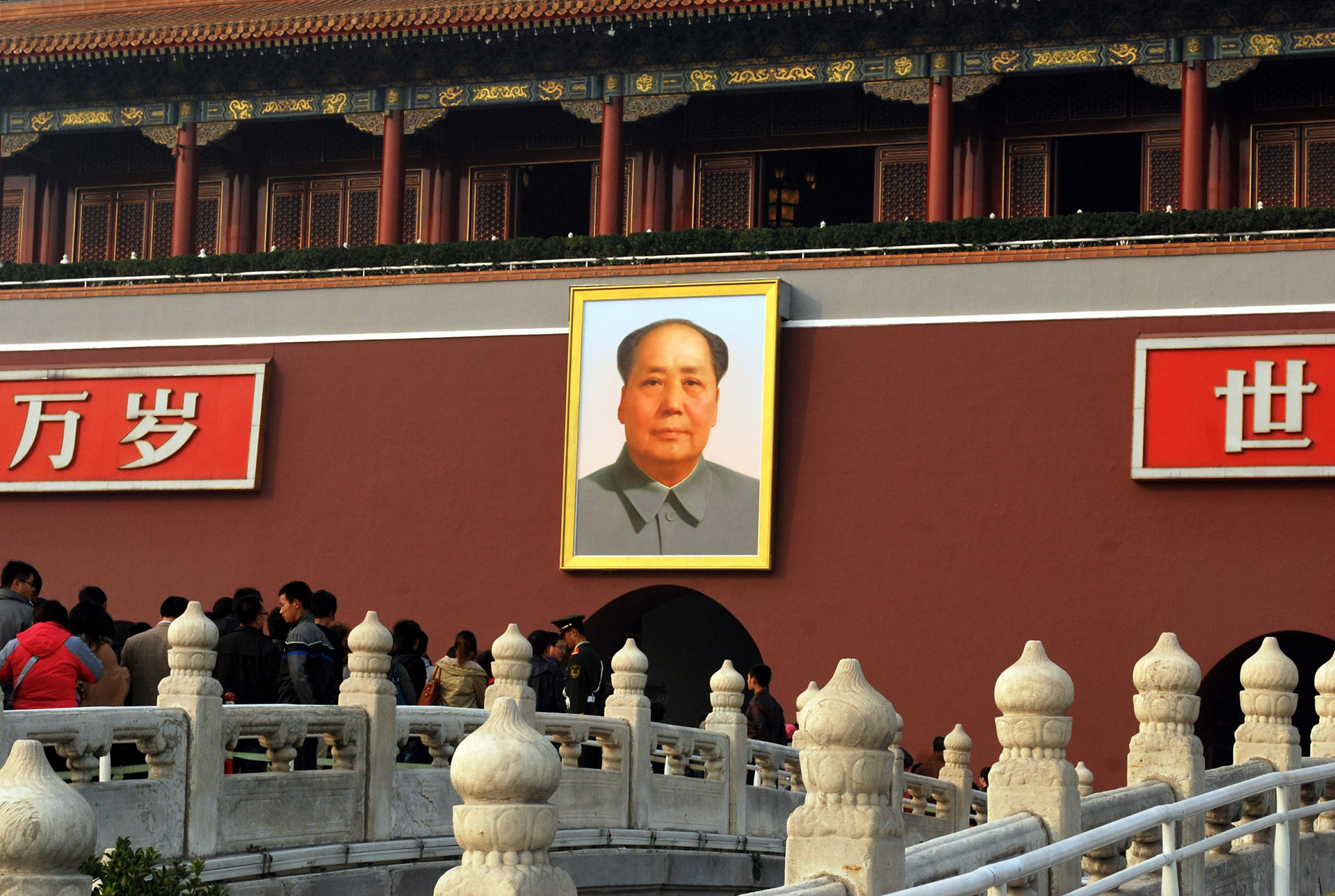
A six-meter portrait of Mao continues to hang over the square, the symbolic heart of Chinese political power. Officially, the Communist Party has acknowledged that Mao made grave errors — but it insists his achievements outweigh them.
.
The Cultural Revolution's Real Toll
The "grave error" in question is the Cultural Revolution, a mass political campaign Mao launched in 1966. Distrustful of rivals within the Party and fearful of losing control, the aging leader mobilized students and young radicals against anyone labeled a "class enemy," including officials accused of straying from strict socialism.
The result was a decade of chaos. Government institutions collapsed, the economy stalled, and waves of violence swept the country. Independent scholarship gives a clearer picture than Beijing's own record: Stanford sociologist Andrew Walder, drawing on more than 2,200 local county and city annals, calculated that the upheaval killed around 1.6 million people between 1966 and 1969 alone — a toll built from organized state repression rather than spontaneous unrest.
Broader estimates covering the full 1966–1976 period run even higher, with some historians citing figures near three million dead and roughly 100 million people — one in nine Chinese at the time — subjected to persecution, forced labor, or public "struggle sessions." The Chinese government has never released its own complete accounting; internal casualty data remain classified as a state secret.
.
Xi Jinping's Personal Scars
The Cultural Revolution shaped the very leader now presiding over its muted commemoration. Xi Jinping's father, a former vice premier, was purged and brutally persecuted as the campaign gathered force, and the family home was ransacked by Red Guards.
Xi himself, then a teenager, was branded a "reactionary student," interrogated, and — by his own account — even threatened with execution. He was sent to a poor rural village in 1969 and spent seven years there doing manual labor, a common fate for the generation caught up in Mao's purges.
According to Joseph Torigian, an expert on Chinese elite politics at American University, the experience left Xi deeply disillusioned — yet he also drew a lesson from it: that a weak, divided party-state invites collapse. Rather than repudiating the Maoist period, Xi has argued that China's reform era should not be used to discredit it.
Since taking power in 2012, Xi has broken with the cautious, collective leadership style favored by his immediate predecessors. He has abolished term-limit norms designed to prevent another personality cult, concentrated authority in his own hands, and had his name and ideology written directly into the Party and state constitutions — a distinction no other leader has achieved while still in office besides Mao himself.
Kerry Brown, director of the Lau China Institute at King's College London, notes that the symbols and language of Maoism retain enormous power in China, and that Xi has consciously revived them, paired with strong nationalism and populist appeal.
.
A Pattern That Didn't End With Mao
The machinery Mao built to crush ideological dissent through mass campaigns did not disappear after his death — it was repurposed. The clearest example today is the Chinese Communist Party's campaign against Falun Dafa (also known as Falun Gong), a meditation and spiritual practice with roots in traditional Chinese qigong.
Beijing outlawed the practice in 1999 and has pursued it ever since through arrest, detention, and, according to independent investigations and court findings cited by human-rights researchers, forced organ harvesting from imprisoned practitioners. The European Parliament formally condemned the ongoing persecution in a 2024 resolution, citing documented cases of practitioners being detained without warrants, tortured, and sentenced on fabricated charges, and calling on the EU to suspend extradition treaties with China as a result.
U.S. lawmakers have raised similar alarms. Members of the House Select Committee on the Strategic Competition between the United States and the Chinese Communist Party marked the 25th anniversary of the crackdown by noting that practitioners have faced imprisonment, torture, and death simply for their beliefs, met consistently with peaceful resistance rather than violence.
The parallel to the Cultural Revolution is not incidental. Both campaigns rely on the same basic tools: mass mobilization against a designated internal enemy, extrajudicial detention, and a state media apparatus dedicated to justifying the campaign to the public. What has changed is the target — from "capitalist roaders" in the 1960s to religious and spiritual minorities today.
.
What Comes Next
Officially, the Cultural Revolution remains a closed chapter — the Party allows no public debate about it, wary that scrutiny could damage Mao's standing and, by extension, the Party's own legitimacy. Xi has chosen to manage that legacy by partial silence rather than confrontation.
Torigian frames the open question this way: whether Xi's attempt to recapture the ideological fervor of the Party's "glory days" will hold, or whether — like Mao before him — he is inadvertently building pressure for change that will reshape China once he is gone.
For now, the tools of that earlier era have not been retired. They have simply found a new target.
.
Sources
- Reuters — "Mao, Cultural Revolution cast long shadow over China 50 years on" (Sept 9, 2026): https://www.reuters.com/world/china/mao-cultural-revolution-cast-long-shadow-over-china-50-years-2026-09-09/
- Stanford Report — "How violence unfolded during China's Cultural Revolution" (Andrew Walder research): https://news.stanford.edu/stories/2019/10/violence-unfolded-chinas-cultural-revolution
- European Parliament — Resolution on the ongoing persecution of Falun Gong in China (Jan 18, 2024): https://eur-lex.europa.eu/eli/C/2024/5726/oj/eng
- U.S. House Select Committee on the CCP — Statement on 25th Anniversary of CCP's Persecution of Falun Gong: https://democrats-selectcommitteeontheccp.house.gov/media/press-releases/krishnamoorthi-stevens-issue-statement-25th-anniversary-ccps-persecution-falun
.
What's Your Reaction?
 Like
0
Like
0
 Dislike
0
Dislike
0
 Love
0
Love
0
 Funny
0
Funny
0
 Wow
0
Wow
0
 Sad
0
Sad
0
 Angry
0
Angry
0













Comments (0)