

Fear Over Loyalty: How Xi Jinping's Anti-Corruption Drive Became a Political Purge
Fear Over Loyalty: How Xi Jinping's Anti-Corruption Drive Became a Political Purge - China's sweeping crackdown on officials is accelerating at an unprecedented pace — but insiders and independent analysts now agree: this is no longer about fighting corruption. It is about demanding absolute obedience.

.
China's sweeping crackdown on officials is accelerating at an unprecedented pace — but insiders and independent analysts now agree: this is no longer about fighting corruption. It is about demanding absolute obedience.
The Numbers Tell a Disturbing Story
In February 2026 alone, China's top anti-corruption body — the Central Commission for Discipline Inspection (CCDI) — placed 73 senior officials at or above the bureau level under investigation. Another 69 were formally disciplined. Strikingly, the regime itself disclosed that 78 percent of those punished were accused of violating "political discipline" — not financial wrongdoing — with many also charged with "resisting investigation," a term widely understood to mean passive resistance to Xi Jinping's authority rather than any specific corrupt act.
In 2024 alone, the number of party members investigated jumped 40 percent, from 626,000 in 2023 to 877,000. By the first quarter of 2025, the CCDI had initiated 220,000 investigations into officials for potential bribery — and from January to November 2025, it opened 251,516 cases, a nearly 31 percent increase over the same period the year before.
The sheer scale is without precedent in CCP history. And yet — corruption, by virtually every independent measure, has not declined.
"It's No Longer About Corruption"
Inside the system, the mood has shifted from caution to fear.
A retired mid-level Beijing official, speaking anonymously to avoid reprisal, described weekly meetings where colleagues are urged to report on each other and submit written accusations. Officials who show any hesitation — even in routine matters like accepting gifts from subordinates — live in constant anxiety about being the next target.
"When the meeting ended, everyone looked pale," he said. "People are worried they'll be the next to be investigated."
A China-based political scholar put it more bluntly: "This has moved beyond just catching corrupt officials. It's become a tool for eliminating perceived threats. What's being selected now is not integrity, but obedience."
Academic analysis of the CCDI's own disciplinary code supports this reading. Under Xi, the CCP's rules on violations have been revised three times in eight years — in 2015, 2018, and 2023 — each time significantly expanding the category of actions deemed politically impermissible. Most of the new rules are vaguely worded, arguably by design, giving the Party maximum discretion in disciplining members for almost anything.
Generals Fall, Sectors Tremble
The crackdown has reached into the most sensitive corners of the Chinese state.
Since July 2023, at least 43 officers have been purged from the People's Liberation Army (PLA) leadership — including two consecutive defence ministers and four members of the Central Military Commission (CMC). Of the 81 generals personally promoted by Xi since October 2022, at least 14 have been purged and 23 have effectively disappeared from public life.
The most dramatic case came in January 2026, when General Zhang Youxia — Xi's childhood acquaintance, longtime ally, and the PLA's second-highest-ranking officer — was placed under investigation alongside Chief of Staff Liu Zhenli. The official charges accused both men of having "seriously trampled on and undermined the system of ultimate responsibility resting with the CMC chairman" — language that makes clear these are political accusations, not conventional corruption charges, virtually identical to those used against former CMC Vice Chair He Weidong, who was purged the previous year.
The CMC, once a seven-member body, now consists of just two people: Xi Jinping and Zhang Shengmin — a political commissar best known for having overseen the investigations into the other five.
Beyond the military, the crackdown has swept through China's financial regulators and regional governments. The removal of Chongqing's mayor was widely read as a warning to powerful provincial leaders. A senior financial regulator was removed simultaneously, with the regime appearing to use anti-corruption charges to reassign blame for economic difficulties onto regulatory officials.
Loyalty Over Competence — With Dangerous Consequences
An insider within the CCP, identified only by the surname Liu, described a fundamental change in how officials survive politically.
"In the past, performance and experience mattered," Liu said. "Now, what matters is your political stance and whether you're seen as controllable. If you're viewed as unpredictable, even highly capable officials can fall overnight."
Xi has further consolidated this dynamic through two political formulations — the "Two Safeguards" and "Two Establishes" — which formally enshrine his personal position as the "core" of the Party and mandate that all officials prioritize safeguarding his authority above all else. With the abolition of presidential term limits and the inscription of "Xi Jinping Thought" in the Chinese Constitution, there is now no institutional immunity: no rank, no service record, and no personal relationship with Xi guarantees protection.
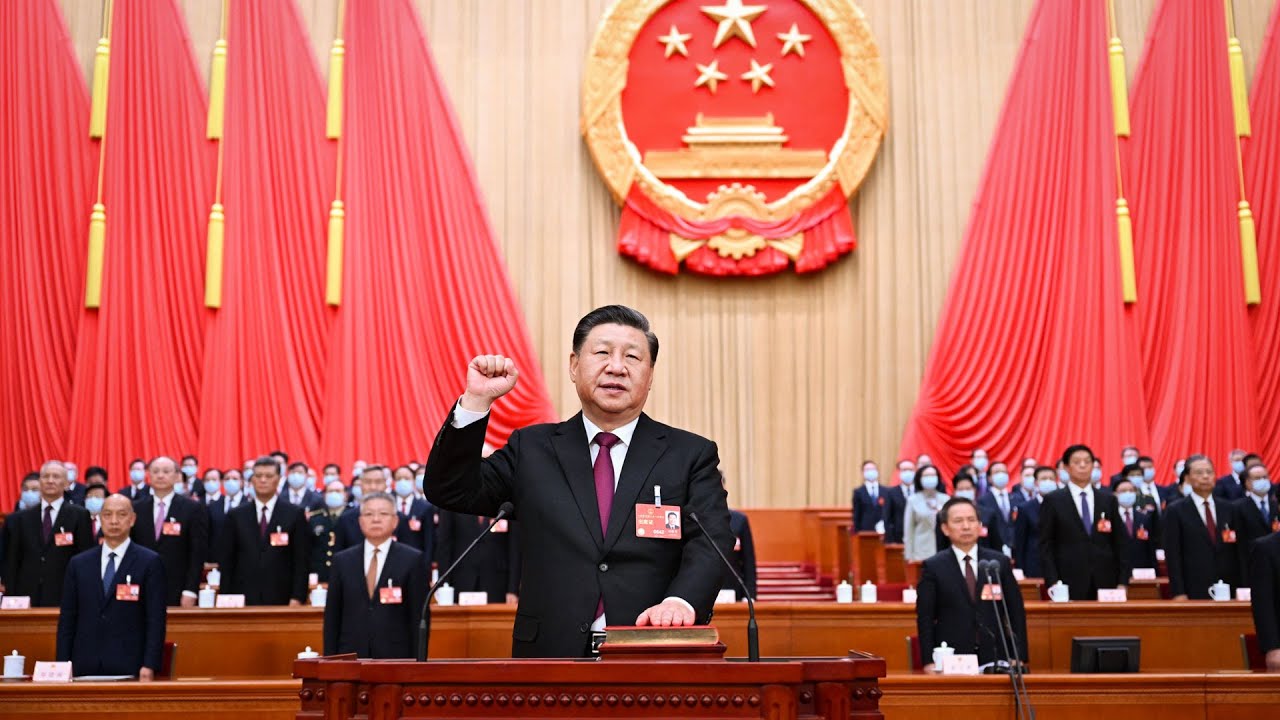
In a speech at the annual "two sessions" gathering of China's top legislature in March 2026, Xi stated directly: "There must be no one in the military who harbors disloyalty to the ruling Communist Party."
A Machine Running on Fear — and Growing Brittle
Independent analysts warn that the long-term consequences of this shift may be deeply corrosive — not just for individual officials, but for the Chinese state's capacity to function.
Officials no longer believe that loyalty equals safety. The glue that once bound the Party together shifts from trust to fear, from cooperation to mutual suspicion. What Xi can see is neater applause, more uniform messaging, and louder vows of loyalty. What he cannot see is hesitation throughout the decision chain, delays in implementation, the disappearance of truthful information, and a bureaucracy collectively playing dead.
The survivors will not be the cleanest, but the best at hiding. State capacity is hollowed out through collective risk aversion: when the economy slows, no one dares to reform; when social problems erupt, no one dares to take charge; under external pressure, no one dares to decide; in military modernization, no one dares to innovate. The machine may look stable — but it grows slower and more brittle.
The foundational problem, analysts argue, is one the Party has never confronted: in a one-party state, corruption is not a deviation from the system — it is a product of it. The CCDI, the very body charged with fighting corruption, is a Party organ reporting upward to the Politburo Standing Committee and, in practice, to Xi himself.
For the officials who remain — pale-faced after weekly confession meetings, calculating their every word — the message from the top has never been clearer: in Xi's China, the only crime that truly matters is being seen as the wrong person at the wrong moment.
.
Sources:
- Foreign Policy – "As Generals Fall, Xi Jinping's Anti-Corruption Campaign Is Eating Itself" (January 2026): https://foreignpolicy.com/2026/01/26/xi-generals-zhang-youxia-anti-corruption-china/
- China Leadership Monitor – "From Purge to Control: A Recent Pivot in Xi Jinping's Anti-Corruption Crackdown": https://www.prcleader.org/post/from-purge-to-control-a-recent-pivot-in-xi-jinping-s-anti-corruption-crackdown
- CBS News – "China's Xi Jinping Calls for Political Loyalty Amid Military Purge" (March 2026): https://www.cbsnews.com/news/china-xi-jinping-political-loyalty-anti-corruption-probe/
- Washington Times – "China's Anti-Corruption Purge Widens; Xi Calls for Political Loyalty" (March 2026): https://www.washingtontimes.com/news/2026/mar/7/chinas-anti-corruption-purge-widens-xi-calls-political-loyalty/
- Observer Research Foundation – "Xi's Purges Target China's Rocket Force" (March 2026): https://www.orfonline.org/expert-speak/xi-s-purges-target-china-s-rocket-force
- Carolina Political Review – "When Loyalty Fails: Zhang Youxia and Xi's New Military Order" (March 2026): https://www.carolinapoliticalreview.org/editorial-content/2026/3/11/when-loyalty-fails-zhang-youxia-and-xis-new-military-order
- Mizzima News – "The Political Logic of China's Never-Ending Anti-Corruption Purge" (March 2026): https://eng.mizzima.com/2026/03/19/32337
- Asia Times – "'Chinese Characteristics' and Xi Jinping's Latest Purge of Brass" (March 2026): https://asiatimes.com/2026/03/xi-jinpings-latest-purge-of-brass-and-chinese-characteristics/
- Wikipedia – "Anti-Corruption Campaign Under Xi Jinping": https://en.wikipedia.org/wiki/Anti-corruption_campaign_under_Xi_Jinping
.
What's Your Reaction?
 Like
0
Like
0
 Dislike
0
Dislike
0
 Love
0
Love
0
 Funny
0
Funny
0
 Wow
0
Wow
0
 Sad
0
Sad
0
 Angry
0
Angry
0












Comments (0)