

China Warns Europe Over South China Sea Ruling as Beijing Digs In
Beijing has told European governments to stop backing a 2016 international ruling that rejected China's vast South China Sea claims, warning that continued support could damage ties with the European Union. The warning follows a joint statement by the United States, the Philippines and more than a dozen allies marking the ruling's tenth anniversary. China has summoned European diplomats in Beijing in protest.

.
Beijing Draws a Line
China's foreign ministry issued a pointed warning to European governments on Tuesday, demanding they stop endorsing a landmark 2016 tribunal ruling on the South China Sea. Spokesperson Lin Jian told reporters in Beijing that Europe has "no right" to comment on what he called China's sovereignty over the disputed waters.
Lin argued that European nations are not party to the dispute and should choose their words carefully to avoid harming relations with China. The ministry confirmed it had already summoned diplomats from the affected European embassies, along with the EU delegation in Beijing, to lodge formal protests.
.
What Triggered the Dispute
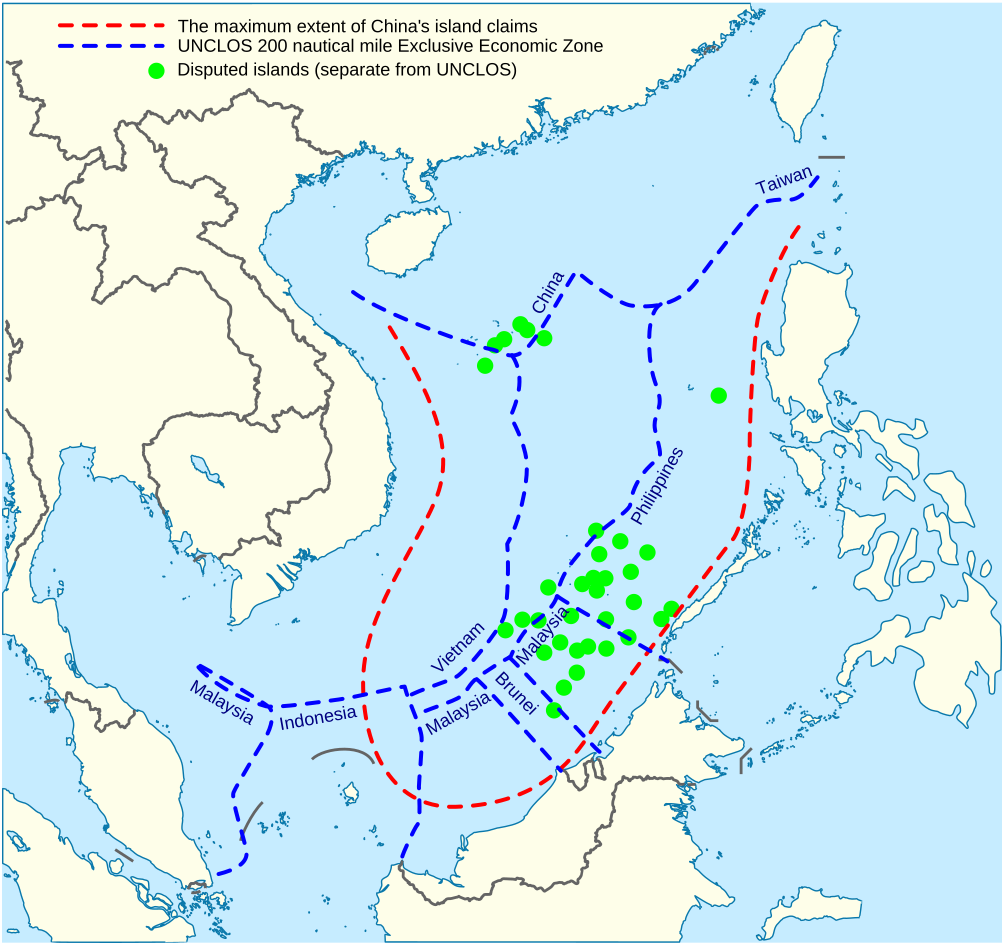
The friction traces back to a joint statement issued on July 12 by the United States, the Philippines, Japan and eleven other countries. The statement marked ten years since the Permanent Court of Arbitration in The Hague ruled that China's expansive maritime claims, including its so-called "nine-dash line," have no basis in international law.
The 2016 tribunal, convened under the U.N. Convention on the Law of the Sea, sided overwhelmingly with the Philippines, which had brought the case after years of confrontation with Chinese vessels. Beijing refused to participate in the proceedings and has never recognized the outcome.
The U.S. State Department, under the current Trump administration, reaffirmed the ruling as "final, legally binding, and definitive," calling on all parties to resolve maritime disputes peacefully and in line with international law. The European Union followed with its own statement backing the tribunal's findings, prompting Beijing's sharp rebuke on Tuesday.
.
A Familiar Pattern From Beijing
China's response fits a well-established pattern: reject the 2016 ruling outright, then pressure any government that references it. Beijing's foreign ministry has previously described the tribunal decision as "null and void," a position it has repeated for a decade regardless of mounting international consensus against it.
Critics of the Chinese Communist Party's foreign policy argue this approach reflects a broader unwillingness to accept multilateral legal frameworks whenever they conflict with Beijing's territorial ambitions. Rights groups and regional analysts have long pointed to Chinese coast guard actions against Philippine vessels, including water-cannon incidents, as evidence that Beijing continues to assert its rejected claims by force rather than through law.
.
Why the Region Is Watching Closely
The South China Sea is one of the world's busiest shipping corridors, and disputes there involve not just China and the Philippines but also Vietnam, Malaysia, Brunei and Taiwan. The 14-nation statement explicitly warned against "destabilizing" actions in the waters, a phrase widely understood as a reference to Chinese coast guard operations near contested reefs and shoals.
Washington's continued backing of the Philippines, a treaty ally, signals that the current U.S. administration intends to keep a firm line on the issue rather than soften its stance for the sake of trade diplomacy with Beijing. That approach marks continuity with earlier U.S. efforts to rally allies around a rules-based order in the Indo-Pacific.
.
Outlook
Beijing's warning to Europe is unlikely to change the legal standing of the 2016 ruling, which remains binding under international law regardless of China's objections. What it may affect is the tone of EU-China relations in the coming months, particularly as European governments weigh trade and investment ties against pressure to align with Washington and Manila on regional security.
For now, the exchange underscores a wider pattern: nations that invoke international law against Chinese territorial claims can expect diplomatic pushback, while Beijing itself has offered no legal counter-argument to the tribunal's findings — only political objection.
.
Sources:
- Reuters – "China urges Europe to stop backing 'illegal' South China Sea ruling to avoid harming ties" (July 14, 2026): https://www.reuters.com/world/china/china-urges-europe-stop-backing-illegal-south-china-sea-ruling-avoid-harming-2026-07-14/
- Reuters – "South China Sea joint statement says China's maritime claims have no basis" (July 12, 2026): https://www.reuters.com/world/china/south-china-sea-joint-statement-says-chinas-maritime-claims-have-no-basis-2026-07-12/
- U.S. Department of State – "Joint Statement on the Tenth Anniversary of the Philippines-China South China Sea Arbitral Tribunal Award": https://www.state.gov/releases/office-of-the-spokesperson/2026/07/joint-statement-on-the-tenth-anniversary-of-the-philippines-china-south-china-sea-arbitral-tribunal-award
- Associated Press (via Las Vegas Sun) – "14 nations and the EU reaffirm 2016 ruling invalidating China's claims in South China Sea": https://lasvegassun.com/news/2026/jul/11/14-nations-and-the-eu-reaffirm-2016-ruling-invalid/
- Ministry of Foreign Affairs of the People's Republic of China – Spokesperson Lin Jian's Regular Press Conference archive (primary source for China's official position): https://www.fmprc.gov.cn/eng/xw/fyrbt/
.
What's Your Reaction?
 Like
0
Like
0
 Dislike
0
Dislike
0
 Love
0
Love
0
 Funny
0
Funny
0
 Wow
0
Wow
0
 Sad
0
Sad
0
 Angry
0
Angry
0















Comments (0)