

Beijing's Power Play: Taiwan's Opposition Leader Flies to China — Weeks Before Trump Meets Xi
Beijing's Power Play: Taiwan's Opposition Leader Flies to China — Weeks Before Trump Meets Xi - A high-stakes diplomatic visit is raising alarm in Taipei: the head of Taiwan's largest opposition party is heading to Beijing — at a moment when the island's defense future hangs in the balance.


.
A high-stakes diplomatic visit is raising alarm in Taipei: the head of Taiwan's largest opposition party is heading to Beijing — at a moment when the island's defense future hangs in the balance.
.
A Trip That Changes the Game
.
The leader of Taiwan's largest opposition party, the Kuomintang (KMT), has accepted an invitation from Chinese leader Xi Jinping to visit China in April — a visit that comes approximately one month before U.S. President Donald Trump's planned trip to Beijing for his own summit with Xi.
China's Taiwan Affairs Office Director Song Tao announced that Xi had invited KMT Chairwoman Cheng Li-wun to lead a party delegation to Jiangsu, Shanghai and Beijing from April 7 to 12.
Cheng, who took up her role as KMT chair in November, has insisted on meeting Xi before making an official trip to the United States — a stance that has drawn criticism from inside and outside her own party that she is too close to Beijing.
The timing of the announcement sent shockwaves through Taipei's political establishment.
Who Is Cheng Li-wun?
.
The KMT — formally known as the Kuomintang or Nationalist Party — has long favored closer political and economic ties with mainland China. But Cheng has taken that stance further than many of her predecessors.
Cheng won election as KMT chairwoman in October and has signaled a swing toward even closer ties with Beijing than her predecessor Eric Chu, who did not visit China during his entire term as chairman beginning in 2021.
It will be the first visit to China by a sitting KMT chairperson since November 2016, when then-KMT leader Hung Hsiu-chu met with Xi in Beijing.
While the KMT has long supported friendlier relations with Beijing, Cheng has been accused by President Lai Ching-te's Democratic Progressive Party (DPP) of doing Beijing's bidding by stalling the government's defense spending plans.
The Defense Budget at the Center of It All
.
Behind the diplomatic drama lies a very concrete political battle: money for Taiwan's military.
The announcement of Cheng's visit comes at a time when President Lai's government is trying to get Taiwan's opposition-majority parliament to approve an extra $40 billion in defense spending.
The KMT has said it supports strengthening Taiwan's defenses but will not sign "blank cheques" and wants more details from the government.
Washington has taken notice. Cheng's trip to China was announced precisely as a U.S. bipartisan Congressional delegation was visiting Taiwan, increasing pressure on the island for greater military spending.
Trump's administration has strongly backed Taiwan's defense buildup — making the KMT's obstruction all the more politically sensitive.
What Beijing Is Really After
.
The Chinese Communist Party (CCP) has never governed Taiwan. Yet it insists the island is Chinese territory and has repeatedly threatened to use military force to take it. Against this backdrop, Cheng's visit fits a clear pattern.
Taiwan's ruling DPP has been blunt in its assessment: Beijing is using its relationship with the KMT as a wedge to divide Taiwan politically and weaken its national resolve. The DPP warned Cheng not to allow herself to become a tool in the CCP's broader campaign to undermine Taiwan from within.
Any efforts to improve cross-strait relations during the visit, Cheng said, must be grounded in the so-called "1992 consensus" and opposition to Taiwan independence. The "1992 consensus" is an informal understanding between the CCP and the former KMT government, acknowledging there is only "one China" — while deliberately leaving the definition of that "China" open to interpretation.
The ruling DPP rejects this framework entirely, insisting that any cross-strait dialogue must happen on the basis of equality, dignity, and without political preconditions.
Doubts — Even Within the KMT
.
Not everyone in the KMT is celebrating. There are concerns within the party itself that a Cheng-Xi meeting could trigger significant voter backlash in Taiwan's district elections later this year.
Speaking to foreign media ahead of the announcement, Cheng acknowledged the limits of what one meeting can achieve: "I do not believe a single meeting can resolve all the issues that have been accumulating for nearly a century. But I hope I can successfully build such a bridge."
She framed her visit in optimistic terms, expressing hope that it would help show the world the two sides of the strait are not inevitably headed toward conflict. Critics, however, question whether bridge-building is truly what Beijing has in mind.
The Military Threat Runs in Parallel
.
While diplomacy plays out in conference rooms, China's military has not softened its pressure on Taiwan.
China has stationed obsolete supersonic fighter jets — converted into attack drones — at six air bases near the Taiwan Strait, according to a report by the Arlington-based Mitchell Institute for Aerospace Studies. The People's Liberation Army continues to send warships and aircraft near Taiwan on an almost daily basis.
The Taiwan Strait is one of the world's most strategically vital shipping routes. Any armed conflict there would immediately reverberate across global trade and security.
The Bigger Picture: Between Washington and Beijing
.
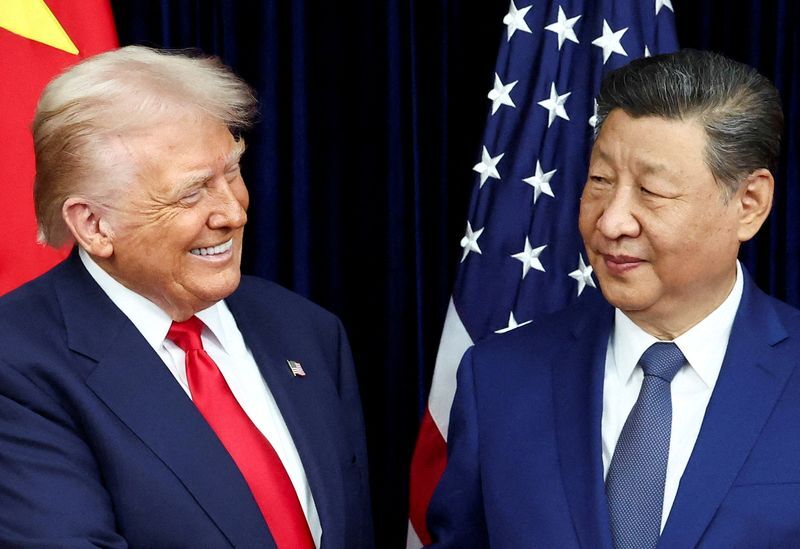
Trump is scheduled to travel to Beijing in mid-May for a summit with Xi — a meeting that was postponed from early April due to U.S. trade negotiations. Beijing's invitation to Cheng, coming just weeks before that summit, appears carefully calculated.
China severed high-level communications with Taiwan in 2016 after President Tsai Ing-wen, from the DPP, took office. Chinese leaders have been openly hostile toward current President Lai Ching-te, whom Beijing labels a "separatist."
By welcoming the KMT while freezing out the elected government, the CCP is sending a clear message: it will deal with Taiwan only on its own terms — and only with those willing to accept them.
Whether Cheng's April visit opens a genuine path toward stability — or simply hands Beijing a propaganda victory — remains to be seen. But for Taiwan's democracy, the stakes could not be higher.
.
Sources:
- Reuters – Taiwan's opposition leader to visit China next month, ahead of Trump: https://www.yahoo.com/news/articles/taiwans-opposition-leader-visit-china-021629027.html
- Bloomberg – Xi Invites Taiwan's Opposition Leader to First Visit Since 2016: https://www.bloomberg.com/news/articles/2026-03-30/xi-invites-taiwan-s-opposition-leader-to-first-visit-in-decade
- The Japan Times – Head of Taiwan's main opposition KMT accepts Xi invite to visit China: https://www.japantimes.co.jp/news/2026/03/30/asia-pacific/politics/kmt-cheng-xi-taiwan-china/
- Taipei Times – KMT chair accepts trip invite from Xi Jinping: https://www.taipeitimes.com/News/front/archives/2026/03/30/2003854724
- Hong Kong Free Press (AFP) – Taiwan opposition leader accepts President Xi's invitation to visit China: https://hongkongfp.com/2026/03/30/taiwan-opposition-leader-accepts-president-xis-invitation-to-visit-china/
- Taiwan News – KMT's Cheng Li-Wun accepts Xi's invite to visit China in April: https://www.taiwannews.com.tw/news/6330471
- Free Malaysia Today (Reuters) – Taiwan opposition leader accepts Xi's invitation to visit China: https://www.freemalaysiatoday.com/category/world/2026/03/30/taiwan-opposition-leader-accepts-xis-invitation-to-visit-china/
.
What's Your Reaction?
 Like
0
Like
0
 Dislike
0
Dislike
0
 Love
0
Love
0
 Funny
0
Funny
0
 Wow
0
Wow
0
 Sad
0
Sad
0
 Angry
0
Angry
0











Comments (0)