

Xi’s Removal of Top Generals Rooted in Disagreements Over China’s Future, Analyst Says


According to Tang Boqiao, a U.S.-based Chinese pro-democracy activist, the confrontation between Xi and Zhang had been brewing for more than three years and was rooted in fundamental disagreements over the CCP’s political direction, military strategy, and China’s future.
“This was nothing like Xi Jinping’s previous purges against [military] generals,” Tang told The Epoch Times on Jan. 27. “Zhang Youxia actually held military power. He’s the only one in China with the capacity to challenge Xi Jinping.”
Zhang comes from one of the CCP’s most prestigious military families. His father, Zhang Zongxun, was a founding general of the communist regime and later served as head of the PLA’s General Logistics Department. Zhang Zongxun and Xi Jinping’s father, Xi Zhongxun, were close even before the communists usurped power in China in 1949.
When Xi rose to power, Zhang Youxia emerged as one of the so-called princelings in the military who backed Xi’s consolidation of authority. By Xi’s third term, Zhang had effectively become the PLA’s top operational commander, outranking all other generals beneath Xi.
That position, Tang said, made Zhang fundamentally different from other senior officers purged under Xi, such as Guo Boxiong or Xu Caihou.
Clash of Values, Strategy
Tang said Zhang had no ambition to replace Xi as the Chinese leader. Instead, their conflict stemmed from clashing worldviews.One major rupture came after Xi pushed through constitutional changes in 2018 that removed term limits. While Zhang initially accepted the move, Tang said he later came to believe that Xi’s indefinite rule was destabilizing and unsustainable for the CCP.
A sharper divide emerged over Taiwan, according to Tang.
He said Zhang repeatedly sought to restrain Xi from launching a military assault on the island. Xi, by contrast, was increasingly eager to test China’s military options.
What began as disagreements over rhetoric and planning evolved into disputes over implementation. According to the Jamestown Foundation analysis, these clashes eventually took the form of what appeared to be open resistance to Xi’s directives.

They said Zhang repeatedly opposed launching an immediate military campaign, arguing that this would risk intervention from the United States and its allies.
Espionage Allegations, Information Warfare
Following Zhang’s removal, The Wall Street Journal reported—citing anonymous sources—that Zhang was accused of leaking nuclear weapons information to the United States, in addition to corruption.Tang dismissed the allegation as implausible and politically motivated. Accusing a top military commander of nuclear espionage, he said, would serve to deter backlash within the ranks by framing Zhang as a traitor.
“Because a country’s most closely guarded secrets typically involve nuclear matters, the decision by Xi’s regime to circulate such allegations signals an intent to destroy Zhang Youxia politically,” Tang said.
.
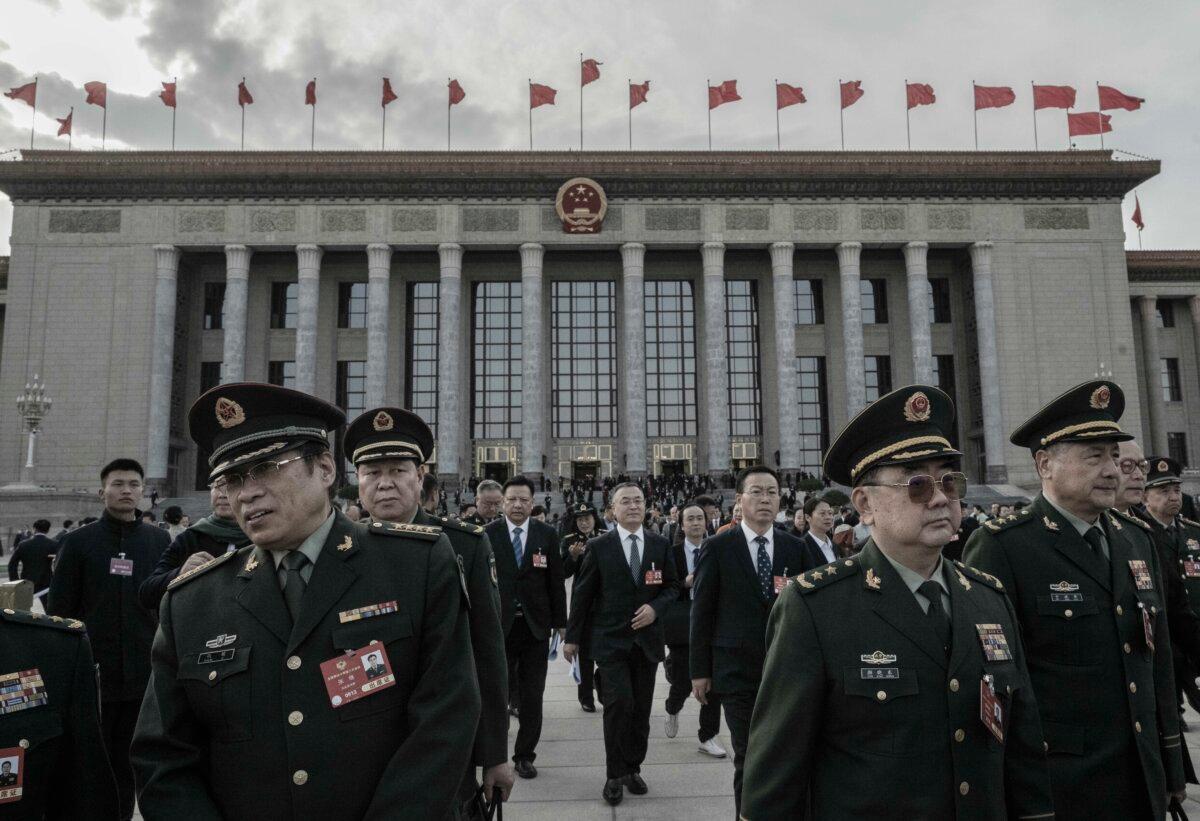
Notably, Zhang’s official biography has not yet been removed from the CCP’s propaganda and military websites. Beyond a limited military editorial criticizing Zhang and Liu, there has been an unusual absence of loyalty pledges, supportive statements, or coordinated propaganda from the PLA’s theater commands and branches, Tang said.
“In past purges, there was wall-to-wall propaganda,” he said. “This time, the propaganda isn’t following up, which is unusual.”
A source in China close to the Chinese military told The Epoch Times on Jan. 26 that some mid- and senior-level officers were abruptly ordered to suspend leave and remain on standby, amid tightened internal controls.
Tang believes the situation remains unresolved and that more people from within the CCP are opposing Xi’s actions.
According to Tang, Xi and Zhang once had a relationship akin to that of close brothers, and even members of Xi’s own family reportedly sympathize with Zhang.
The likely outcome, Tang concluded, is mutual damage. Zhang is unlikely to recover his position, while Xi’s authority within the bureaucracy and military will continue to erode, fueling passive resistance and noncompliance.
What's Your Reaction?
 Like
0
Like
0
 Dislike
0
Dislike
0
 Love
0
Love
0
 Funny
0
Funny
0
 Wow
0
Wow
0
 Sad
0
Sad
0
 Angry
0
Angry
0













Comments (0)