

Why ASML Chipmaking Tools Remain China’s Core Bottleneck Despite Reports of EUV Progress

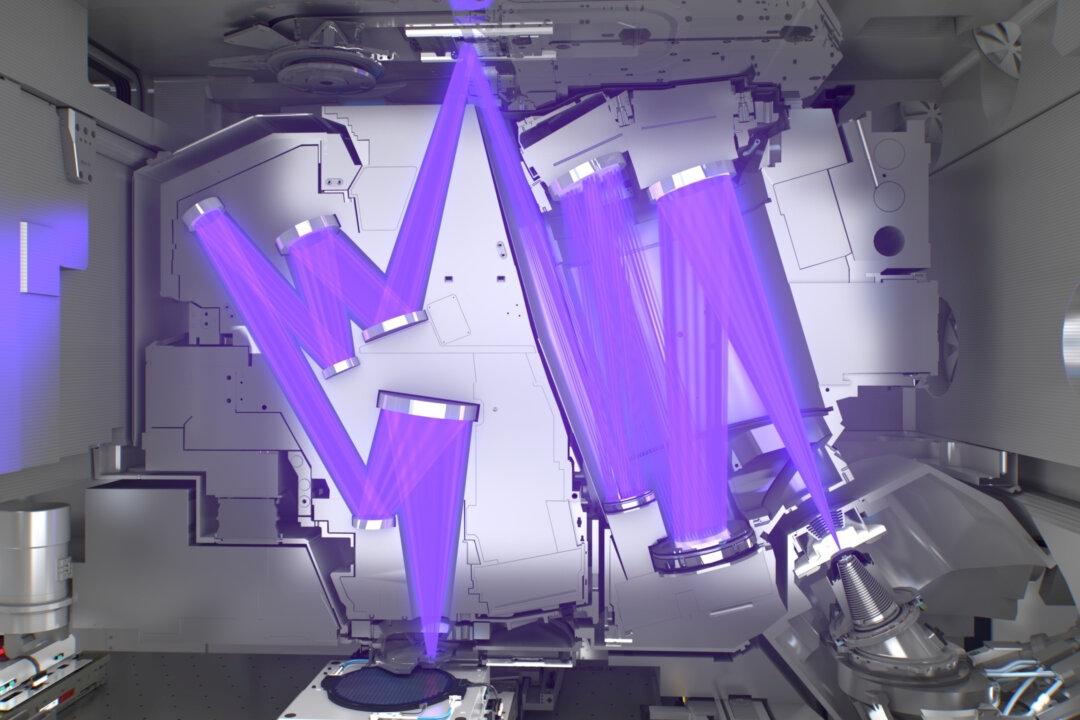
For weeks, Chinese state outlets have touted “major breakthroughs” in extreme-ultraviolet (EUV) lithography—the light-etching machines that make the world’s most advanced chips and the main choke point in Beijing’s semiconductor push.
Yet industry insiders, engineers, and analysts say the fanfare is wildly premature.
Beijing’s labs can now flash tiny bursts of EUV light, yet the country remains at least two decades—most experts say closer to three—from matching Advanced Semiconductor Materials Lithography (ASML), the Dutch firm that alone can mass-produce working EUV systems.
A full EUV platform needs three subsystems to work in perfect sync: a powerful light source, high-precision mirrors, and an ultrastable stage that moves the silicon wafer. The light source is the hardest piece.
The global standard, pioneered by ASML, is an LPP (laser-produced plasma) source that fires a carbon dioxide (CO₂) laser at microscopic droplets of molten tin.
China’s leading LPP project sits inside the Shanghai Institute of Optics and Fine Mechanics (SIOM), headed by Lin Nan, a former ASML light-source scientist lured home in 2021.
Lin’s team in March reported 3.42 percent conversion efficiency and single-pulse energies above 20 millijoules—better than the 3.2 percent logged in 2019 by the Netherlands’s Advanced Research Centre for Nanolithography and Switzerland’s ETH Zurich’s 1.8 percent in 2021.
Conversion efficiency is the share of laser power that becomes usable EUV light, so at 3 percent, 97 percent is lost as heat or stray radiation; higher figures cut that waste and speed production.
State media hailed the numbers as “internationally advanced,” yet they still trail earlier lab marks—4.9 percent achieved at the University of Central Florida in 2007 and 4.7 percent set by Japan’s Utsunomiya University last year—and remain well below the roughly 5.5 percent efficiency of today’s best commercial CO₂-laser sources from companies such as ASML, the report stated.
Other Chinese institutes are testing alternative physics.
Researchers at the Guangdong Institute of Intelligent Manufacturing and Huazhong University of Science and Technology are experimenting with slim fiber-optic lasers that fire in rapid succession, hoping to avoid the huge CO₂ laser setup that ASML relies on.
Tsinghua University is trying the boldest idea so far. It wants to generate EUV light with a particle accelerator that produces a continuous stream of tightly packed light pulses, known as steady-state microbunching (SSMB) EUV.
Industry Skepticism
Despite growing media speculation, ASML Chief Executive Christophe Fouquet remains doubtful of these claims.Hsueh Tsung‑chih, a former procurement manager at Taiwan Semiconductor Manufacturing Company (TSMC), the world’s leading chipmaker, echoed Fouquet’s assessment.
“Nearly every one of those Chinese headlines is wildly overstated and sensational,” he told The Epoch Times.
“If they truly have that capability, they’d keep quiet to avoid sanctions.”
Hsieh estimates China is at least 20 years from ASML’s current level.
“What they have now is lab‑controlled. In the lab, you can use enormous equipment and ignore cost just to get one successful shot,” he explained.
Turning that into a production tool—identical wafers, 24 hours a day—“can take 20 years and still fail,” he said. “Just like many professors publish great papers but can’t turn them into products.”
“Mass production means identical quality every second,” Hsueh added.
Lin Tsung-nan, an electrical-engineering professor at National Taiwan University, noted that ASML’s top EUV light source currently operates at 600 watts or higher, whereas the prototype in China’s HIT is reported to operate at under 100 watts.
“This is nowhere near the power needed on a real fab,” he told The Epoch Times, where at least 250 watts is typically required to achieve production-level throughput.
Li Kuan-hua, head of policy research at Taiwan’s Industrial Technology Research Institute, dismisses each Chinese claim as a mere “paper machine,” reminding that a factory-ready EUV system still needs flawless mirrors, vibration-free stages, and constant feedback from cutting-edge fabs—even if the light source itself were perfected.
“Especially at 3‑nm and 2‑nm nodes, where minuscule tolerances can ruin yields,” Li told The Epoch Times.
The yields refer to the share of wafers that meet tight performance specs during chip production.
Why Talents—and Freedom—Matter
Building a lithography ecosystem, experts say, is as much about people and institutions as about physics.“Science needs the freedom to fail,” Su Tzu-yun, director of Taipei’s Institute for National Defense and Security Research, told The Epoch Times.
Reverse-engineering works for an aircraft carrier, he said, but not for physics that lives at the scale of atoms.
Li adds that true lithography mastery demands the painstaking “craftsman spirit” seen in Japan—decades of repetition and simulation. In China, funding races often reward speed over rigor, pushing researchers to inflate claims.
What ASML Actually Built
Money alone didn’t give ASML its edge. The Dutch company spent three years proving EUV could work and another 15 turning it into a factory workhorse, sharing data with customers like TSMC, Samsung, and Intel to fine-tune every glitch.Hsueh said that patient, methodical culture is the opposite of Beijing’s habit of chasing shortcuts through IP theft or splashy acquisitions.
EUV technology requires petabytes—millions of gigabytes—of optical data gathered over decades, data that only ASML possesses. “Even if someone bought the company tomorrow,” Hsueh said, “their army of PhDs still couldn’t replicate the machine overnight.”
TSMC’s new fab in Arizona showed just how crucial tacit expertise can be, he said, with yields stuck in limbo until the company flew in hundreds of veteran engineers from Taiwan and shipped over its massive data archives.
“That soft power can’t be copied,” Hsueh noted.
China has thrived with low-barrier products like solar panels, he said, “but semiconductors are where it hits the wall.”
Even in i-line lithography—the 365-nanometer tools used for older chips—China’s market share is only about 4 percent, the report stated. In cutting-edge EUV, it is virtually zero.
Li said U.S. export controls have slowed China’s progress to a crawl. As nations with 3- and 2-nanometer lines race ahead, “the gap will only widen.”
Su pegs the current lag at 30 years.
Even a few breakthroughs might shrink that to 20, he said, but the rest of the world will keep moving too. “The distance,” he said, “is likely to hold.”
What's Your Reaction?
 Like
0
Like
0
 Dislike
0
Dislike
0
 Love
0
Love
0
 Funny
0
Funny
0
 Wow
0
Wow
0
 Sad
0
Sad
0
 Angry
0
Angry
0















Comments (0)