

What's Really in Your Baby's Food? A New Study Has Alarming Answers
What's Really in Your Baby's Food? A New Study Has Alarming Answers - Seven out of ten products in the baby food aisle are ultra-processed — loaded with additives, sugar, and industrial chemicals. And the most popular packaging format of the last decade may be the worst offender of all.

.
Seven out of ten products in the baby food aisle are ultra-processed — loaded with additives, sugar, and industrial chemicals. And the most popular packaging format of the last decade may be the worst offender of all.
.
You pick up a pouch of baby food at the supermarket. The packaging shows images of fresh fruit. The label says "natural" or "wholesome." You assume you are making a healthy choice for your infant.
You are probably not.
A major new peer-reviewed study has found that 71 percent of all infant and toddler food products sold in U.S. grocery stores are classified as ultra-processed foods — products that are not made from real ingredients in any meaningful sense, but assembled from industrial compounds, synthetic additives, and heavily refined raw materials in factory conditions. And in the majority of cases, the first ingredient listed is not a fruit, a vegetable, or a grain. It is a chemical additive.
What the Study Found
.
Researchers at The George Institute for Global Health analyzed 651 infant and toddler food products from the top ten U.S. grocery store chains, using the well-established NOVA classification system — the most widely used scientific tool for identifying ultra-processed foods. The results, published in the peer-reviewed journal Nutrients in February 2026, represent what researchers described as a worrying trend.
Across all products studied, researchers identified more than 105 unique additives. The most common were flavor enhancers, found in 36 percent of products; thickeners in 29 percent; and emulsifiers and synthetic color additives each in 19 percent. Lead researcher Dr. Elizabeth Dunford of the George Institute described the findings as particularly concerning given how vulnerable infants are: "Infancy is a critical time for shaping lifelong eating habits — introducing babies to foods that are overly sweet, salty and packed with additives can set the stage for unhealthy preferences that last beyond childhood."
"What shocked me," Dunford added in an interview with CNN, "was that the top ingredient in 71 percent of these baby foods wasn't a fruit or vegetable — it was one or more additives. We know that babies' guts are not fully developed enough to handle additives in the way an adult stomach could. There is no need for these additives; they are simply cosmetic, designed to make the food look more appealing."
The Sugar and Salt Problem
.
The nutritional gap between ultra-processed baby foods and their less-processed alternatives is stark.
Ultra-processed baby foods contained twice as much sugar as non-ultra-processed equivalents — 14 grams per 100 grams compared to 7.3 grams. Added sugars were found exclusively in ultra-processed products. The disparity was sharpest in snack and finger foods, where ultra-processed options had 2.5 times more sugar per serving. Sodium levels were also consistently higher — 70mg per 100g in ultra-processed products versus 41mg in less-processed alternatives.
These numbers matter especially for infants because the flavor preferences formed in the first year of life tend to persist. Research has consistently shown that babies exposed to ultra-processed foods learn to prefer sugar and artificial flavors over the natural, nutrient-dense foods that form the foundation of a healthy diet — setting up preferences that can last a lifetime.
The Pouch Problem
.
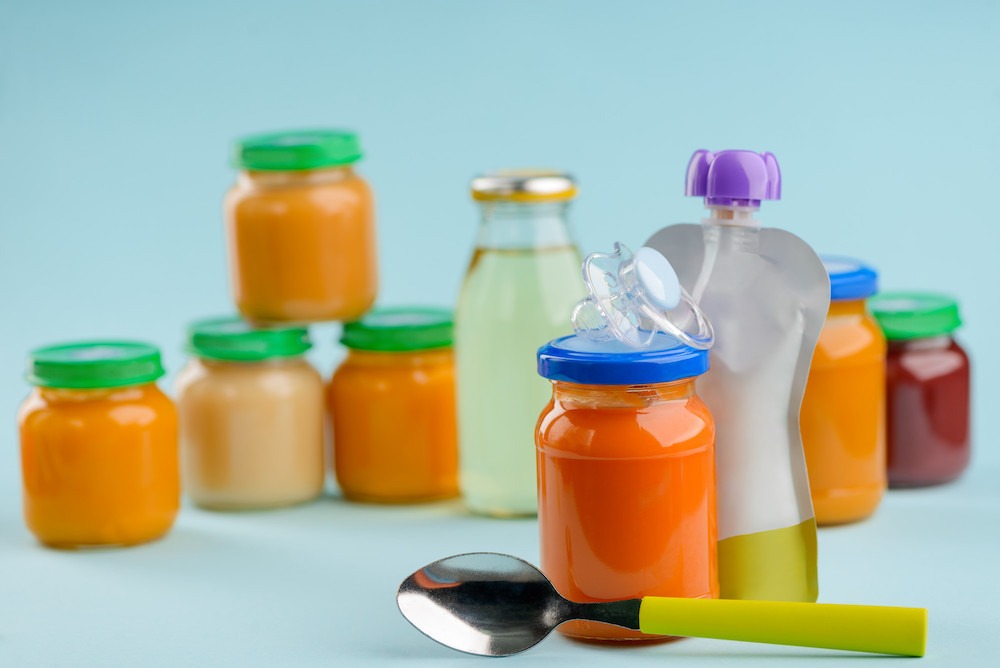
One product format stands out as particularly problematic: the squeezable food pouch. These have become one of the most popular baby food formats in the United States — and for good reason. They are convenient, portable, and easy to use on the go. But the research paints a troubling picture.
Sales of baby food in pouches have grown nearly 900 percent since 2010, researchers noted — making them one of the fastest-growing segments of the baby food market. Yet 73 percent of pouch products were classified as ultra-processed.
A related 2024 analysis of the same dataset found that 50 percent of all sugar consumed from infant foods comes from pouches alone. The same study found that 70 percent of the 651 baby foods examined failed to meet World Health Organization guidelines for protein content in infant foods. One in five contained salt levels above WHO recommended limits, and 25 percent did not meet calorie recommendations.
Why These Additives Are Not Just "Cosmetic" Concerns
.
Industry groups have long argued that food additives are safe because they are approved by the U.S. Food and Drug Administration. But the scientific picture is more complicated.
Nearly 99 percent of new food chemicals enter the market through a regulatory loophole that allows companies to add new substances to foods without any FDA safety review — by self-declaring them "Generally Recognized as Safe," a process that critics say puts the burden of proof on consumers, not manufacturers.
An April 2025 study found a link between common thickeners and emulsifiers — including polysorbate 80, carrageenan, xanthan gum, and guar gum — and an increased risk of type 2 diabetes. Other studies have documented disruptions in gut microbiota and inflammatory responses associated with these compounds.
Infants and toddlers face heightened risk: their gut physiology is more vulnerable than that of adults, and the additives studied may affect inflammation pathways and gut barrier function. A previous study also found that the early-life gut microbiome influences a child's risk of developing anxiety and depression later in childhood — adding a mental health dimension to what might otherwise seem like a purely physical concern.
Longer-term, the health stakes are significant: studies have shown that consuming just 10 percent more daily calories from ultra-processed food is associated with a 50 percent higher risk of cardiovascular disease-related death, a 55 percent greater chance of obesity, and a 40 percent higher probability of developing type 2 diabetes.
A Regulatory System That Is Failing Families
.
There are currently no federal labeling requirements for ultra-processed foods in the United States. In Europe, products containing specific additives linked to adverse health effects — including certain synthetic dyes — must carry warning labels. American parents have no such guidance.
In the absence of federal action, individual states have started moving. California signed a historic new law last year to legally define ultra-processed foods and phase out the most harmful from public school meals. Lawmakers in dozens of other states have introduced legislation targeting harmful chemicals in the food supply — but progress remains fragmented and slow.
The American Academy of Pediatrics called for "urgently needed reforms" to the FDA's food additive regulatory process as far back as 2018. Seven years later, those reforms have not materialized.
What Parents Can Do Right Now
.
The situation is alarming — but parents are not powerless. Experts offer practical, achievable steps that do not require cooking expertise or expensive equipment.
The simplest rule: look at the ingredient list. It is often possible to find less-processed alternatives to common baby foods. Instead of a flavored yogurt with added colors or sweeteners, a yogurt made with just cultured milk and fruit accomplishes the same nutritional goal with a fraction of the additives. When buying packaged foods, choose options with shorter, simpler ingredient lists — the fewer unfamiliar words, the better.
For those willing to spend fifteen minutes in the kitchen, the rewards are significant. Steaming a bag of frozen vegetables and blending them with a small amount of water produces a pure, additive-free puree that can be frozen in ice cube trays and stored for weeks. Fresh herbs like basil or mint can add variety without chemicals. The result is not only healthier — it is substantially cheaper than commercial baby food.
The goal does not have to be perfection. Research consistently shows that dietary patterns established in the first years of life tend to persist — meaning that even small, consistent shifts toward whole, minimally processed foods during infancy can meaningfully shape a child's palate and long-term metabolic health.
The baby food aisle was supposed to make parenthood easier. What a major scientific study has now confirmed is that it has been making it more dangerous — one squeezable pouch at a time.
.
Sources:
- The George Institute for Global Health – Official Study Press Release (February 11, 2026): https://www.georgeinstitute.org/news-and-media/news/nearly-three-quarters-of-us-baby-foods-are-ultra-processed-new-study-finds
- CNN Health – Over 70% of Tested Baby Foods Are Ultraprocessed and Full of Additives: https://www.cnn.com/2026/02/11/health/baby-food-additives-ultraprocessed-study-wellness
- Environmental Working Group (EWG) – Nearly Three-Quarters of U.S. Baby Foods Are Ultra-Processed: https://www.ewg.org/news-insights/news/2026/02/nearly-three-quarters-us-baby-foods-are-ultra-processed-new-study-finds
- U.S. News & World Report – Most U.S. Baby Food Is Ultra-Processed, Study Finds: https://www.usnews.com/news/health-news/articles/2026-02-12/most-u-s-baby-food-is-ultra-processed-study-finds
- EurekAlert / AAAS – Nearly Three Quarters of US Baby Foods Are Ultra-Processed: https://www.eurekalert.org/news-releases/1115759
- Nutrition Insight – Study Finds 71% of US Baby Foods Are Ultra-Processed: https://www.nutritioninsight.com/news/ultra-processed-baby-foods-us-study.html
- Medical Xpress – Nearly Three-Quarters of U.S. Baby Foods Are Ultra-Processed: https://medicalxpress.com/news/2026-02-quarters-baby-foods-ultra.html
- Original Study – Nutrients Journal (DOI): https://doi.org/10.3390/nu18040584
.
What's Your Reaction?
 Like
0
Like
0
 Dislike
0
Dislike
0
 Love
0
Love
0
 Funny
0
Funny
0
 Wow
0
Wow
0
 Sad
0
Sad
0
 Angry
0
Angry
0












Comments (0)