

Trump Calls Japan's Takaichi Straight From Air Force One — Alliance 'Ironclad,' China Briefing Stays Secret
Hours after wrapping up a two-day state visit to Beijing, U.S. President Donald Trump called Japanese Prime Minister Sanae Takaichi from Air Force One to reaffirm the U.S.–Japan alliance. The two leaders discussed China, the Indo-Pacific, and Iran — but what exactly was said about the Beijing summit stays confidential.


.
A Call at Altitude — and a Clear Signal
The timing was deliberate. Barely off Chinese soil, President Donald Trump picked up the phone aboard Air Force One on Friday and called Japanese Prime Minister Sanae Takaichi in Tokyo. The message was unmistakable: Washington's partnership with Japan remains solid, regardless of what was agreed — or not agreed — in Beijing.
Takaichi told reporters afterward that the two leaders reaffirmed the "ironclad" nature of the U.S.–Japan alliance. "We exchanged views on issues surrounding China, including the economy and security, and reaffirmed close communication on Indo-Pacific issues," she said.
What Was Discussed — and What Wasn't
The phone call covered three main areas: China policy, Indo-Pacific security, and Iran. Takaichi said she shared Japan's position on the ongoing Iran conflict with Trump, though she did not provide details.
One question, however, went unanswered. When a reporter asked whether the two leaders had discussed Taiwan, Takaichi declined to respond. The silence itself speaks volumes — Taiwan remains one of the most sensitive fault lines in the region, and Japan has been watching the Beijing summit closely for any signals that Washington might soften its stance.
A Secret Briefing on the China Visit
Trump did debrief Takaichi on his two-day stay in Beijing — but with a condition attached. "President Trump briefed me in detail on his China visit, on the condition that our conversation remain confidential," Takaichi said.
That the briefing happened at all is significant. It signals that Washington is actively managing allied relationships and not leaving partners in the dark after a major diplomatic engagement with China.
What Happened in Beijing
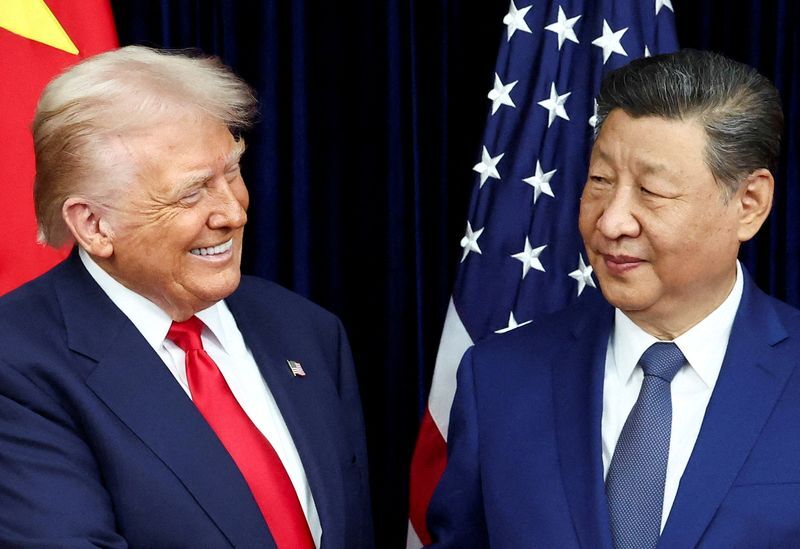
Trump's state visit to China on May 14 and 15 was his first trip to the country since 2017. He met with Chinese leader Xi Jinping at the Great Hall of the People in Beijing for talks that ran twice as long as originally scheduled. The two sides discussed the Iran conflict, trade, technology access, and fentanyl flows into the United States.
Xi declared that China and the U.S. had agreed to pursue a "constructive relationship of strategic stability" — a phrase carefully chosen to project confidence while leaving room for continued rivalry. The Chinese Communist Party-controlled state framed the summit as a victory for Beijing's diplomatic standing.
Analysts at the Center for Strategic and International Studies noted that regional allies — especially Japan, South Korea, and Taiwan — are nervous that Trump may have made concessions on issues critical to their security in exchange for Chinese cooperation on Iran.
Japan's Balancing Act
For Takaichi, the call was more than a formality. Japan has been navigating a difficult stretch in its relations with China since late 2025, when Takaichi made remarks suggesting that a Taiwan crisis could constitute a "survival-threatening situation" for Japan — comments that sharply worsened ties with Beijing.
Since taking office in October 2025, Takaichi has consistently prioritized the U.S.–Japan alliance as the cornerstone of her foreign policy. She met Trump at the White House in March 2026, and the two have spoken by phone multiple times. Each exchange has reinforced that Tokyo sees Washington as its indispensable partner in a region where China's military and economic influence continues to grow.
Looking Ahead
The phone call is likely to be followed by closer consultations between Tokyo and Washington as the details of the Beijing summit become clearer. Japan will be particularly focused on any agreements — or informal understandings — that touch on Taiwan, trade, or the broader balance of power in the Indo-Pacific.
For now, Takaichi kept the contents of Trump's briefing firmly under wraps. But the fact that the call happened within hours of Air Force One leaving Chinese airspace suggests both leaders understand the stakes — and the need to keep their alliance visibly, and vocally, intact.
.
Sources:
- Reuters – Trump reaffirmed 'ironclad' US–Japan alliance after China trip: https://uk.news.yahoo.com/trump-reaffirmed-ironclad-us-japan-115711220.html
- Center for Strategic and International Studies – Trump–Xi Summit Analysis: https://www.csis.org/analysis/trump-xi-summit-beijing-managing-worlds-most-important-relationship
- Wikipedia – 2026 State Visit by Donald Trump to China: https://en.wikipedia.org/wiki/2026_state_visit_by_Donald_Trump_to_China
- Responsible Statecraft – Takaichi–Trump Alliance Dynamics: https://responsiblestatecraft.org/sanae-takaichi-donald-trump/
- Northeastern University – Trump–Xi Summit Expert Analysis: https://news.northeastern.edu/2026/05/13/trump-xi-2026-summit-analysis/
.
What's Your Reaction?
 Like
0
Like
0
 Dislike
0
Dislike
0
 Love
0
Love
0
 Funny
0
Funny
0
 Wow
0
Wow
0
 Sad
0
Sad
0
 Angry
0
Angry
0












Comments (0)