

How to Win the Race for the Moon


.
评论
唐纳德·特朗普总统显然已经明确表示,他希望美国人在他的任期结束前(2029 年 1 月)重返月球,并赶在中国 2030 年实现登月目标之前完成。
这很可能就是为什么10月20日,美国国家航空航天局(NASA)代理局长、交通部长肖恩·达菲在接受CNBC电视台采访时表示:“总统和我希望在本届总统任期内登上月球……我们将推进这项工作,并在与中国的第二次太空竞赛中获胜。”
让美国人重返月球这场简单的竞赛,美国完全有能力赢得,但对人类而言意义更为重大的登月竞赛,或者说在月球上确保足够的存在,以确保中国及其太空盟友俄罗斯不能阻止美国及其60个国家的《阿尔忒弥斯协定》联盟伙伴进入月球,同样是美国的能力所在。
中国共产党正不遗余力地在月球上建立军事优势,以实现其在地球上政治、经济和军事霸权的野心。通过阻止中共进入月球和火星,民主国家在极端情况下无法利用太空资源来击败中共的霸权。
从本质上讲,中共寻求太空霸权,以通过将月球和火星变成“监狱大门”来巩固其地球霸权,阻止人类逃离中共的统治。
最近,10月30日,中国载人航天工程办公室(CMSEO)发言人张敬波表示:“关于具体时间表,我们仍然坚定不移地朝着2030年实现中国登月的目标前进。”
张先生还表示:“包括长征十号火箭、孟州飞船、蓝月着陆器、望宇月球舱外活动服和探索载人月球车在内的关键飞行硬件的初步原型设计已经完成。”
.
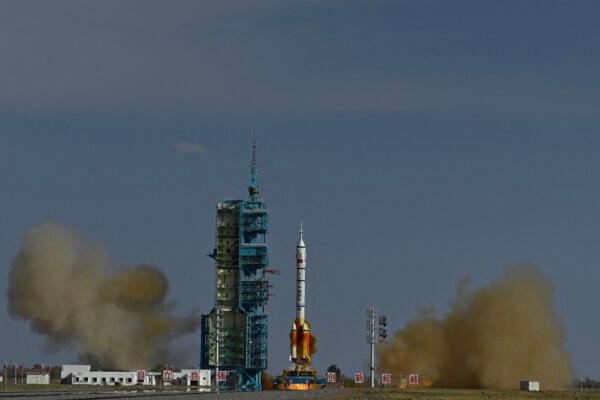
2025年4月24日,一枚长征二号F运载火箭搭载着神舟二号飞船和三名航天员从戈壁沙漠的酒泉卫星发射中心升空。(图片来源:Pedro Prdoa/AFP via Getty Images)
.
2026年,中国很可能开始试飞其新型中国航天科技集团公司(CASC)长征十号重型运载火箭(SLV),需要两枚长征十号火箭将新型蓝月号登月飞船和新型孟州号载人飞船送入月球轨道对接,并转移两名宇航员,之后蓝月号将降落到月球上。
但中国方面也明确阐述了北京登月的目标。在2024年9月举行的中国深空探测实验室会议上,中国重大深空探测项目总设计师吴彦华解释道:
“A basic [moon base] model to be built by 2035 in the lunar south pole region, and an extended model to be built by about 2050 … Per the blueprint, the extended model will be a comprehensive lunar station network that utilizes the lunar orbit station as its central hub and the south pole station as its primary base, and it will include exploration nodes on the lunar equator and the far side of the moon.”
Wu also revealed that “the planned ILRS [China–Russia International Lunar Research Station] will be powered by solar, radioisotope, and nuclear generators. It will also include lunar-Earth and high-speed lunar surface communication networks, as well as lunar vehicles like a hopper, an unmanned long-range vehicle, and pressurized and unpressurized manned rovers.”
Chinese sources have also mentioned the possibility of China building a small space station for lunar orbit, like the Artemis Program Gateway Space Station. These sources have also suggested that this lunar space station would be built at Earth-moon Lagrange Point-1 (EM-L1, between the Earth and moon), which would facilitate constant contact and resupply of Chinese moon bases.
Such an infrastructure on the moon, according to Wu, “will be capable of laying a foundation for manned landings on Mars in the future,” and an “expandable, maintainable system capable of long-term robotic operations with short-term human participation.”
As the People’s Liberation Army controls all Chinese space activities, it is to be expected that the Chinese military will quickly use its expanding manned moon bases to secure cislunar space, or the region between the Earth and the moon, to counter current passive and future U.S. active military space assets, with an EM-L1 lunar space station ideally suited for denying access to the moon.
As such, it is indeed essential for the freedom and security of Americans and all democracies that NASA devise and implement a plan that fulfills Trump’s goal of returning Americans to the moon before China, and to win the race to build a dominant presence on the moon that gives the U.S. president options to deter and deny CCP attempts to dominate the moon.
This will be a principal task for aerial entrepreneur and commercial astronaut Jared Isaacman, whom Trump renominated on Nov. 4 to become the 15th Senate-confirmed NASA administrator.
In a move that will assist Isaacman’s leadership, apparently also at Trump’s request, on Oct. 20, Duffy announced that NASA would reopen competition for the contract to build the Human Landing System (HLS), or manned moon landing vehicle, for the Artemis-III manned moon mission scheduled for 2027 or 2028.
The main reason for doing so was the determination that Elon Musk’s SpaceX Corporation, which won the HLS contract for Artemis-III in 2021, was not meeting its goals to build the HLS in time for Artemis-III.
Also on Oct. 20, Duffy stated he was open to solutions from SpaceX and from Jeff Bezos’s Blue Origin company, saying, “Whatever one can get us there first to the moon, we’re gonna take. And if SpaceX is behind, but Blue Origin can do it before them, good on Blue Origin. But by the way, we also might have two companies, and that can get us back to the moon in 2028.”
Time constraints may dictate that Artemis-III retain the current $2–$4 billion-per-mission NASA Space Launch System (SLS), which will only bring the manned Orion spaceship to lunar orbit. Still, the reopening of the HLS competition means that Isaacman has options to devise a far less expensive U.S. “architecture” for returning to and occupying the moon.
.
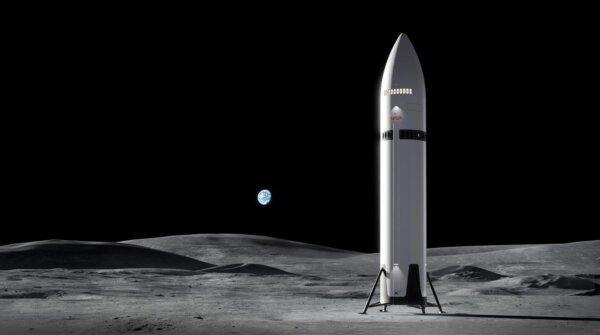
Concept art of the SpaceX lunar lander slated to be used for Artemis III in 2027. (Courtesy of NASA).
.
On Oct. 30, SpaceX responded to the controversy with a rare public update on its webpage that stated the following: “SpaceX’s HLS team has completed 49 milestones tied to developing the subsystems, infrastructure, and operations needed to land astronauts on the moon.
“Starship provides unmatched capability to explore the Moon. ... Cargo variants of the Starship lander will be capable of landing up to 100 metric tons directly on the surface, including large payloads like unpressurized rovers, pressurized rovers, nuclear reactors, and lunar habitats.
“Starship continues to simultaneously be the fastest path to returning humans to the surface of the Moon and a core enabler of the Artemis program’s goal to establish a permanent, sustainable presence on the lunar surface.”
But with the successful second-mission first-stage recovery on Nov. 13 of Blue Origin’s New Glenn (NG-2) space launch vehicle, and the Nov. 20 announcement by Blue Origin that its NG-3 mission will have a more powerful second stage capable of moving 20 tons to the moon, NASA has options here.
Blue Origin’s NG-3 mission is scheduled for early 2026 and will transport the 21-ton unmanned Blue Moon Mk 1 moon landing vehicle on its “Pathfinder Mission” with the capability of taking 3 tons of cargo to the moon.
Blue Moon Mk 1 will be the predecessor to the larger Blue Moon Mk 2, which will be able to take 20 tons of cargo to the moon, but may not be ready until the early 2030s.
However, if SpaceX is truly judged unable to meet a 2027 or 2028 goal, then there is the option to rapidly modify the Blue Moon Mk 1 to accommodate at least two astronauts, with the goal of putting Americans on the moon before 2029.
The Artemis-III SLS could then take three astronauts in the Orion spaceship. However, at less cost, subsequent astronaut transport missions could be accomplished with the SpaceX Falcon Heavy and a moon-mission modified SpaceX Dragon manned spaceship.
但美国的王牌仍然是基于 SpaceX 星舰的 HLS,或者至少是专用且更简单的货运版本,它能够运送 100 吨月球货物,这将确保美国在中国之前建立多个月球基地,从而赢得登月竞赛。
此外,2021 年,法国斯特拉斯堡国际空间大学的一个团队提议将星舰发展成一个水平月球基地,其可居住空间是国际空间站的 2.5 倍。
如果中国决定在EM-L1部署小型空间站,那么NASA也可以选择迅速部署类似Gateway的小型月球空间站,以便有能力打破中共对月球的任何“封锁”。
Gateway 最初设计用于停放可重复使用的登月飞行器,但它也可以支持更小、更便宜的运载火箭将人类送上月球,并为快速补给和救援任务提供选择。
简而言之,美国有多种选择来赢得登月竞赛,并建立月球和地月空间架构,以阻止中国在太空的侵略。
Views expressed in this article are opinions of the author and do not necessarily reflect the views of The Epoch Times.
.
What's Your Reaction?
 Like
0
Like
0
 Dislike
0
Dislike
0
 Love
0
Love
0
 Funny
0
Funny
0
 Wow
0
Wow
0
 Sad
0
Sad
0
 Angry
0
Angry
0



















Comments (0)