

How Beijing Targets Critics, Dissidents in Canada


.
In-depth
In another incident in February, Sheng’s name was used to attempt to send a bomb threat to the office of Taiwan’s president, according to email records reviewed by The Epoch Times. She received an email on Feb. 20 from Taiwan’s National Police Agency asking her to confirm her identity in relation to a threat email that had been sent to the agency’s director general using her name.
“China’s transnational repression is one of the most dangerous and under-recognized threats to global democracy–and Canada has become a frontline target,” Sheng told The Epoch Times.
A Concern Among G7 Leaders
At this year’s G7 Leaders’ Summit in Canada, world leaders issued a joint statement condemning the rise of transnational repression. They said they were “deeply concerned” over foreign governments targeting dissidents abroad, and pledged coordinated action to counter the practice.Commissioner Marie-Josée Hogue, who led Canada’s recent inquiry into foreign interference, said that while transnational repression was outside the scope of her investigation, the practice–which she called a “genuine scourge”–warrants prompt government action.

Commissioner Justice Marie-Josee Hogue listens during the Foreign Interference Commission in Ottawa, on Sept. 18, 2024. The Canadian Press/Justin Tang
.
TNR takes place when foreign states or their proxies reach beyond their borders to advance their interests or silence criticism or dissent through intimidation, threats, or violence. It can take various forms, such as surveillance, vandalism, murder attempts, forced return by confiscating passports, threats against relatives in the home country, or digital smear campaigns.
Gloria Fung, a Toronto-based pro-democracy advocate from Hong Kong, says she has seen first-hand how Beijing’s TNR affects diaspora communities by instilling fear.
Serving as the immediate past president of Canada-Hong Kong Link and co-convenor of the Canadian Coalition for a Foreign Influence Transparency Registry, Fung says she has been the target of TNR due to her advocacy work. She told The Epoch Times she has received threatening calls and has seen people following her or taking photos without her consent.
“I’m not afraid because I’m already a public figure, and they won’t be able to silence me or stop me from doing what I consider to be the right thing to do–to voice out the concerns of the voiceless people in Hong Kong and China,” she said.
“This is the least we can do for them.”
.

Gloria Fung, President of Canada-Hong Kong Link, joins rights groups on Parliament Hill on Feb. 27, 2025, to address gaps identified in the Foreign Interference Commission's final report. NTD
.
Here is a look at how Beijing has targeted critics and dissidents in Canada in recent years.
.
Targeting Spiritual Groups: Falun Gong
Spiritual groups that face persecution in China have also been targeted by Beijing in Canada.
Their targeting in Canada over the past 26 years has taken several forms, such as physical assault, intimidation of relatives, surveillance, cyberattacks, exclusion from local events and activities, impersonation attempts, and pressure on elected officials to withdraw support for Falun Gong.

Toronto police arrest a man who attacked Falun Gong practitioners with a metal bar outside the Chinese Consulate's visa office in Toronto on Jan. 23, 2024. Falun Dafa Association of Canada/Handout Photo
.
In another case, Canada-based practitioner Helen Li, who often participated in activities to highlight the persecution, came across a Chinese man outside her residence in the fall of 2022 who said he knew who her father was. Although she ignored him, she says her father in China began to receive intimidation calls from local police, asking him to persuade her to stop practicing Falun Gong.
Meanwhile, Beijing’s interference attempts have become more “hidden and invisible,” says the 2024 report, with impersonation attempts becoming more prominent since 2010. Numerous municipal, provincial, and federal politicians have received bogus emails from people claiming to be Falun Gong practitioners who use extreme language in an attempt to discredit the group, according to the Falun Dafa Association of Canada.
One such email was sent to Tory MP Scott Reid in 2015 by someone claiming to be a colleague of “Ms. Grace”–presumably Grace Wollensak, spokesperson for the Falun Dafa Association of Canada–and made several “bizarre” statements, according to the 2024 report. Wollensak said she didn’t know anyone by the sender’s name and that the content was not something a practitioner would say.
Wollensak later learned other MPs had received similar emails after one MP complained to her about the aggressive language used in the messages. Wollensak confirmed the emails, some of which claimed to be from senders related to her, were fake.
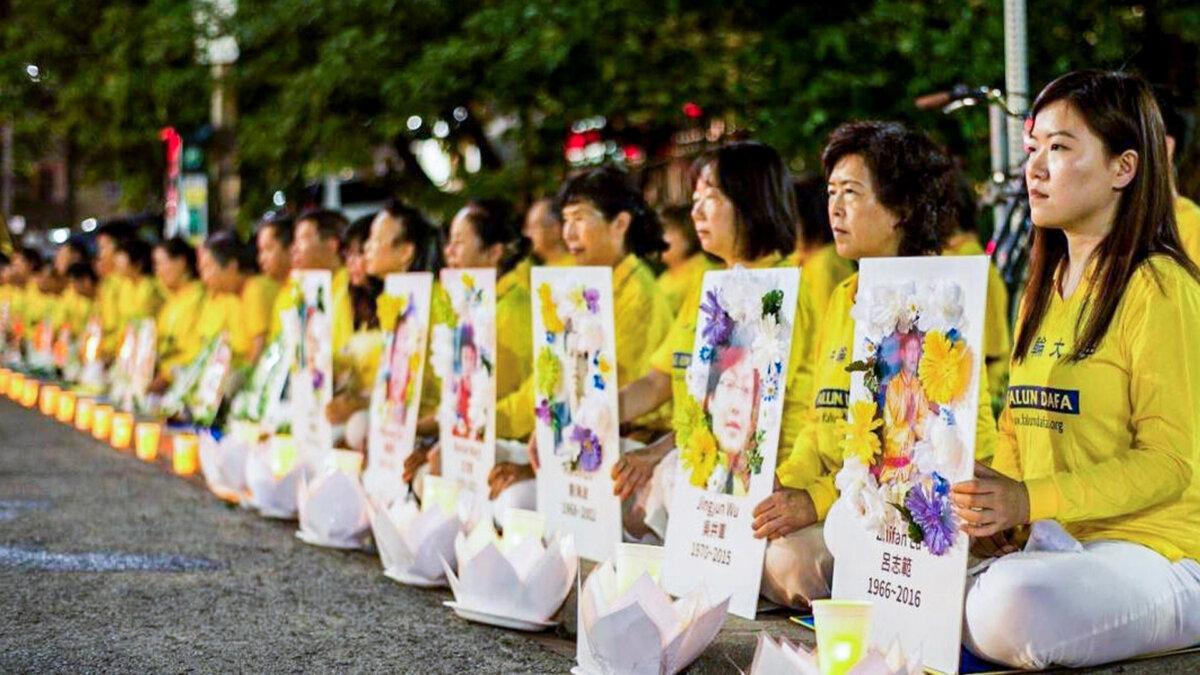
Falun Gong practitioners participate in a candlelight vigil, holding photos of fellow adherents who have died as a result of persecution in China, in front of the Chinese Consulate in Toronto on July 13, 2019. The Epoch Times
.
Sheng Xue says Beijing’s hostile actions beyond its borders are a growing threat.
Hong Kong Bounties on Canadian Citizens
In a recent move condemned by Canada as transnational repression, on July 25 the Hong Kong government issued arrest warrants for 19 people overseas, some of whom live in Canada.Canada responded to the measures the following day, describing them as an escalation of Beijing’s transnational repression.
The ministers added that Canadian intelligence had found the information on the recent bounties was being amplified in an “inauthentic and coordinated” way by online accounts targeting Chinese-speaking communities in Canada. They also urged anyone who felt unsafe due to transnational repression to contact the RCMP.
.

A pedestrian looks at the police reward notices for the arrest warrants issued for eight pro-democracy activists living in the United States, Britain, Canada and Australia for alleged national security offences in Hong Kong, on July 14, 2023. Louise Delmotte, AP
.
One such well-known case in Canada unfolded earlier this year, after it came to light that Hong Kong authorities had issued a bounty on a Canadian citizen and Tory candidate Joe Tay, an outspoken Hong Kong pro-democracy activist.
Cheuk Kwan, co-chair of the Toronto Association for Democracy in China, says one of Hong Kong’s aims in issuing international arrest warrants and bounties is to intimidate the diaspora. He told The Epoch Times he has heard from community members who fear “being kidnapped and shipped back to China or Hong Kong.”
“[It’s] part of the game they have to play to strike fear in the diaspora,” Kwan said.
.

Joe Tay, a singer and actor who moved from Hong Kong to Canada, is seen in a file photo. He was running for the Conservative Party in the Ontario riding of Don Valley North. Courtesy of Joe Tay
.
The first was the “inauthentic and coordinated” amplification of content about Tay’s arrest warrant, the bounty on his head, and his ability to run for office. The second was the “deliberate suppression” of search terms related to Joe Tay.
Tay lost the election narrowly to his Liberal rival. No evidence has emerged to suggest his defeat was linked to interference by the Chinese regime.
.
Targeting MPs, Political Parties
Beijing’s efforts to silence critics have also targeted several Canadian parliamentarians.
Another targeted elected official is NDP MP Jenny Kwan, who was born in Hong Kong and has been outspoken against human rights violations by the Chinese Communist Party (CCP).

NDP MP Jenny Kwan speaks to reporters about her briefing with CSIS where they confirmed that she was a target of foreign interference, in the foyer of the House of Commons on Parliament Hill in Ottawa, on May 29, 2023. The Canadian Press/Justin Tang
.
While he tried to respond to the false narratives, his messaging was not picked up or circulated by Chinese language outlets, says the report. The misinformation operation may have cost Chiu his seat, the commissioner said in a preliminary report released on May 3, 2024.
Suppressed Ethnic Groups: Tibetans
Advocates for Tibetan autonomy and Tibetans’ human rights have also faced repression in Canada.Beijing has long been under international scrutiny for its human rights abuses in Tibet, which it began to occupy in 1950. While China describes its takeover of Tibet as a “peaceful liberation” that helped the region evolve from a “feudal serfdom under theocracy” to a land of “modernization,” the Tibetan government-in-exile calls it a “military invasion” that has led to the “destruction” of Tibet’s culture, environment, and human rights.

Tibetans protest outside the Chinese consulate in Toronto. Leaders in the Canadian Tibetan and Uyghur communities are critical of Torstar Printing Group for printing and distributing China Daily, which is owned by the Chinese Communist Party. Evan Ning/The Epoch Times
.
Gloria Fung says trying to divide diaspora groups in Canada is a common strategy Beijing uses to target critics and dissidents.
“TNR [is] also a means to infiltrate,” she said. “They even send agents here to infiltrate into our Canadian activist groups so as to divide and conquer–take over the leadership to ultimately eliminate the groups.”
.
Uyghur Muslims
Members of the Uyghur diaspora in Canada have also been targeted, including through intimidating phone calls, threats to relatives in Xinjiang, and denial of identity documents, says the 2020 Amnesty International report.
Uyghurs in Canada have reported being denied extensions or renewals of their passports and travel documents, as well as birth certificates for their children, in an effort by Chinese state agents to make them return to China, says the report.
Others have described receiving messages or voicemails telling them to collect “important documents” from the Chinese consulate or embassy, with many being “too afraid” to comply with the requests, according to first-hand interviews conducted by Amnesty International.
.
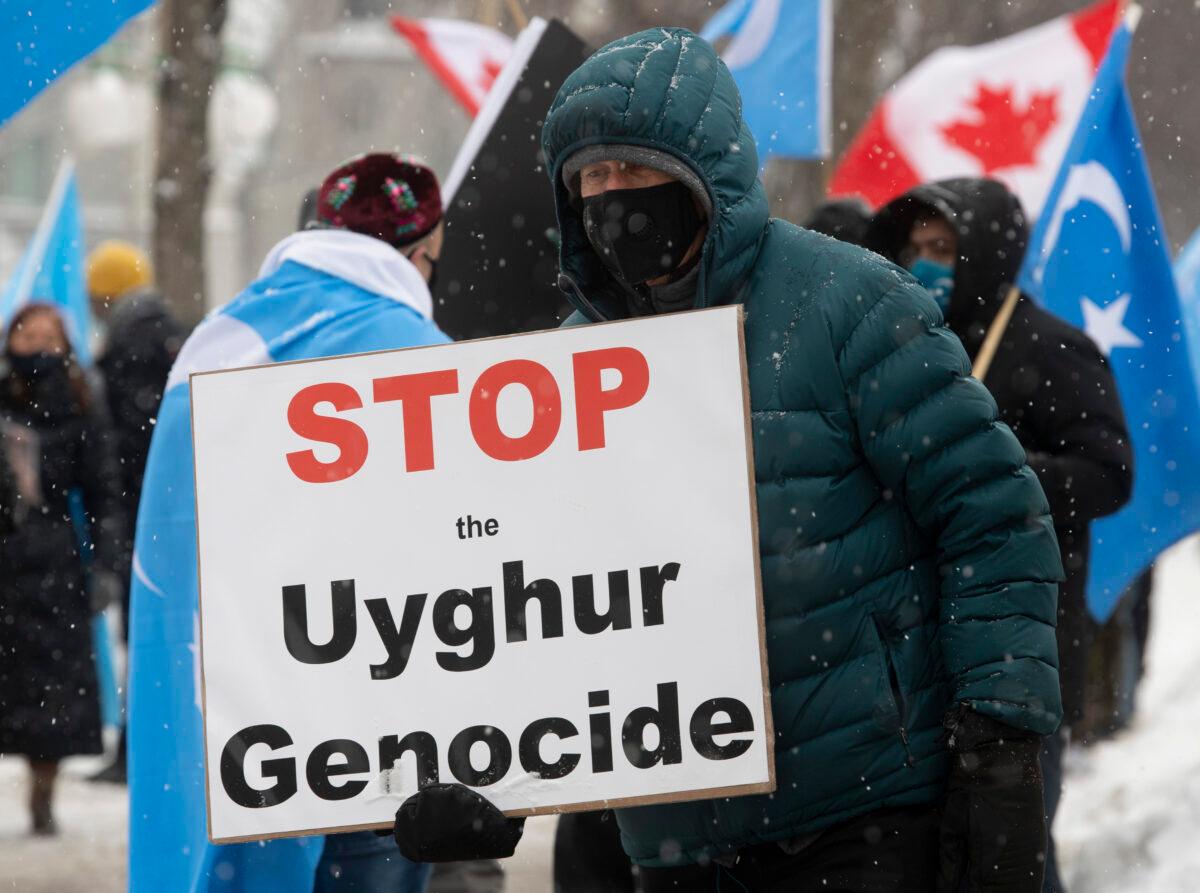
Demonstrators gather outside the Parliament buildings in Ottawa during a protest against Uyghur genocide on Feb. 22, 2021. Adrian Wyld/The Canadian Press
.
Threats against relatives in China are another tactic used by Chinese officials, experienced first-hand by several Uyghur individuals in Canada, the 2020 report says, adding that the measures are generally aimed at pressuring diaspora members to become informants or cease their activism abroad.
Mehmet Tohti, executive director of the Canada-based Uyghur Rights Advocacy Project, has been sounding the alarm over the situation in Xinjiang and Uyghurs abroad.
“The Chinese government basically controls the Uighurs abroad by taking their family members hostage and at the same time applying pressure to control them to serve or work for the Chinese government.”
He noted that Uyghurs abroad often lose communication with their families in Xinjiang due to Beijing’s tight control of the region.
“In my case, I have 37 family members or extended family members in concentration camps,” Tohti told the committee. “I haven’t spoken with my mother for two years. No one [in our community] has been able to communicate with their parents or loved ones for two years.”
.
Targeting Critics On Campus
Critics of the Chinese regime have also faced attempts to silence them in universities and other academic settings.
Since then, Lhamo faced “cyberbullying, online harassment, death threats, sexist and racist insults, and a barrage of obscene and degrading comments on her social media accounts” with most of the messages being in Mandarin and some containing Chinese nationalistic sentiments, says the report.
She completed her term as student union president, though she said many Chinese student groups appeared to be monitoring her while on campus, and that she faced “significant pressure to self-censor about human rights issues in China.”
.

Chemi Lhamo, who served as president of the student union at the University of Toronto Scarborough, in an undated photo. Courtesy of Chemi Lhamo
.
While Lhamo could not provide evidence of Chinese state involvement in her case, she said the pace and scale at which Chinese students coordinated against her is a sign that “they were likely directed to act by the Chinese consulate.”
In a similar case, a Uyghur activist who gave a lecture in 2019 at McMaster University on human rights violations in Xinjiang was filmed and her talk was interrupted by a student who yelled insults at her.

The Chinese Embassy in Ottawa in a file photo. The Canadian Press/Sean Kilpatrick
.
Cheuk Kwan from the Toronto Association for Democracy in China says Hong Kong dissidents, including students abroad, face constant psychological pressure, fearing repercussions if they return home after speaking out.
Foreign Agent Registry
For months, Gloria Fung has been advocating for the swift implementation of the foreign influence transparency registry, a key measure proposed in legislation known as “An Act respecting countering foreign interference,” which received royal assent in June 2024.Meanwhile, Public Safety Canada says it has been actively responding to transnational repression, citing immediate changes that took effect with the passing of the legislation.
.

The Peace Tower is framed through the iron railing on Parliament Hill in Ottawa on Oct. 24, 2024. The Canadian Press/Sean Kilpatrick
.
“[The act] introduced legislative measures to better equip the government to detect, disrupt, and protect against foreign interference threats and transnational repression in Canada, including new criminal offences,” spokesperson Max Watson previously told The Epoch Times.
He added that in Canada, the government and law enforcement have been working with at-risk communities and offering tools to protect them from transnational repression, and that internationally, Ottawa is working with partners to tackle the global threat.
Fung calls the delay in establishing the registry “troubling and disappointing,” adding that its prompt implementation is essential to effectively combat transnational repression.
“We can’t afford to further delay our action in combating TNR and foreign interference,” she said.
Meanwhile, Sheng Xue says that although Beijing’s repression in Canada appears to mainly target Chinese dissidents, it is an issue that concerns all Canadians.
“This is not only an attack on individuals of Chinese origin–it’s an attack on Canadian sovereignty, rule of law, and civil liberties,” she said. “The CCP is effectively trying to extend its authoritarian control onto Canadian soil, threatening freedom of speech, political expression, and public safety within our own borders.”
She added that allowing transnational repression to go unchecked “normalizes” the idea that foreign autocratic regimes can operate “with impunity” inside democracies.
“Today it targets Chinese dissidents; tomorrow it could target anyone who disagrees with foreign powers,” she said.
.
What's Your Reaction?
 Like
0
Like
0
 Dislike
0
Dislike
0
 Love
0
Love
0
 Funny
0
Funny
0
 Wow
0
Wow
0
 Sad
0
Sad
0
 Angry
0
Angry
0













Comments (0)