

G7 in Évian: The Bill Is Coming Due — for Everyone
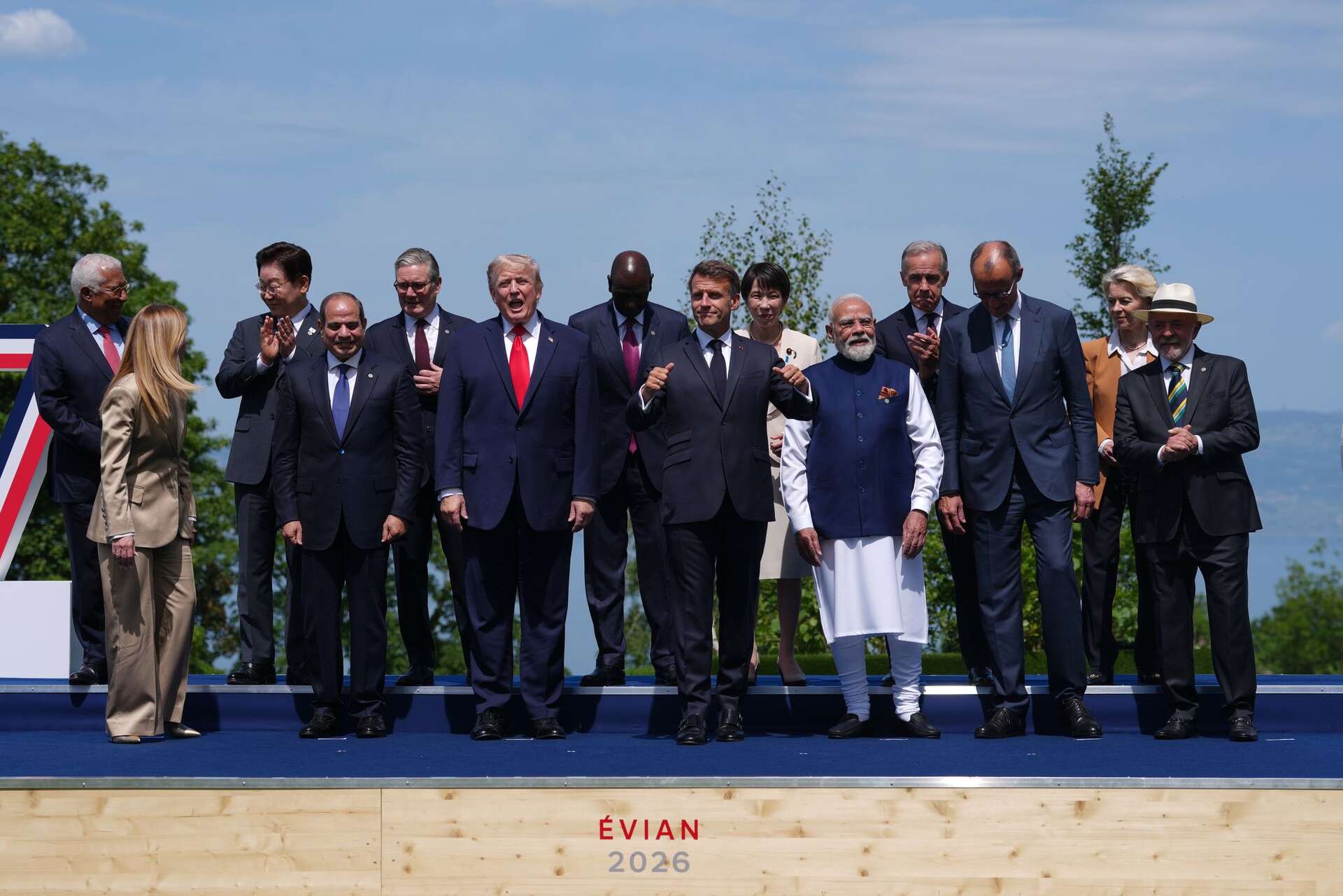
The G7 summit in Évian ended on Wednesday with unity statements on Ukraine, a cautious welcome for the U.S.-Iran deal, and a frank reckoning with the world's biggest economic fault lines. But the harder question — who pays for years of imbalance, dependency, and delayed decisions — was left largely unanswered.

.
A Summit That Almost Didn't Happen Smoothly
Three days, three continents' worth of crises, and one overarching theme: the global economic order is broken, and nobody can agree on how to fix it.
The G7 leaders gathered in the French Alpine resort of Évian-les-Bains against a backdrop of rising inflation, a 30 percent spike in oil prices, and a war in the Middle East that Europe hadn't been consulted about before it started. When U.S. President Donald Trump and Iranian officials announced a preliminary peace deal just hours before the summit opened, the worst-case scenario — a fractious, televised diplomatic breakdown — was avoided.
But the relief was partial. Economists warn that even with the Strait of Hormuz set to reopen, it could take a year before global fuel supplies return to normal. Central banks in Europe and Japan have already raised interest rates to fight renewed inflation. And the damage to household budgets across the G7 is already done.
"The economy is in deep turmoil," said Eric LeCompte of Jubilee USA Network. "You don't have to be in a developing country to see it. You can just go to a grocery store and feel it."
Ukraine: Words of Unity, Questions About Follow-Through
On Ukraine, the G7 delivered its clearest joint statement in some time. Leaders declared their backing for Ukraine's territorial integrity and agreed to tighten sanctions on Russia — a notable result given how difficult it has been in recent months to bring Washington fully on board.
Trump called his meeting with Ukrainian President Volodymyr Zelenskyy "very good," and optimism grew that progress toward peace talks was possible. Zelenskyy, who arrived in Évian without a confirmed bilateral with Trump, ultimately got one — and signaled he was ready to meet Trump again on Wednesday.
As we reported in our previous G7 coverage, Zelenskyy arrived with a stronger hand than a year ago, when his Oval Office encounter with Trump and Vice President JD Vance ended badly. Ukrainian drone strikes have cut deeper into Russian territory, weakening Moscow's battlefield position. The G7 statement reflected that shift.
Still, the gap between a joint declaration and a workable peace framework remains wide. Russia has shown no sign of genuine flexibility. And Europe's preferred strategy — more sanctions, more weapons, more pressure — has so far not produced the breakthrough its architects promised.
The Iran Deal: A Window of 60 Days
G7 leaders welcomed the U.S.-Iran agreement and pledged to support its implementation. France and Britain are expected to lead a joint maritime mission to help clear mines from the Strait of Hormuz and escort tankers through the narrow waterway — plans they had prepared in advance and were waiting for a stable ceasefire to activate.
The summit also opened discussions on reducing long-term energy dependence on the Gulf, including developing alternative supply routes through Egypt.
But European allies remain wary. The preliminary deal opens a 60-day window for detailed technical negotiations that must still resolve the fate of Iran's highly enriched uranium stockpiles and its ballistic missile program. France, Britain, and Germany — which led the original Western engagement with Tehran starting in 2003 — are pushing for a seat in those talks. Whether Trump's team will include them is unclear.
IMF chief Kristalina Georgieva offered a carefully optimistic reading: the world economy is holding up, she said, with no signs of a full global slowdown yet. A formal updated forecast is due July 8. The IMF's best-case scenario, assuming a short-lived conflict, projects global growth of 3.1 percent in 2026, down from 3.4 percent in 2025. Its worst case shows growth falling to 2 percent, with inflation reaching 5.8 percent.
The Elephant Gets Its Own Agenda Item: China
Wednesday's session turned to the issue that has run beneath every G7 discussion this week like an underground current: China. As covered in detail in our earlier reporting on China's absence from the G7, Beijing was not at the table — but shaped almost every item on it.
France framed the problem in three words: China produces too much, the United States consumes too much, and Europe invests too little.
China's trade surplus hit a record $735 billion in 2024, driven by state-subsidized manufacturing output that far exceeds what Chinese households can absorb. That surplus has flooded global markets with cheap goods — cars, solar panels, electronics — undercutting industries across the G7. The EU recorded its largest-ever trade deficit with China last year, exceeding €360 billion.
Europe's own position is more complex. Its external surplus doesn't stem from industrial dominance but from chronic underinvestment at home. A landmark 2024 report by former European Central Bank president Mario Draghi concluded that Europe's household savings are not being channeled into productive investment — they flow abroad instead, to economies offering better returns.
Meanwhile, the United States sits at the other end of the spectrum: a persistent current account deficit, fueled by high household consumption and low savings, means the country depends on foreign capital to sustain domestic spending. The world's largest economy is effectively borrowing from the world's largest exporter to keep its population shopping.
G7 finance ministers warned last month that these imbalances, if left unaddressed, risk unwinding in a financial crisis.
Critical Minerals: Dependency That Took Decades to Build
Closely linked to the China discussion is the race to secure critical minerals — the rare earths and battery metals that underpin electric vehicles, defense systems, and advanced electronics.
China's dominance of this sector is the product of decades of deliberate industrial policy. When Beijing tightened export licenses on rare earth magnets in 2025, factories across Europe and the United States slowed or stopped production almost immediately. The EU sources virtually all of its heavy rare earth elements and nearly all of its rare earth magnets from China. The economic shock of the export restrictions exposed just how deep that dependency runs.
France pushed hard at Évian for a joint G7 statement on critical minerals that could include price supports, market standards, subsidies, guaranteed purchase agreements, and scaled-up private investment in supply chains outside China. The United States has separately proposed a minerals trading bloc — though G7 nations remain divided on how it would work alongside Washington's "America First" trade posture.
Whatever is agreed will be, as diplomats acknowledged, only a first step. It will take years, possibly decades, to meaningfully reduce China's grip on these supply chains.
The G7's Relevance: Still Standing, But Diminished
The summit also prompted a broader reckoning about the club itself. The G7 now represents just 44 percent of global GDP — down from more than 60 percent when it was founded in 1975. Emerging economies including India, China, and Brazil account for a growing share of the world economy yet have no permanent seat at the table.
France, keen to avoid open conflict as host, preemptively dropped the idea of a broad final communiqué. Instead, the summit produced targeted declarations on specific issues — global imbalances, critical minerals, AI, and development financing. The result was a summit that functioned but did not lead.
"The G7 has always been able, if needed, to come up with real decisions that still govern half the world economy," said Martin Muehleisen, a former IMF strategy chief. But analysts noted that by sidestepping the question of who bears responsibility for the Iran war's economic fallout, the leaders left a significant gap in their collective credibility.
"U.S. policymaking has been hurting world economic activity," said Marcelo Estevao of the Institute of International Finance. The G7 — born of the 1973 oil shock — ducked the primary economic challenge of this week. That, observers said, risks eroding the club's own purpose.
Whether the Évian summit ultimately marks a turning point — on Ukraine, on critical minerals, on the global imbalance — or simply another well-managed gathering that deferred the hardest decisions, will depend on what happens in the next 60 days: the window the Iran deal has opened, and the window the world is watching.
.
Sources
- Reuters, "Why the G7 is worried about global economic imbalances" — document provided (reuters.com)
- Reuters, "G7 leaders back Ukraine, plan greater pressure on Russia" — document provided (reuters.com)
- Reuters, "Trump's Iran war weighs on G7 economies, but don't expect hard talk in France" — document provided (reuters.com)
- Euronews, "G7 summit live: US to focus again on Ukraine after Iran deal, Trump says" — https://www.euronews.com/my-europe/2026/06/15/g7-summit-leaders-set-to-arrive-in-evian-after-us-iran-ceasefire-deal
- Atlantic Council, "Seven charts that will define France's G7 summit" — https://www.atlanticcouncil.org/dispatches/seven-charts-that-will-define-frances-g7-summit/
- Geneva Solutions, "What can G7 achieve amid Ukraine and Iran wars, economic crisis and aid cuts?" — https://genevasolutions.news/global-news/what-can-g7-achieve-amid-ukraine-and-iran-wars-economic-crisis-and-aid
- University of Toronto G7 Research Group, Kirton analysis — https://www.g7.utoronto.ca/evaluations/2026evian/kirton-G7-prospects-260331.html
.
What's Your Reaction?
 Like
0
Like
0
 Dislike
0
Dislike
0
 Love
0
Love
0
 Funny
0
Funny
0
 Wow
0
Wow
0
 Sad
0
Sad
0
 Angry
0
Angry
0













Comments (0)