

Flash Flood Kills Nine on Nepal-Tibet Border, China Reports 'Major Casualties' Across Frontier
A sudden flash flood tore through Nepal's Rasuwa district on Wednesday, sweeping away entire villages and killing at least nine people. Chinese state media reported "major casualties" on the Tibetan side of the border after a related mudslide, though Beijing gave no figures. Officials on both sides warn the death toll is likely to rise.

.
A Wall of Water Hits the Himalayas
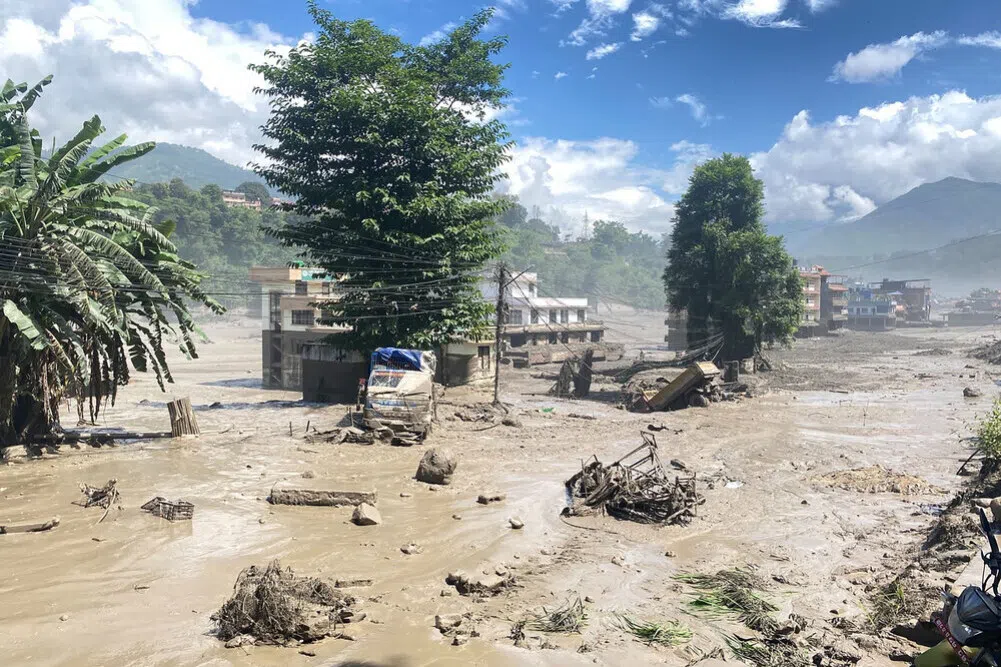
A flash flood swept through Nepal's mountainous Rasuwa district early Wednesday morning, killing at least nine people and leaving dozens more unaccounted for. The disaster struck the settlements of Syapru Besi and Timure, an area of roughly 50,000 residents near the border with China's Tibet region.
The Bhote Koshi river, which flows down from Tibet into Nepal, rose far above its normal level and tore through riverside communities. Local television showed homes collapsing into the floodwater, cars floating downstream, and a metal bridge being ripped away entirely.
"There is devastation everywhere we look," Tula Bahadur BK, a health worker in Rasuwa, said. "The settlements next to the river have been completely swept away. Five of my own relatives are missing."
Rescue Efforts Stall as Waters Stay High
Rescue helicopters have so far been unable to land in the worst-hit areas because the river remains dangerously high, according to Nepali army spokesperson Raja Ram Basnet. Despite the difficult conditions, authorities said as many as a dozen people had been airlifted to safety, with more search-and-rescue flights planned once conditions allow.
Local officials named around a dozen affected settlements, including Syaphrubesi, Betrawati, Mailung, Salletar, Shantibazar, Pairebesi, Khalti Basti, Sole, Trishuli and Battar. The market town of Syaphrubesi appears to have suffered some of the heaviest destruction.
District administrator Narendra Pariyar warned that "there could be heavy casualties or loss of property," and urged residents living along the Bhote Koshi to move immediately to higher ground.
Reports also point to a number of security personnel unaccounted for. Nepali media have cited figures ranging from four to nine Armed Police Force members stationed at a border outpost in Timure who have lost contact since the flood struck. Nepal's Home Ministry has not yet confirmed a final number, underscoring how fluid the situation remains hours after the disaster.
Hydropower and Trade Routes Crippled
The flood has knocked out a significant share of Nepal's electricity supply. Nepal's energy ministry said around 430 megawatts of capacity were affected, most of it from hydroelectric plants, equal to more than 12 percent of the country's total hydropower output of 3.2 gigawatts.
Several major hydropower and transmission sites were damaged, including the Rasuwagadhi, Chilime, Trishuli-3A and Devighat projects. Roads, market areas and police posts along the Nepal-China trade corridor were also hit, cutting off one of the region's key overland links between the two countries.
This is not the first time the route has been severed by disaster. A flood on the same river last year destroyed the "Friendship Bridge" connecting Nepal and China, disrupting cross-border trade and transport for months. Investigators later traced that flood to a supraglacial lake in Tibet that drained suddenly, a pattern increasingly linked to glacial melt in the region.
China Reports Damage but Withholds Details
Across the border in Tibet's Gyirong county, a mudslide triggered by the same weather system struck the Gyirong Port, a major land crossing between China and Nepal. China's state-run Xinhua news agency said the mudslide caused "major casualties" and left people missing, but did not release any casualty figures or further details.
Chinese President Xi Jinping called for "all-out" rescue efforts and stronger early-warning systems to prevent further disasters, according to Xinhua. State broadcaster CCTV aired footage of floodwater carrying debris through the border crossing, though the footage could not be independently verified.
The lack of transparency from Chinese authorities is a familiar pattern. Beijing has a long record of releasing minimal or delayed information after disasters, particularly in Tibetan areas, making independent verification of the toll on the Chinese side difficult.
A Region Increasingly Prone to Disaster
Rasuwa has been the site of repeated catastrophes in recent years. The district was devastated by Nepal's 2015 earthquake, which killed more than 9,000 people nationwide, including many buried by a landslide in the nearby Langtang valley. Just over a year ago, in July 2025, a flood originating in Tibet's Lhende river killed at least nine people in the same area and left dozens missing.
Scientists have repeatedly linked the region's growing flood risk to glacial melt driven by rising temperatures in the Himalayas. Monsoon season, which runs from June to September, regularly triggers deadly flooding and landslides across South Asia, but the frequency of glacier-related flash floods in this specific valley has drawn particular concern from climate researchers.
Government Response and What Comes Next
Nepali Prime Minister Balendra Shah has ordered the evacuation of residents from low-lying areas and mobilized police and army units to support the rescue effort. "Instructions have been given to move the people living in the lower areas to safer places," Shah said, adding that people along the river should "exercise extra caution and remain alert."
Downstream districts, including Nuwakot, Dhading, Gorkha and Chitwan, have been placed on alert as floodwaters move into the Trishuli river system, which eventually flows into India as the Gandak river.
With rescue helicopters still grounded in the worst-affected zones and communication lines cut in parts of the border region, the full scale of the disaster, on both the Nepali and Tibetan sides, may not be known for days.
.
Sources
- Al Jazeera – "At least eight killed as Nepal flash flood damages roads, energy facilities" – https://www.aljazeera.com/news/2026/8/26/at-least-eight-killed-in-nepal-flash-floods-that-swept-away-villages-roads
- The Kathmandu Post – "Bhotekoshi flood: What we know, what remains unclear" – https://kathmandupost.com/national/2026/08/26/bhotekoshi-flood-what-we-know-what-remains-unclear
- Reuters – "Flash flood on Nepal-Tibet border kills nine and destroys villages, toll likely to jump" – https://www.reuters.com/business/environment/nepal-flash-flood-washes-away-villages-project-sites-near-tibet-border-2026-08-26/
- The Japan Times – "Deadly flash flood and mudslide cause casualties in Nepal and China" – https://www.japantimes.co.jp/news/2026/08/26/asia-pacific/nepal-flash-flood/
.
What's Your Reaction?
 Like
0
Like
0
 Dislike
0
Dislike
0
 Love
0
Love
0
 Funny
0
Funny
0
 Wow
0
Wow
0
 Sad
0
Sad
0
 Angry
0
Angry
0










Comments (0)