

Dragon Boat Festival: How a 2,000-Year-Old Tradition Stays Alive
Every year in June, millions of people across China, Hong Kong and Taiwan celebrate one of the world's oldest living cultural traditions. The Dragon Boat Festival blends legend, sport, food and ancient beliefs into a holiday that has endured for more than two millennia — and continues to grow.

.
A Holiday With Ancient Roots
The Dragon Boat Festival — known in Mandarin as Duānwǔ Jié (端午节) — falls on the fifth day of the fifth month of the Chinese lunar calendar. In 2026, mainland China observes it as a national public holiday from June 19 to 21.
The festival is one of China's four major traditional celebrations, alongside Spring Festival, Qingming and Mid-Autumn Festival. Its roots stretch back over two thousand years, drawing from ancient beliefs about the summer solstice, health, protection and harmony with nature.
"The Dragon Boat Festival is probably the richest and most diverse of all traditional Chinese festivals," said Liu Xiaofeng, a history professor at Tsinghua University. "Across different regions, people developed a wide variety of traditions based on ideas connected to the summer solstice and the balance of yin and yang."
The Legend of Qu Yuan
The festival's most famous story centers on Qu Yuan (屈原), a poet and statesman of the Chu Kingdom during the Warring States period, around 340–278 BCE. He was admired for his moral integrity and his passionate poetry — including the masterpiece Li Sao ("Encountering Sorrow"), one of the earliest major works in Chinese literature.
When corrupt officials forced him into exile and his kingdom fell to invaders, Qu Yuan drowned himself in the Miluo River as a final act of protest. The people who loved him raced out in boats to search for his body. They beat drums to drive away evil spirits and threw sticky rice dumplings into the water so that fish would not harm him.
That act of grief and devotion became the foundation of the festival's two most enduring traditions: dragon boat racing and zongzi.
Historians note that the festival likely predates Qu Yuan, with older roots in summer rituals for warding off disease and evil spirits. But his story — a symbol of loyalty and moral courage — became permanently woven into the holiday's identity.
The Race: Speed, Drums and Team Spirit
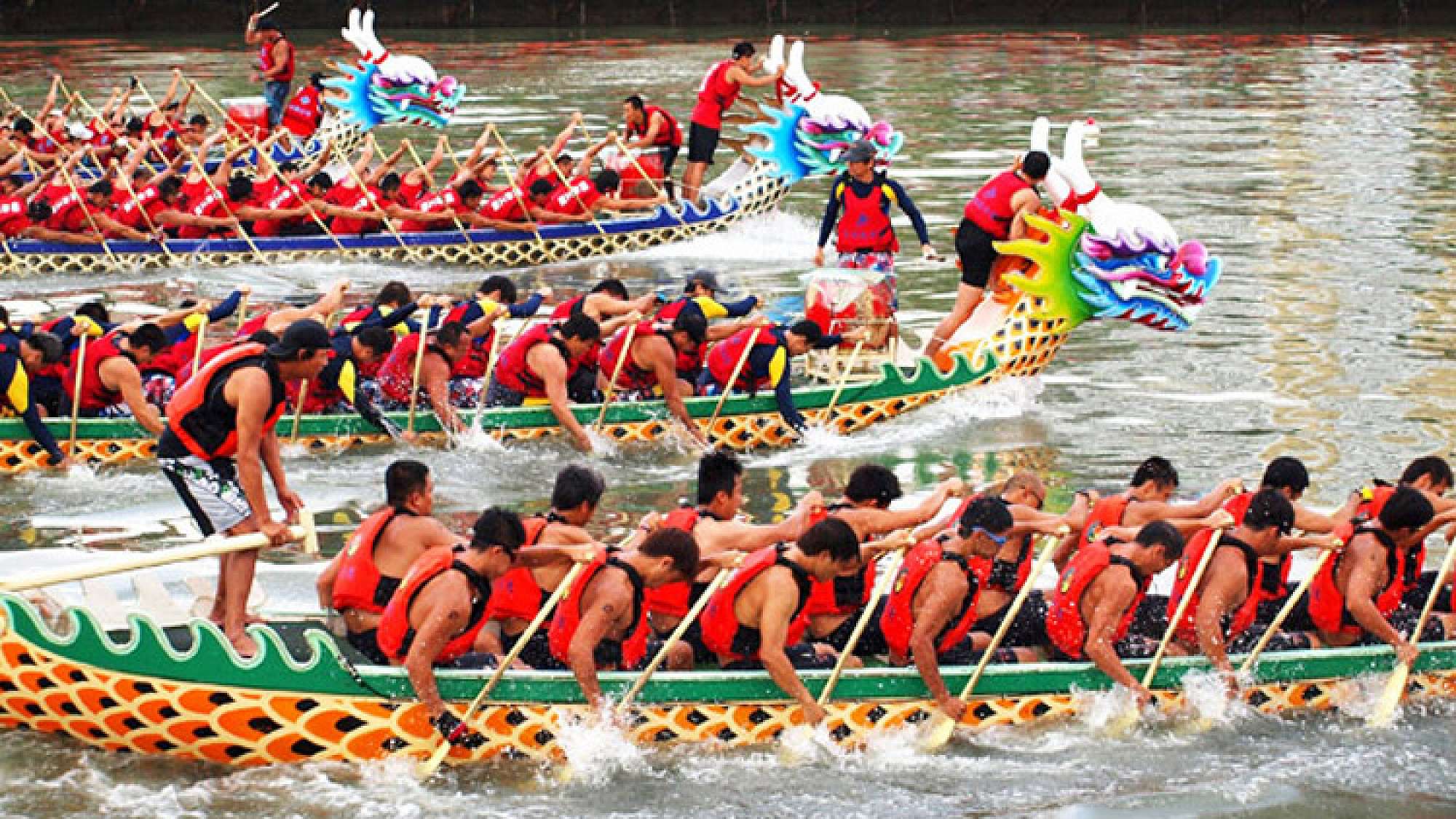
Dragon boat racing is the festival's most spectacular element. Long, narrow wooden boats decorated with dragon heads and tails carry teams of paddlers guided by the thunderous beat of a drummer at the front. Races are intense, fast and deeply communal.
In Beijing, a three-day competition this year features men's, women's and mixed teams racing distances of 100, 200 and 500 meters. Participants came from Beijing, Tianjin, Hebei, Shanxi and Guangdong provinces. The races continue through June 21 at the capital's Grand Canal.
"The competition helped strengthen our team spirit," said Li Maoshan, one of Friday's participants. "It also gave us an opportunity to demonstrate the spirit of perseverance and hard work."
In Hong Kong, racers added a festive touch — some teams wore costumes featuring Ne Zha, a beloved figure from Chinese Taoist mythology. The winning team, tradition holds, will enjoy a year of good fortune.
Zongzi: The Taste of Tradition
At the family table, the festival belongs to zongzi (粽子) — pyramid-shaped dumplings made from glutinous rice stuffed with sweet or savory fillings. Common ingredients include red bean paste, dates, salted egg yolks and pork. The bundles are wrapped in bamboo leaves, tied with string and then steamed or boiled.
Making zongzi together is a cherished family activity across generations. In China, schools and community groups often hold zongzi-making classes so that younger people can learn the skill directly from their elders.
Other traditional practices include hanging mugwort and calamus plants near the door to repel insects and disease — customs rooted in ancient Chinese medicine — and in some regions drinking realgar wine, believed to protect against spirits and illness.
Recognized by the World
The Dragon Boat Festival's cultural significance extends beyond China's borders. In 2009, UNESCO officially inscribed it on the Representative List of the Intangible Cultural Heritage of Humanity — the first Chinese festival to receive that recognition.
Today, dragon boat racing has grown into a competitive international sport practiced on six continents. The festival's blend of legend, physical competition, family ritual and ancient belief gives it a depth that few holidays anywhere in the world can match.
.
Sources
- AP News – Dragon Boat Festival 2026 celebrations in Beijing, Hong Kong and Taiwan (content provided by user): https://apnews.com/article/china-beijing-dragon-boat-festival-qu-yuan-chinese-97fb9175fe29c360d3d99a8d504bc7fd
- Britannica – Dragon Boat Festival: https://www.britannica.com/topic/Dragon-Boat-Festival
- Wikipedia – Dragon Boat Festival (UNESCO inscription): https://en.wikipedia.org/wiki/Dragon_Boat_Festival
- Leeds University Union – Dragon Boat Festival: Tradition, History, and Cultural Significance: https://www.luu.ac.uk/dragon-boat-festival-tradition-history-and-cultural-significance-2/
- China Highlights – Dragon Boat Festival 2026: https://www.chinahighlights.com/festivals/dragon-boat-festival.htm
.
What's Your Reaction?
 Like
0
Like
0
 Dislike
0
Dislike
0
 Love
0
Love
0
 Funny
0
Funny
0
 Wow
0
Wow
0
 Sad
0
Sad
0
 Angry
0
Angry
0













Comments (0)