

Chinese Robot Shatters Usain Bolt's Sprint Record Three Times in One Week — And a Robot Soldier Warning Follows
A Chinese humanoid robot has now run 100 meters faster than Usain Bolt's human world record — not once, but three times in a single week, ending the Beijing games at 8.64 seconds. The story goes far beyond a sprint: it touches AI, US-China tech rivalry, and a developer's prediction that robot soldiers could be only 5 to 10 years away.

.
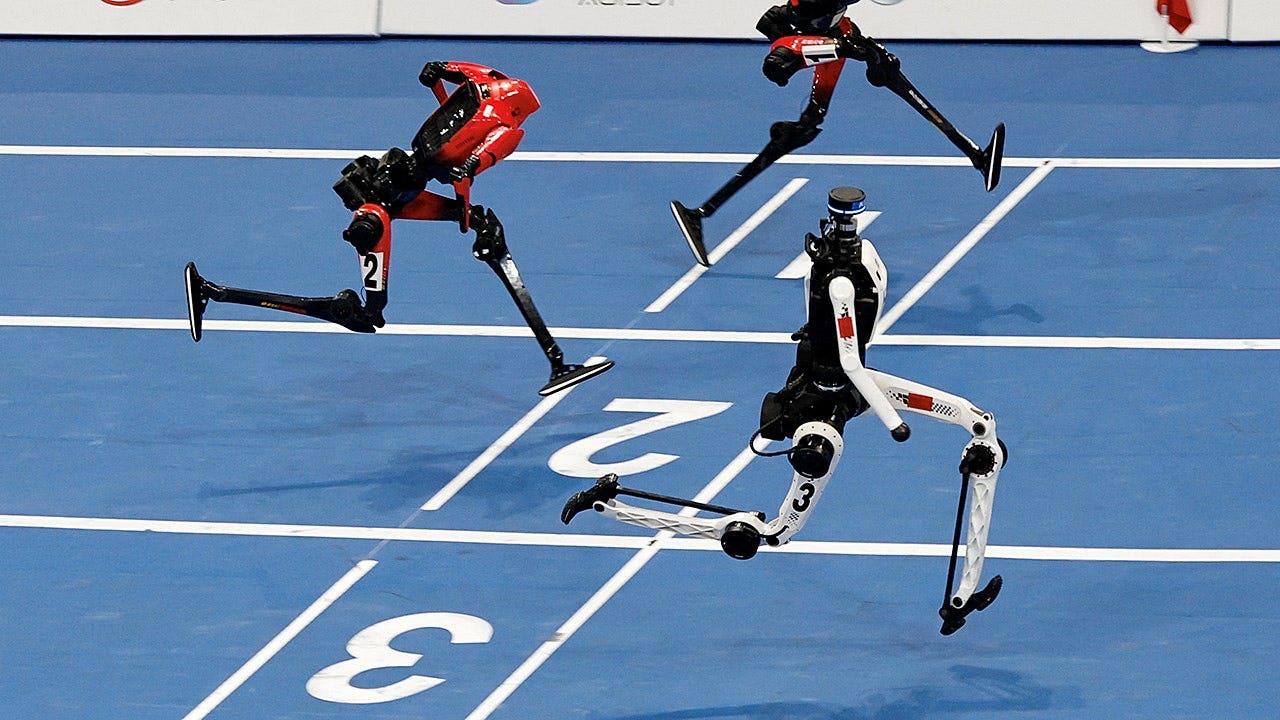
If your image of a humanoid robot still involves stiff knees and awkward stage demos, it is time to update it. At Beijing's second World Humanoid Robot Games, a robot called Tiangong Ultra didn't just beat Usain Bolt's legendary 100-meter world record. It beat it, then beat its own new record, then beat that one too — all within the same five-day competition.
By the time the Games closed on August 26, Tiangong Ultra had lowered its own mark from 9.39 seconds to 8.86 seconds, and finally to 8.64 seconds in the large-size robot final. Developed by the Beijing Humanoid Robot Innovation Centre, Tiangong Ultra lowered its time repeatedly over the course of the Games, clocking 9.39 seconds early on before improving to 8.86 and then 8.64 in the final held on the last day. For comparison, Bolt's official 9.58-second world record, set in 2009, remains untouched in human competition; these machines race under their own separate rules.
.
A Year Ago, the Same Robot Was Twice as Slow
To understand how fast this technology is moving, rewind just twelve months. The 8.64-second time was faster than the best 100-meter time of over 12 seconds at the inaugural World Humanoid Robot Games last year, and Tiangong had already rewritten the 100m mark twice before the final. Twelve months earlier still, the very first Games saw the winning robot cross the line in just over 21 seconds.
Going from roughly 21 seconds to under 9 seconds in a single year is an extraordinary leap for any machine that has to balance itself, coordinate dozens of motors, and process sensor data in real time — all while sprinting flat out.
The competition wasn't a solo effort either. Tiangong Ultra was initially behind Lightning, a robot developed by smartphone maker Honor, before overtaking it close to the finish, with Lightning crossing in 9.47 seconds — meaning both robots technically outran Bolt's human world record. Honor's engineers had reportedly extended Lightning's legs by 10 centimeters ahead of the competition to gain speed.
.
The Finish Line Exposed the Technology's Limits
Speed came at a cost. Several robots struggled the moment the race ended, since sprinting in a straight line is a very different challenge from stopping safely. Tiangong completed its sub-nine-second sprint by striking a thick mat placed beyond the finish line to stop the machine, and a small fire briefly appeared in the robot's torso after it collapsed from the impact; in the other semifinal, a robot disassembled mid-race.
Scenes like these were a running theme of the event. Robots tumbled during boxing matches, needed human handlers to swap batteries, and occasionally collapsed altogether. It's a useful reminder that raw athletic performance and reliable, everyday usefulness are two very different engineering problems.
.
More Than a Sprint: 2,000 Robots, 51 Events
This year's Games were vastly larger than the first edition. The event brought together humanoid robots at the 2nd World Humanoid Robot Games, with events including sprinting and the high jump, and served as an all-round benchmark for measuring a robot's overall performance — a proving ground for real-world applications to come.
Beyond athletics, teams competed in tasks modeled on ordinary jobs: cleaning hotel rooms, sorting objects, operating in mock factory floors, and responding to simulated emergencies. That combination — track-and-field spectacle paired with workplace simulation — hints at where organizers ultimately want this technology to go: out of the arena and into daily life.
At the closing ceremony, organizers also released a large dataset of real-world robot operation data, covering more than 100 skills and thousands of tasks, and announced that the third Games will return to Beijing in August 2027.
.
The Bigger, More Uncomfortable Story: Robot Soldiers
A sprint record makes for an eye-catching headline. But the more consequential comment from the Games came from a robotics engineer, not a stopwatch. Yang Kun, who works for the Shanghai-based company AG BOT, told American reporters that building military-ready humanoid robots is his company's ultimate goal.
Yang said he believes Chinese companies are only five to 10 years away from achieving robot soldiers, describing it as a way to "make sure people in the world will not be attacked" and to "show the power of a country like China" so that no other nation would attack — which he framed as something that would prevent war. His company's kickboxing robot, the A3, competed at the Games. Asked whether such robots might one day act against their intended purpose, Yang said he did not believe robots could become "evil" since they lack emotion, and that everything depends on who controls and builds them.
This is one engineer's personal timeline, not an announced Chinese government program or deployment schedule. Still, it signals where at least some developers in China's fast-growing robotics industry believe the technology is heading — and that the conversation has already moved well past sports arenas.
Independent defense analysts caution that meaningful battlefield deployment is still a distant prospect. Building the command structures, training, and reliability needed for military use will take years of additional work, and near-term uses are more likely to involve robots supporting human operators — for example in reconnaissance or logistics — rather than robots acting alone in combat.
.
Washington Is Already Treating This as a Security Issue
The United States has not waited to see how the technology matures before acting. On July 28, 2026, the Federal Communications Commission updated its Covered List — the list of communications equipment and services the FCC has determined pose an unacceptable risk to U.S. national security — to include foreign-produced "advanced robotic devices," a category defined to include humanoids and quadrupeds.
In practice, this means newly authorized foreign-made humanoid and quadruped robots generally cannot receive the FCC equipment approval required to be imported or sold in the United States, unless they receive a specific conditional approval. Legislators have gone further still: a provision in the House's 2027 defense policy bill, known as the GUARD Act, would bar the U.S. Department of Defense from buying humanoid robots built by "foreign adversaries," a category that includes China.
Taken together, these moves show that Washington already views advanced humanoid robotics — not just AI software — as a national-security category in its own right, on par with concerns previously reserved for telecom equipment and networking hardware.
.
What This Means Going Forward
Most people will not encounter a robot soldier on their street anytime soon. But the underlying technology — better balance systems, faster reflexes, more capable sensors — is likely to show up first in factories, warehouses, hotels, and disaster response long before it ever reaches a battlefield. Manufacturers are betting heavily on this: China's humanoid sector has been scaling production capacity throughout 2026, aiming to bring costs down as reliability improves.
The bigger questions raised by Yang's comments — how much autonomy an armed robot should ever be given, and who is accountable when an AI-controlled machine makes a dangerous mistake — remain unresolved. Given how quickly this year's Games showed the technology advancing, those questions may need answers sooner than many expect.
.
Sources
- Al Jazeera — "Chinese robot Tiangong clocks sub-9-second 100 metres in Beijing": https://www.aljazeera.com/sports/2026/8/25/chinese-robot-tiangong-clocks-sub-9-second-100-metres-in-beijing
- CGTN — "Tiangong Ultra sets 100m record as World Humanoid Robot Games close": https://news.cgtn.com/news/2026-08-27/Tiangong-Ultra-sets-100m-record-as-World-Humanoid-Robot-Games-close-1PWx9LjZDC8/p.html
- CBS News — "Humanoid robot soldiers likely only 5-10 years away, one developer behind China's robotics boom tells CBS News": https://www.cbsnews.com/news/china-humanoid-robot-soldiers-only-years-away-developer-tells-cbs-news/
- Federal Communications Commission — "FCC Adds Foreign-Produced Power Inverters and Robots to Covered List": https://www.fcc.gov/document/fcc-adds-foreign-produced-power-inverters-and-robots-covered-list-0
.
What's Your Reaction?
 Like
0
Like
0
 Dislike
0
Dislike
0
 Love
0
Love
0
 Funny
0
Funny
0
 Wow
0
Wow
0
 Sad
0
Sad
0
 Angry
0
Angry
0











Comments (0)