

China's Fuel Crisis: How the Iran War Is Squeezing the World's Biggest Oil Importer

..
Prices Up 25%, Long Lines at the Pump — and No Easy Way Out
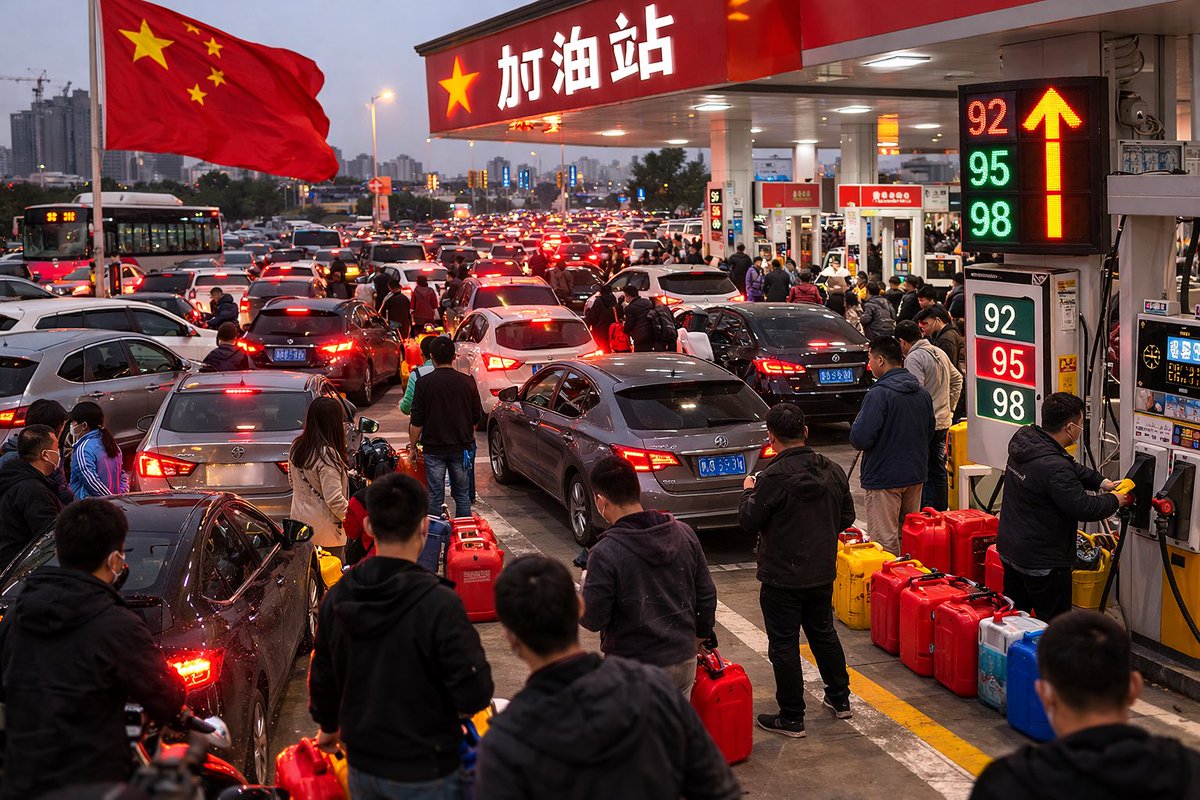
China is feeling the full force of the global energy shock triggered by the US-Israeli war on Iran. Since fighting broke out in late February 2026, the country has raised domestic fuel prices multiple times, drivers are queuing for hours at gas stations, and independent refiners are scrambling to stay profitable. For a nation that imports roughly 70 percent of its oil — much of it from the Middle East — the crisis has exposed a structural vulnerability that Beijing has long sought to conceal.
Four Price Hikes in Less Than Two Months
China's fuel prices don't float freely on the market. They are set by the National Development and Reform Commission (NDRC), the government body responsible for economic planning. In early March, the NDRC raised retail prices for gasoline and diesel by the most in four years, following a rapid surge in global crude costs.
Between March 12 and the start of the war, Chinese pump prices rose by around 11 percent — a significant jump, but far below the increases seen elsewhere. In total, prices are now approximately 25 percent higher than at the start of the conflict. By comparison, the United States has seen diesel prices climb by nearly 39 percent over the same period.
The price hikes are a direct consequence of what is unfolding in the Persian Gulf. Iran's closure of the Strait of Hormuz disrupted around 20 percent of global oil supplies and significant volumes of liquefied natural gas (LNG). The International Energy Agency (IEA) describes this as the largest supply disruption in the history of the global oil market, with flows through the Strait collapsing from 20 million barrels per day to a trickle.
Why China Is Especially Exposed
China imports roughly 70 percent of its oil, with much of it transported by sea. Unlike the United States, China lacks the global military reach to fully secure its supply routes.
Iran accounts for about 13 percent of China's crude oil imports, with Venezuela supplying another 4 percent. Both sources have been severely disrupted: Iran is at war, and the US seizure of Venezuelan President Nicolás Maduro earlier in January cut off another key supply line. The combined effect has left Beijing scrambling for alternatives.
China maintains strategic oil reserves estimated to cover roughly 120 days of consumption — a useful buffer, but not a long-term solution if the Strait of Hormuz remains blocked for months.
Long Queues, Scarce Fuel
The price hikes have prompted panic buying in parts of the country. Residents in provinces including Heilongjiang, Henan, and Yunnan reported long queues at gas stations, with some waiting an entire day or more just to fill up. Farmers relying on fuel for agricultural machinery have been particularly affected, struggling to secure supply during what is a critical period for spring planting.
Chinese authorities have asked major refineries to suspend diesel and gasoline exports in order to keep more fuel available for domestic consumption — a measure that underscores just how seriously Beijing is treating the supply crunch.
On March 23, the government went further. The NDRC moved to cap further retail price increases, cushioning the blow to consumers as global crude markets remained volatile. Authorities also committed to coordinating with refiners and distributors to ensure adequate domestic supply.
The Squeeze on Refiners
While consumers are paying more at the pump, some fuel retailers and independent refiners — known in industry circles as "teapots" — are caught in a difficult position of their own.
Wholesale prices for gasoline and diesel have surged in line with crude costs, while retail prices remain partly capped under China's pricing system. The result has been a sharp narrowing of the gap between what refiners pay and what they can charge.
Some teapot refiners have been able to cushion the blow by drawing on stocks of Iranian and Russian crude purchased before the war, when Brent was trading at around $73 per barrel. Brent has since surged toward $100 to $120 per barrel, making those earlier purchases a temporary lifeline.
A Global Crisis with No Quick Fix
Unlike the 2022 energy shock triggered by Russia's invasion of Ukraine — which was largely driven by sanctions and could be managed through rerouting and substitution — the 2026 disruption centres on a physical chokepoint that cannot be offset through diversification.
Even if the war were to stop tomorrow, repairing energy production sites and realigning tanker capacity would take months. Impacts on local energy systems are likely to be felt at least through the end of 2026.
US government officials and Wall Street analysts are beginning to consider the possibility that oil prices could surge to an unprecedented $200 per barrel if the conflict continues.
For China, the geopolitical implications stretch beyond pump prices. Beijing is likely to continue expanding its military capabilities to protect energy routes and signal its willingness to defend its economic interests. China has already increased its naval presence in the Indian Ocean and Gulf region, deploying a spy ship to the Gulf while reportedly assisting Iran through satellite monitoring and tanker-tracking data systems.
What This Means for Ordinary Chinese
For most Chinese citizens, the crisis is felt most acutely in daily costs. Truckers, farmers, and small business owners are bearing a disproportionate share of the burden, as higher fuel prices ripple through the cost of food, goods, and transport.
The risk of inflation will rise significantly if the war continues for several more months, potentially pushing the world toward a situation comparable to the 1973 oil crisis, according to economic analysts.
Beijing's managed pricing system has so far shielded Chinese consumers from the worst of the global surge. But that protection has limits — and the longer the Strait of Hormuz remains closed, the harder it will be to hold the line.
.
Sources
- IRU (World Road Transport Organisation) — War in Iran: fuel prices remain high and volatile (March 2026): https://www.iru.org/news-resources/newsroom/war-iran-fuel-prices-remain-high-and-volatile
- IRU — Iran war: fuel prices still climbing (March 30, 2026): https://www.iru.org/news-resources/newsroom/iran-war-fuel-prices-still-climbing
- Asia Times — War in Iran squeezing China's oil lifeline (March 2026): https://asiatimes.com/2026/03/war-in-iran-squeezing-chinas-oil-lifeline/
- Al Jazeera — Which countries have seen the highest petrol prices since the Iran war? (March 11, 2026): https://www.aljazeera.com/news/2026/3/11/which-countries-have-seen-the-highest-petrol-prices-since-the-iran-war
- Al Jazeera — Why the oil and gas price shock from the Iran war won't just fade away (March 23, 2026): https://www.aljazeera.com/opinions/2026/3/23/why-the-oil-and-gas-price-shock-from-the-iran-war-wont-just-fade-away
- Bloomberg — Iran War: How High Could Oil Prices Get with Strait of Hormuz Closure? (March 2026): https://www.bloomberg.com/graphics/2026-iran-war-hormuz-closure-oil-shock/
- Energy News (OE Digital) — China increases retail fuel prices by the most in four years, amid Iran War (March 9, 2026): https://energynews.oedigital.com/heating-oil/2026/03/09/china-increases-retail-fuel-prices-by-the-most-in-four-years-amid-iran-war
- Wikipedia — 2026 Iran war fuel crisis: https://en.wikipedia.org/wiki/2026_Iran_war_fuel_crisis
- China-Global South Project — China Fuel Price Cap Iran Oil Crisis (March 24, 2026): https://chinaglobalsouth.com/2026/03/24/china-fuel-price-cap-iran-oil-crisis/
.
What's Your Reaction?
 Like
1
Like
1
 Dislike
0
Dislike
0
 Love
1
Love
1
 Funny
0
Funny
0
 Wow
1
Wow
1
 Sad
0
Sad
0
 Angry
0
Angry
0














Comments (0)