

China Warns Panama: Keep Third Parties Out of Our Bilateral Ties
China's top diplomat met Panama's foreign minister on the sidelines of a UN Security Council session in New York — delivering a pointed message: their relationship is none of Washington's business. The backdrop is a months-long dispute over two strategically critical port terminals near the Panama Canal that Beijing has lost to Western operators.

.
A Diplomatic Meeting With a Clear Subtext
On the margins of a United Nations Security Council meeting in New York, Chinese Foreign Minister Wang Yi sat down with his Panamanian counterpart Javier Martínez-Acha on Tuesday. The message Wang conveyed, according to China's state-run news agency Xinhua, was straightforward: Beijing wants deeper cooperation with Panama — and wants outside powers to stay out of the equation.
Wang explicitly stated that China-Panama relations "should not be subject to third-party interference." No names were mentioned, but the target of that statement was unmistakable: the United States and its sustained pressure campaign to remove Chinese-linked operators from infrastructure near the Panama Canal, a waterway that processes roughly 5 percent of global maritime trade.
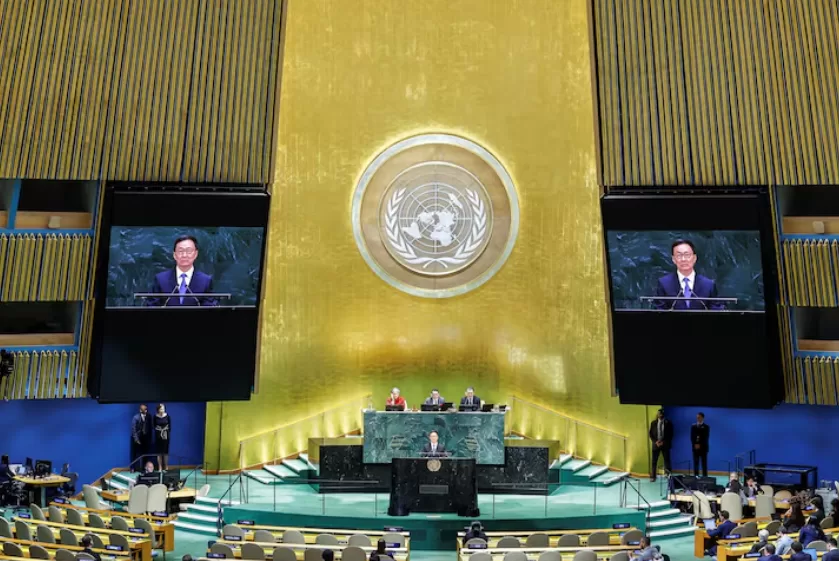
The meeting took place during an especially symbolic moment. China holds the rotating presidency of the UN Security Council in May, and Wang Yi chaired a high-level open debate titled "Upholding the purposes and principles of the UN Charter." From the podium, he warned — without naming the U.S. — that "the purposes of the UN Charter have been disregarded" and that world peace was "in great jeopardy."
How It Got Here: Ports, Courts, and Pressure
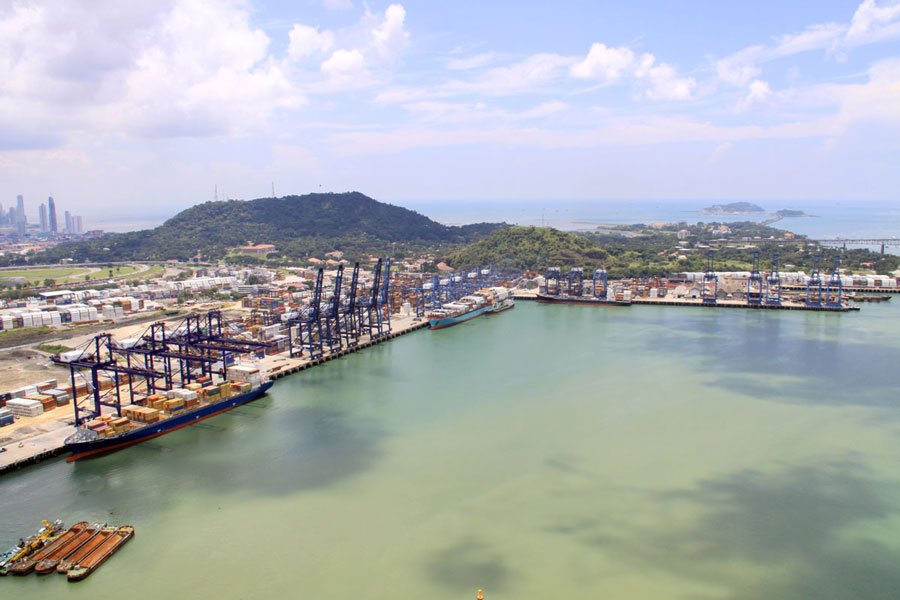
The dispute over the Panama Canal's port terminals has been building for years — and came to a head in early 2026. At the center of the conflict are two container terminals: Balboa on the Pacific side, and Cristobal on the Atlantic side. Both sit near the entrances to the canal and were operated for nearly three decades by Panama Ports Company, a subsidiary of Hong Kong-listed conglomerate CK Hutchison.
In late January, Panama's Supreme Court declared the legal basis of the original 1997 concession — and a 2021 extension — unconstitutional. By late February, the Panamanian government formally annulled the contracts and handed interim operations to two Western shipping giants: Danish group Maersk, through its APM Terminals unit, now runs Balboa; Switzerland-based Mediterranean Shipping Company (MSC) took over Cristobal.
The court ruling came after sustained U.S. pressure. The Trump administration had framed the presence of a Chinese-linked operator near the canal as a direct security threat. U.S. Ambassador to Panama Kevin Marino Cabrera called the Panama Ports Company "a bad operator" and said Washington was "enthusiastic that they will soon no longer be operating those ports."
Beijing's Reaction: Arbitration, Ship Detentions, Diplomatic Pushback
China and Hong Kong authorities condemned the ruling, calling it an "act of bad faith." CK Hutchison launched an international arbitration case against Panama, expanding its damages claim to more than $2 billion. The company accused Panamanian authorities of unlawfully seizing its property.
Beijing's response went beyond the courts. China's Ministry of Transport summoned representatives from Maersk and MSC — the companies now running the terminals — for talks. More telling was what happened at Chinese ports: Panama-flagged ships began facing a sharp spike in inspections and detentions. According to data analyzed by maritime outlet The Loadstar, Panamanian vessels accounted for 91 of 123 vessels detained for inspection in China in March alone.
Five Latin American and Caribbean nations joined the United States in issuing a joint statement condemning what they described as Beijing's use of "targeted economic pressure." The statement called China's actions "a blatant attempt to politicize maritime trade and infringe on the sovereignty of the nations of our hemisphere."
Panama: Dialogue, Not Submission
Panama's foreign minister, speaking from the UN podium just before his meeting with Wang Yi, struck a careful but firm tone. Martínez-Acha called for "dialogue over confrontation," reminding the assembly that Panama was "born to connect oceans, continents, cultures and economies." The country finds itself threading a needle: it cannot afford to antagonize either Washington or Beijing, both of which have significant economic leverage.
The diplomatic context is also shaped by a broader failed deal. In 2025, CK Hutchison had reached an agreement in principle to sell its global port assets — including the Panama terminals — to a consortium led by U.S. investment giant BlackRock and MSC, in a deal worth approximately $22.8 billion. Beijing blocked that sale, with Chinese state media calling it "spineless groveling" and demanding that state carrier COSCO receive a controlling stake. The deal ultimately collapsed under geopolitical pressure.
What's at Stake
The Panama Canal is not just a trade corridor — it is a geopolitical fault line. The canal connects the Atlantic and Pacific Oceans and is critical for global shipping routes. Its two flanking ports are some of the most strategically important logistics nodes in the Western Hemisphere.
For the Trump administration, removing Chinese-linked operators from those ports was a signature early foreign policy win. For Beijing, the loss represents a humiliating rollback of influence in a region it had cultivated through infrastructure investment and diplomatic outreach. Wang Yi's meeting with Panama's foreign minister signals that China has no intention of quietly accepting the outcome.
Whether Panama — a small country caught between two superpowers — can protect its own sovereignty and economic interests will depend on how it manages that tension in the months ahead.
.
Sources:
- Reuters – China says Panama ties should not be subject to third-party interference (May 27, 2026): https://www.reuters.com/world/china/china-says-panama-ties-should-not-be-subject-third-party-interference-xinhua-2026-05-27/
- South China Morning Post – Panama encourages dialogue at UN as canal tensions with China simmer (May 26, 2026): https://www.scmp.com/news/china/diplomacy/article/3354958/panama-encourages-dialogue-and-bridge-building-un-canal-tensions-china-simmer
- CNBC – Panama officially voids CK Hutchison contracts, transfers ports to Maersk and MSC (February 24, 2026): https://www.cnbc.com/2026/02/24/panama-officially-voids-annuls-ck-hutchison-contracts-interim-control-maersk-msc-canal-dispute.html
- Associated Press (via AOL) – Panama seizes 2 key canal ports from Hong Kong operator (February 23, 2026): https://www.aol.com/articles/panama-orders-occupation-2-key-160549765.html
- Newsweek – Why Panama Canal sparked war of words between China and the Americas: https://www.newsweek.com/why-panama-canal-sparked-war-of-words-between-china-and-the-americas-11896534
- CSIS – Chinese Ports in Panama Come Under New Management: https://www.csis.org/analysis/chinese-ports-panama-come-under-new-management
- China-Global South Project – Panama Paradox: China's Escalation Ladder and Logistics Coercion (April 2026): https://chinaglobalsouth.com/analysis/china-panama-ports-escalation/
.
What's Your Reaction?
 Like
0
Like
0
 Dislike
0
Dislike
0
 Love
0
Love
0
 Funny
0
Funny
0
 Wow
0
Wow
0
 Sad
0
Sad
0
 Angry
0
Angry
0










Comments (0)