

China Signals Possible Xi–Trump Summit While Rejecting ‘G2’ Framework


.
As the Iran War continues, China signaled that a meeting between its leader, Xi Jinping, and President Donald Trump could take place soon, even as Beijing publicly distanced itself from the idea of a U.S.–China “G2” partnership.
Beijing Signals High-Level Engagement
During the press conference, Wang answered questions covering a range of topics, including relations with the United States, Japan, and Russia, as well as Taiwan and the war in Iran.Asked whether the ongoing conflict in the Middle East could affect Trump’s expected visit to China later this month, Wang emphasized the importance of engagement between the world’s two largest economies.
“The relationship between China and the United States is one of far-reaching and global implications,” he said.
“Turning our backs on each other would only lead to mutual misperception and miscalculation. Sliding into conflict or confrontation could bring disaster to the world.”
He described 2026 as a “landmark year” for China–U.S. relations and said the agenda for high-level exchanges is already on the table, adding that both sides should carefully prepare and minimize disruptions.
The remarks were widely interpreted by observers as an indirect confirmation that a summit between Xi and Trump is being planned.
Ding Shu-fan, a researcher at the Center for International Relations at National Chengchi University in Taiwan, told The Epoch Times that the comments suggest Trump’s expected spring visit to China is likely to proceed.
Negotiations between the two sides are still ongoing, he said, noting that Treasury Secretary Scott Bessent is expected to meet Chinese Vice Premier He Lifeng soon, potentially to finalize arrangements for the leaders’ meeting.
.
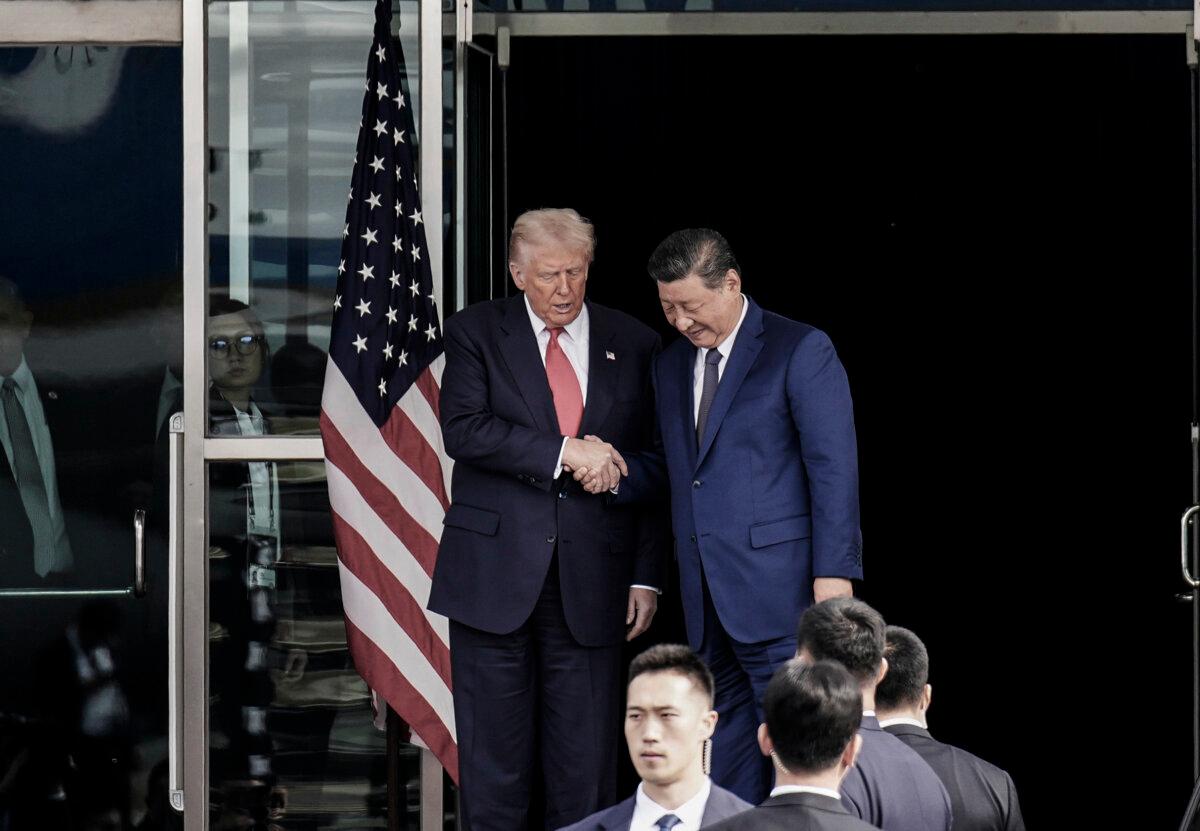
President Donald Trump and Chinese leader Xi Jinping shake hands as they depart following a bilateral meeting at Gimhae Air Base in Busan, South Korea, on Oct. 30, 2025. Andrew Harnik/Getty Images
.
China Rejects ‘G2’ Narrative
Despite signaling openness to a summit, Wang dismissed the notion that China and the United States should jointly manage global affairs.Responding to a question from NBC about whether Beijing accepts the idea of a U.S.–China “G2,” Wang said China does not support the concept.
Instead, he said, building “an equal and orderly multipolar world” should be the shared responsibility of all countries.
The “G2” concept—referring to a potential partnership between the world’s two largest economies—was first popularized by American economist C. Fred Bergsten in 2005. It envisioned close U.S.–China cooperation on global issues such as economic stability and climate policy.
The idea gained some traction among U.S. officials during the Obama administration but has remained controversial in both countries.
Trump himself referenced the concept in a Truth Social post in October 2025 ahead of a meeting with Xi in Busan, South Korea, writing in all caps: “The G2 will be convening shortly!”
Analysts See Strategic Caution in Beijing
Some analysts say Wang’s comments reflect a more cautious approach by Beijing amid mounting geopolitical pressure.Tang Jingyuan, a U.S.-based China current affairs commentator, said Chinese leaders may now be seeking to stabilize relations with Washington after a series of major moves by the Trump administration.
Those moves include trade pressure on China through tariffs, as well as U.S. actions abroad that have affected regimes friendly to Beijing, such as Venezuela and Iran.
Iran and Venezuela have long maintained close ties with Beijing and are major oil suppliers to China.
According to Tang, the developments have raised concerns in Beijing about its geopolitical position and increased the communist leadership’s interest in maintaining stable relations with Washington.
Wang’s cautious tone was also evident when he addressed the situation in Iran.
Summarizing Beijing’s position, he said that the key message is “to bring about a cease-fire and end hostilities.” In his remarks, however, he did not explicitly mention either the United States or Israel.
The carefully worded response reflects the highly scripted nature of the Chinese foreign minister’s press conferences. Media questions are typically submitted in advance, and the majority are allocated to Chinese state media, with only a few to the foreign press.
Chen Pokong, a U.S.-based Chinese political commentator, told The Epoch Times that Beijing may be reluctant to confront Washington directly after recent developments in Venezuela and Iran caught the Chinese leadership off guard.
He noted that, despite actions against regimes aligned with Beijing, Chinese officials have not publicly protested strongly or indicated any cancellation of a potential Xi–Trump summit.
For years, China has sought to build partnerships with countries that could counterbalance U.S. influence, Tang said. These relationships have included Russia in Europe, Iran in the Middle East, and Venezuela and Cuba in Latin America.
Nevertheless, recent geopolitical shifts have complicated that strategy.
Russia remains locked in its prolonged war with Ukraine, while political upheavals in Venezuela and Iran have weakened two regimes that were seen as key partners for Beijing, according to Tang.
“In a way, [China] seeks to calm the relationship with the United States,” he said. “[It’s because] the Chinese Communist Party feels that it’s in a dangerous position.”
Ding said Beijing is likely trying to avoid the appearance of forming a formal alliance with Tehran, even though China may still provide diplomatic support to Iran.
As tensions continue to unfold across multiple regions, analysts say Beijing appears focused on maintaining stability in its relationship with Washington while navigating a shifting global landscape.
What's Your Reaction?
 Like
0
Like
0
 Dislike
0
Dislike
0
 Love
0
Love
0
 Funny
0
Funny
0
 Wow
0
Wow
0
 Sad
0
Sad
0
 Angry
0
Angry
0












Comments (0)