

China and Russia Shield Iran: UN Security Council Fails to Reopen Global Oil Lifeline
The Strait of Hormuz — a narrow waterway between Iran, Oman, and the United Arab Emirates — is no longer open for business. Through this passage, roughly one-fifth of the world's oil and gas shipments previously flowed. Since late February 2026, that flow has been choked off. Iran threatened to attack vessels transiting the strait after the United States and Israel launched a war against it on February 28.

.
The World's Most Critical Shipping Lane Remains Blocked
The Strait of Hormuz — a narrow waterway between Iran, Oman, and the United Arab Emirates — is no longer open for business. Through this passage, roughly one-fifth of the world's oil and gas shipments previously flowed. Since late February 2026, that flow has been choked off. Iran threatened to attack vessels transiting the strait after the United States and Israel launched a war against it on February 28.
The blockade has sent fuel prices soaring across much of the world and led some countries, particularly in Asia, to introduce restrictions on consumption and ration supplies.
On Tuesday, the international community tried — and failed — to do something about it.
A UN Vote That Changed Nothing
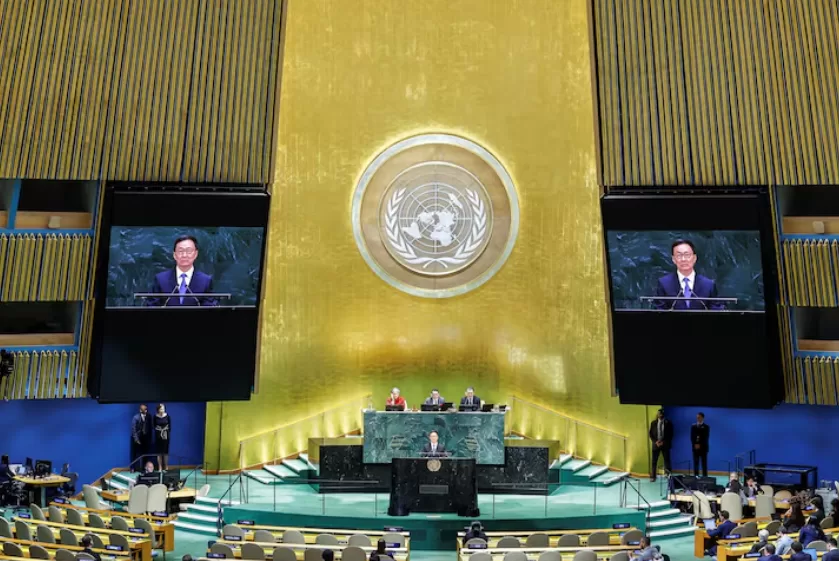
Russia and China on Tuesday vetoed a UN Security Council resolution aimed at reopening the Strait of Hormuz that had been repeatedly watered down in hopes those two countries would abstain.
Eleven countries voted in favor of the draft, while Colombia and Pakistan abstained. But under UN rules, a single "no" vote from any of the five permanent members of the Security Council — the United States, United Kingdom, France, China, and Russia — kills a resolution entirely. Beijing and Moscow exercised that power.
The nations' leaders were not swayed by warnings from Bahrain's foreign minister that continued closure of the strait would cause greater economic instability and undermine the Security Council's authority.
How the Resolution Was Stripped Down — and Still Blocked
The road to Tuesday's vote was one of steady concessions. The initial Gulf proposal would have authorized countries to use "all necessary means" — UN wording that would include military action — to ensure transit through the Strait of Hormuz and deter attempts to close it.
After Russia, China, and France all expressed opposition to approving the use of force, the resolution was revised to eliminate all references to offensive action. A vote had been expected on Saturday, but negotiations continued.
The resolution was further weakened to eliminate any reference to Security Council authorization — which is an order for action — and limit its provisions to the Strait of Hormuz. Previous drafts had included adjacent waters.
The final text merely "strongly encourages" member states to coordinate efforts "defensive in nature, commensurate to the circumstances" to ensure freedom of navigation — language with no binding force whatsoever.
It wasn't enough for Beijing and Moscow.
Why China and Russia Said No
Russia's envoy Vasily Nebenzya described the resolution as "unbalanced, inaccurate and confrontational" for framing Iran as the sole source of the region's destabilization and threats to maritime security.
China's UN envoy Fu Cong said the draft "failed to capture the root causes and the full picture of the conflict in a comprehensive and balanced manner."
Daniel Forti, head of UN Affairs at the International Crisis Group, said China and Russia saw the resolution "as too escalatory and not capturing the need for impartial and consistent diplomacy." He added that "they argued the text placed all of the blame on Iran."
Both countries are now expected to put forward a counter-resolution. The two Iranian allies are expected to submit a counterproposal broadly calling for a cessation of hostilities and a return to diplomacy.
Washington Condemns the Vetoes
US Ambassador to the UN Mike Waltz condemned the Russian and Chinese vetoes, arguing that Iran's blockade was preventing not just oil but also medical aid and humanitarian goods from reaching crisis zones around the world.
The UAE's mission to the UN said it "deeply regrets" the Security Council's failure to endorse what it described as "a clear framework for international cooperation in ending Iran's illegal attacks and threats to the global economy."
France also expressed disappointment. Its UN ambassador said the goal of the resolution had been purely defensive — to protect shipping without triggering an escalation.
Trump's Deadline Looms in the Background
Tuesday's UN vote unfolded against a backdrop of rising tension. Just hours before the vote, US President Donald Trump issued an unprecedented threat that a "whole civilization will die tonight" if Iran does not open the strategic waterway and reach a deal before his 8 p.m. Eastern deadline.
White House press secretary Karoline Leavitt told Fox News: "The Iranian regime has until 8 p.m. Eastern Time to meet the moment and make a deal with the United States."
The Trump administration has set — and extended — similar deadlines before. Trump has given Iran deadlines three times and then delayed them. Whether this one holds remains to be seen.
What Comes Next
The failure at the UN leaves the world in a precarious position. It's doubtful the resolution, even if it had been adopted, would have impacted the war, now in its fifth week, because it had been significantly weakened. But its defeat removes even the symbolic weight of multilateral consensus.
The vote comes after more than five weeks of war, sparked by US-Israeli strikes on Iran, that have raised oil prices and disrupted traffic through one of the world's most critical energy corridors.
A UN envoy is reportedly traveling to Tehran to pursue diplomatic channels. But with China and Russia providing political cover for Iran, and the strait still blocked, the path to resolution — diplomatic or otherwise — remains deeply unclear.
.
Sources
- UN News – Security Council Meeting Coverage, April 7, 2026: https://news.un.org/en/story/2026/04/1167261
- PBS NewsHour / Associated Press – Full vote breakdown and analysis: https://www.pbs.org/newshour/world/russia-and-china-veto-watered-down-un-resolution-aimed-at-reopening-the-strait-of-hormuz
- Al-Monitor – Resolution negotiation history and expert analysis: https://www.al-monitor.com/originals/2026/04/china-russia-veto-scaled-back-hormuz-resolution-un-security-council
- The National – Background on GCC coordination and UAE reaction: https://www.thenationalnews.com/news/us/2026/04/07/russia-and-china-block-un-resolution-calling-for-reopening-of-strait-of-hormuz/
- Euronews / AP – Timeline of resolution changes and vote context: https://www.euronews.com/2026/04/07/russia-and-china-veto-un-resolution-aimed-at-reopening-hormuz-strait-as-us-deadline-for-de
.
What's Your Reaction?
 Like
0
Like
0
 Dislike
0
Dislike
0
 Love
0
Love
0
 Funny
0
Funny
0
 Wow
0
Wow
0
 Sad
0
Sad
0
 Angry
0
Angry
0














Comments (0)